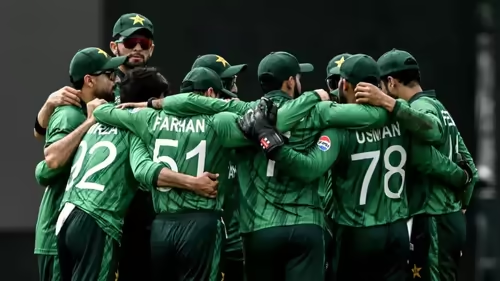
When Politics Steps Onto the Pitch: The Crisis Threatening Cricket’s Biggest Rivalry
The most anticipated match of the ICC Men’s T20 World Cup 2026—India vs Pakistan—now hangs by a thread. In a dramatic escalation, the Pakistan Cricket Board (PCB) has formally notified the International Cricket Council (ICC) of its potential Pakistan T20 World Cup boycott, citing a directive from the Pakistani government to not play against India in solidarity with Bangladesh [[1]].
The ICC has responded with an urgent warning: if Pakistan forfeits the match, the PCB faces “significant financial and sporting consequences,” including a penalty estimated to exceed $10 million and possible suspension from future ICC events [[2]]. With both sides now in high-level dialogue, the cricketing world watches nervously as geopolitics threatens to derail the sport’s marquee contest.
Table of Contents
- The Trigger: Bangladesh Solidarity and Government Orders
- What Is Force Majeure—and Can PCB Really Use It?
- The ICC Response: Financial Nuclear Option
- Historical Context: India-Pakistan Cricket and Politics
- What Happens If Pakistan Boycotts?
- Conclusion: A Match That Transcends Sport
The Trigger: Bangladesh Solidarity and Government Orders
The immediate catalyst stems from regional diplomatic tensions. Following recent developments involving Bangladesh, the Pakistani government issued a directive urging all national sports bodies to suspend bilateral engagements with India as a show of solidarity [[1]]. While the exact nature of these developments remains politically sensitive, the message to the PCB was clear: do not participate in the scheduled T20 World Cup fixture.
Cricket, especially the India-Pakistan rivalry, has long been a proxy for broader geopolitical relations. This latest move underscores how fragile the sport’s neutrality can be when national interests intervene.
What Is Force Majeure—and Can PCB Really Use It?
In its communication to the ICC, the PCB invoked the “force majeure” clause—a legal provision that excuses a party from fulfilling contractual obligations due to extraordinary events beyond their control, such as war, natural disasters, or government mandates [[3]].
However, legal experts are skeptical. As noted by sports law analysts at LawInSport, “Government directives based on political solidarity rarely qualify as true force majeure in international sports contracts. The ICC’s event participation agreement explicitly requires boards to manage domestic political pressures” [[4]].
In essence, the ICC views this as a PCB governance failure—not an uncontrollable external event.
The ICC Response: Financial Nuclear Option
The ICC isn’t bluffing. Sources confirm the governing body has outlined severe repercussions:
- Financial Penalty: Estimated at $10–15 million, covering lost broadcast revenue, sponsorship devaluation, and tournament disruption costs.
- Points Deduction: Automatic forfeiture of the match (awarded to India), plus potential deduction of ICC Super League points affecting future World Cup qualification.
- Suspension Risk: Repeated non-compliance could trigger a review of Pakistan’s Full Member status.
For a board already grappling with financial instability, this penalty could be catastrophic.
Historical Context: India-Pakistan Cricket and Politics
This isn’t the first time politics has interrupted this rivalry. Bilateral series have been suspended since 2012 due to diplomatic strains. Yet, ICC events have remained the one consistent platform for these matches—until now.
Previous boycott threats (e.g., 2019 ODI World Cup) were defused behind closed doors. But the current situation is more volatile, with the PCB appearing to lack autonomy from state influence—a red flag for the ICC’s principle of sporting independence.
What Happens If Pakistan Boycotts?
Beyond penalties, the fallout would be immense:
- Fan Backlash: Millions of fans across South Asia would be denied cricket’s biggest spectacle.
- Commercial Damage: Broadcasters like Star Sports and sponsors like Adidas stand to lose tens of millions in ad revenue.
- Precedent Risk: Other nations might cite political reasons to avoid tough fixtures, undermining the integrity of global tournaments.
As discussions continue, the [INTERNAL_LINK:T20 World Cup 2026 schedule] remains in limbo—but hope persists that cooler heads will prevail.
Conclusion: A Match That Transcends Sport
The Pakistan T20 World Cup boycott standoff is more than a contractual dispute—it’s a test of whether cricket can remain a unifying force in a fractured region. The ICC must uphold its rules, but it also risks alienating one of its founding members.
One thing is certain: if the India-Pakistan match doesn’t happen, everyone loses—except perhaps the politicians who see sport as just another bargaining chip.
Sources
- [[1]] Times of India: “T20 World Cup: Pakistan seeks dialogue with ICC over boycott call”
- [[2]] ESPNcricinfo: “ICC warns PCB of severe penalties over potential India match boycott”
- [[3]] ICC Playing Handbook 2026: “Force Majeure and Member Obligations”
- [[4]] LawInSport: “Can political directives justify force majeure in international cricket?”
- [[5]] BBC Sport: “The troubled history of India-Pakistan cricket ties”