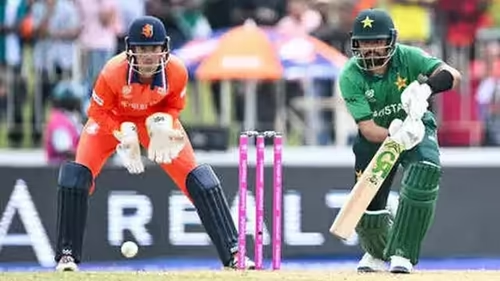
The pressure is mounting on Pakistan’s star batter, Babar Azam. Once hailed as the world’s premier batsman across formats, his T20 World Cup campaign has drawn sharp criticism from two of the game’s most respected voices: Ricky Ponting and Ravi Shastri. Their blunt assessment? The captain may be standing at a career-defining crossroads.
Table of Contents
- The Ponting & Shastri Verdict on Babar Azam
- By the Numbers: Babar’s T20 World Cup Stats
- Is the Number 3 Spot the Answer?
- The Evolving Demands of Modern T20 Cricket
- Conclusion: A Pivotal Moment for Pakistan’s Star
- Sources
The Ponting & Shastri Verdict on Babar Azam
Ricky Ponting didn’t mince words. He stated, “No disrespect to Babar at all, but with the way he’s playing, he just doesn’t fit into a T20 side right now” [[2]]. This harsh critique stems from Babar’s perceived inability to adapt his game to the breakneck pace of modern T20s. Ponting elaborated that the Pakistani maestro has “lost a bit of his power,” a sentiment echoed by former India coach Ravi Shastri [[5]].
Both experts point to Babar’s slow starts as a critical flaw that puts immense pressure on the rest of the Pakistani batting lineup. In a format where the first six overs can often dictate the course of an innings, an anchor role at the top is seen as a luxury many teams can no longer afford. This has led to a growing chorus questioning whether his traditional, elegant stroke-play is still viable in today’s power-hitting era.
By the Numbers: Babar’s T20 World Cup Performance
The stats from the ongoing T20 World Cup seem to support the pundits’ concerns. In the 2024 tournament, Babar has managed only 122 runs in four innings, with a concerning average of 40.7 and a strike rate hovering around 101.7 [[9], [13]]. While his average might look respectable on paper, the context is key. His strike rate is significantly lower than the tournament’s leading run-scorers and is well below his own career T20I norm [[14]].
For perspective, his overall T20 World Cup record stands at 549 runs from 17 matches at an average of 36.60, but with a career strike rate in the competition of just 111.4 [[8], [16]]. In a format where a 140+ strike rate is becoming the benchmark for top-order batters, these figures paint a picture of a player struggling to keep up with the game’s relentless evolution.
Is the Number 3 Spot the Answer?
One proposed solution from the experts is a tactical shift in the Pakistan batting order. Ponting has suggested that Babar might be better suited to the number three position, a spot that could theoretically allow him to see off the new ball while still having the freedom to build an innings without the immediate pressure of taking on the powerplay bowlers [[12]].
However, this move isn’t without its complications. It would require promoting an aggressive opener like Saim Ayub to partner with wicketkeeper Mohammad Rizwan at the top [[21]]. The success of this strategy hinges entirely on the new opening pair’s ability to provide a flying start, something Pakistan has often lacked. If they fail, the pressure simply shifts to Babar at number three, potentially exacerbating the very problem they’re trying to solve.
The Evolving Demands of Modern T20 Cricket
The core of the issue lies in the fundamental shift in T20 cricket philosophy. The game is no longer just about accumulating runs; it’s about the rate at which you accumulate them. Power-hitting from ball one is now a prerequisite for top-order batters in most elite teams.
Babar Azam’s classical technique, built on timing and placement rather than brute force, is being tested like never before. His recent performances for the Sydney Sixers in the BBL, where he scored at a meagre strike rate of 103.06, further highlight this struggle to adapt [[12]]. The question for Pakistan’s management is stark: can their best batter evolve his game, or is his style becoming a relic in the high-octane T20 landscape?
This dilemma presents a fascinating strategic challenge for the team. Do they double down on their star player and hope he rediscovers his touch, or do they make a bold, potentially unpopular, call for the sake of the team’s collective T20 ambitions? For more on Pakistan’s strategic choices, check out our deep dive into their T20 World Cup strategy.
Conclusion: A Pivotal Moment for Pakistan’s Star
Babar Azam finds himself at a true crossroads. The criticism from respected figures like Ponting and Shastri isn’t just about a few poor scores; it’s a fundamental questioning of his suitability for the modern T20 game in his current role. His next few innings will be crucial. A return to his fluent best could silence the doubters and reaffirm his status as a global great. But if the struggles continue, Pakistan may be forced to make a difficult decision that could reshape their entire T20 approach moving forward. One thing is certain: all eyes will be on the Pakistani skipper as he navigates this pivotal phase of his career.
Sources
- Facebook. “Ricky Ponting 🗣️ “No disrespect to Babar at all, but with the way he’s playing, he just doesn’t fit into a T20 side right now.”” https://www.facebook.com/cricketwittyapa/posts/… [[2]]
- India Today. “Babar Azam putting pressure on Pakistan, not himself…” https://www.indiatoday.in/sports/cricket/story/… [[5]]
- NDTV Sports. “Babar has scored 517 runs in 16 T20 World Cup games to date, but at a poor strike rate of 112.” https://sports.ndtv.com/t20-world-cup-2024/… [[8]]
- Indian Express. “‘Babar Azam’s lost his power’: Ricky Ponting explains why…” https://indianexpress.com/article/sports/cricket/… [[12]]
- Cricmetric. “Babar azam icc T20 world cup stats.” https://www.cricmetric.com/sage/?q=Babar%20azam… [[13]]
- CricStatsINT (Facebook). “Babar Azam in T20is in 2024…” https://www.facebook.com/CricStatsINT/posts/… [[14]]
- Howstat. “Babar Azam – Profile & Statistical Summary – T20 World Cups.” https://howstat.com/cricket/statistics/WorldCup/… [[16]]
- CricTracker. “T20 World Cup 2024: Rating opening batting pairs from each team…” https://www.crictracker.com/cricket-analysis/… [[21]]