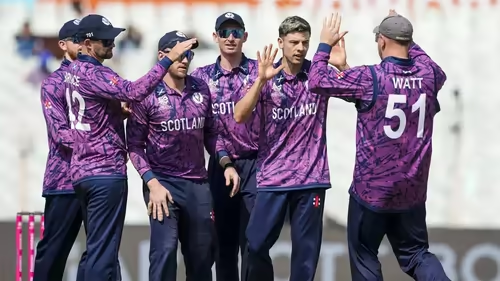
The dream T20 World Cup debut for Italy turned into a harsh reality check—and it was Scotland who delivered the lesson. In a one-sided Group B clash that sent shockwaves through the tournament’s early stages, Scotland didn’t just beat Italy—they dismantled them with surgical precision, winning by a commanding 73 runs.
This emphatic victory wasn’t just about the margin; it was a statement from an associate nation that they belong on cricket’s biggest stage. And at the heart of it all were two men: explosive opener George Munsey and the ever-reliable Michael Leask.
Table of Contents
- Munsey’s Masterclass Sets the Tone
- Leask’s All-Round Dominance Seals the Deal
- Italy’s Fighting—but Flawed—Response
- What This Means for the T20 World Cup Group Stage
- The Rise of Associate Nations in Modern T20 Cricket
- Conclusion: Scotland’s Bold Statement
- Sources
Munsey’s Masterclass Sets the Tone
From the very first over, George Munsey made it clear he wasn’t there to make up the numbers. The left-handed batter unleashed a breathtaking assault on the Italian bowling attack, carving boundaries with brutal efficiency. His innings of 84 off just 50 balls was a clinic in modern T20 batting—mixing power, placement, and fearless intent.
Munsey’s knock included 9 fours and 4 sixes, and he anchored Scotland’s innings after a slightly shaky start. His partnership with captain Richie Berrington laid a solid platform, but it was his acceleration in the middle overs that truly broke the back of Italy’s defense. By the time he was dismissed in the 15th over, Scotland was already well on its way to a formidable total.
Leask’s All-Round Dominance Seals the Deal
If Munsey provided the fireworks with the bat, Michael Leask delivered the knockout blow with both bat and ball. Coming in lower down the order, Leask smashed an unbeaten 23 off just 11 deliveries, propelling Scotland to a daunting 181/7—a total that always looked beyond Italy’s reach.
But his real magic came with the ball. Opening the bowling alongside Brad Wheal, Leask ripped through Italy’s top order with a devastating spell of left-arm spin. He finished with figures of 4/17 in his four overs, including the crucial wickets of captain Aaron Jones and key batter Ben Manenti. His ability to control the run rate while taking wickets at regular intervals strangled Italy’s chase before it could even begin to breathe.
Italy’s Fighting—but Flawed—Response
To their credit, Italy didn’t roll over completely. Ben Manenti, one of their most experienced players, played a gritty and determined knock of 55, trying to keep his team in the contest. However, he found little support from the other end.
The Italian top order collapsed spectacularly, losing three wickets for just 14 runs. Their inability to handle the new ball, coupled with poor shot selection against quality spin, exposed the gulf in class between established T20 sides and newcomers. Despite Manenti’s fifty, Italy was eventually bowled out for a paltry 108 in the 18th over, handing Scotland a comprehensive 73-run victory.
What This Means for the T20 World Cup Group Stage
This result has massive implications for Group B. For Scotland, it’s a huge confidence booster and puts them firmly in contention for a Super Eight spot. They’ve now shown they can not only compete but dominate against fellow qualifiers.
For Italy, the path forward is steep. As debutants, they’ll need to regroup quickly. Their next matches against stronger opponents like Australia or South Africa could be even more challenging if they don’t address their top-order fragility. This loss is a stark reminder that the T20 World Cup is no place for half-measures—even for passionate underdogs. For more on the tournament’s format and standings, see our guide to the T20 World Cup 2026 format.
The Rise of Associate Nations in Modern T20 Cricket
Scotland’s performance is part of a larger trend in international cricket. Associate nations are no longer just participants—they’re serious contenders. Teams like Namibia, Netherlands, and now Scotland have consistently punched above their weight in recent ICC events.
This is thanks to better funding, access to high-performance coaching, and more opportunities to play against full-member nations. According to the International Cricket Council (ICC), increased investment in global development pathways is paying dividends, creating a more competitive and exciting T20 landscape. Scotland’s win over Italy isn’t just a result—it’s proof that the game is truly going global.
Conclusion: Scotland’s Bold Statement
In the end, the Scotland vs Italy clash was more than just a group-stage fixture. It was a showcase of Scotland’s growing prowess and a sobering initiation for Italy. With George Munsey’s explosive batting and Michael Leask’s all-round brilliance, Scotland sent a clear message to the rest of the tournament: underestimate us at your peril. As the T20 World Cup progresses, this performance will be remembered as the moment Scotland announced themselves as genuine dark horses.
Sources
- Times of India. “Scotland crash Italy’s T20 World Cup party with emphatic win.” https://timesofindia.indiatimes.com/…
- ICC Official Website. “T20 World Cup 2026 – Team Profiles & Stats.” https://www.icc-cricket.com/
- ESPNcricinfo. “Scotland vs Italy, T20 World Cup 2026 – Match Report.” https://www.espncricinfo.com/…
- Cricbuzz. “George Munsey, Michael Leask star as Scotland thrash Italy by 73 runs.” https://www.cricbuzz.com/…