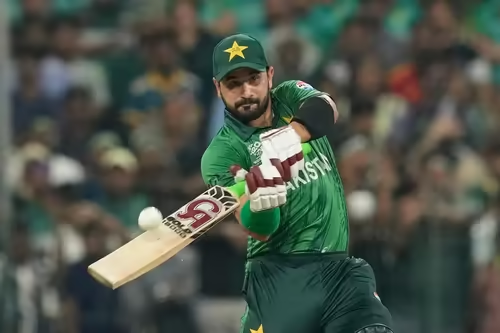
Don’t expect Pakistan to play it safe. With the most anticipated match of the ICC Men’s T20 World Cup 2026 just days away, opener Sahibzada Farhan has sent a clear message to arch-rivals India: we’re coming hard, and we’re coming fast. In a fiery pre-match declaration, Farhan vowed that Pakistan will embrace “positive, attacking cricket” when the two giants collide in Colombo on February 15 [[1]].
This isn’t just bravado—it’s backed by form. Farhan’s blistering **73 off 41 balls** against the USA earned him Player of the Match honors and propelled Pakistan to a dominant 32-run win. Now, riding a wave of confidence, he’s ready to take on the ultimate challenge: Team India, on a neutral but familiar Colombo stage.
Table of Contents
- Farhan’s Red-Hot Form: From USA Hero to India Nemesis?
- Captain Salman Ali Agha’s Balanced Blueprint
- Pakistan’s Powerplay Bowling: The Achilles’ Heel They’re Fixing
- Why Colombo Feels Like Home for Pakistan
- How India Might Counter Pakistan’s Aggression
- More Than Just a Game: What’s at Stake in This Clash
- Conclusion: Attack as the Best Defense
- Sources
Farhan’s Red-Hot Form: From USA Hero to India Nemesis?
For years, Pakistan’s top order has been inconsistent in ICC events. But Farhan’s innings against the USA changed the narrative. His knock—laced with **6 fours and 5 sixes**—wasn’t just explosive; it was intelligent. He targeted specific bowlers, rotated strike under pressure, and accelerated without losing control [[3]].
Now, he’s channeling that momentum into psychological warfare. “We won’t hold back,” Farhan said. “Against a team like India, you have to take the game to them from ball one.” That mindset could be dangerous—especially if India’s new-ball bowlers leak early runs.
Captain Salman Ali Agha’s Balanced Blueprint
While Farhan talks aggression, captain Salman Ali Agha offers a more nuanced perspective. Speaking in the same press conference, Agha emphasized “balanced batting” as the team’s core philosophy [[1]].
What does that mean? It’s not reckless hitting—it’s calculated risk-taking:
- Openers attack in the first six overs, but avoid high-risk shots on good deliveries.
- Middle order (like Iftikhar Ahmed and Mohammad Nawaz) rotates strike and builds pressure.
- Finishers (Khushdil Shah, Shadab Khan) clear boundaries in the death.
This structure ensures that even if one batter falls early, the innings doesn’t collapse—a recurring issue in past India-Pakistan encounters.
Pakistan’s Powerplay Bowling: The Achilles’ Heel They’re Fixing
Despite batting confidence, Pakistan knows their bowling has vulnerabilities—especially in the powerplay. Against the USA, they conceded **52 runs in the first six overs**, allowing Shayan Jahangir to race to 36 off 18 balls [[5]].
To counter India’s explosive openers (Yashasvi Jaiswal, Ruturaj Gaikwad), Pakistan is intensifying death and new-ball drills:
- Naseem Shah is working on inswingers to trap left-handers lbw.
- Haris Rauf is refining his slower bouncer to disrupt timing.
- Field placements are being adjusted—more point and cover to cut off drives.
If they can restrict India to under 45 in the powerplay, their spinners (Shadab, Nawaz) can strangle the middle overs.
Why Colombo Feels Like Home for Pakistan
Unlike India, who are flying in fresh, Pakistan has used Colombo as a base since early February. They’ve played warm-ups and their Group A opener here, giving them crucial familiarity with:
- Pitch behavior (slightly slow, grips for spinners)
- Dew patterns (minimal in February evenings)
- Boundary dimensions (shorter square boundaries favor leg-side hitters like Farhan)
This logistical edge—acknowledged even by India’s Ryan ten Doeschate—could be the silent X-factor.
How India Might Counter Pakistan’s Aggression
India won’t sit back. Their likely response:
- Early spin: Axar Patel or Kuldeep Yadav in the 3rd over to disrupt Farhan’s rhythm.
- Target Agha’s inexperience: The captain has limited T20I exposure—pressure could rattle him.
- Bumrah’s yorkers: Use pinpoint death bowling to shut down late-order hitting.
It’s a classic clash of philosophies: Pakistan’s fearless intent vs India’s tactical discipline.
More Than Just a Game: What’s at Stake in This Clash
Beyond Group A points, this match carries immense weight:
- Psychological dominance: Winner gains massive confidence for the Super 8s.
- Net run rate boost: A convincing win could decide top-two qualification.
- National pride: Over a billion fans watching—failure isn’t an option.
For Farhan, it’s a chance to cement his legacy. For Pakistan, it’s a statement of intent.
Conclusion: Attack as the Best Defense
In the high-voltage theater of the Pakistan vs India T20 World Cup 2026 clash, Sahibzada Farhan’s promise of “positive, attacking cricket” isn’t just a tactic—it’s a declaration of belief. Backed by a balanced squad and home-like conditions in Colombo, Pakistan is betting that aggression, not caution, will crack India’s armor. Whether that gamble pays off on February 15 remains to be seen—but one thing’s certain: fans are in for a thriller.