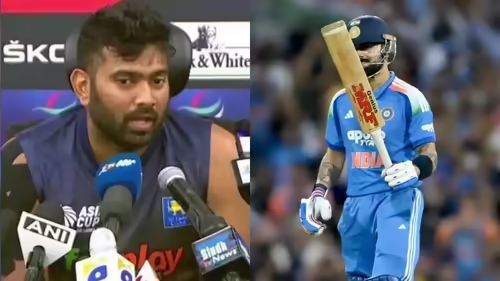
What started as a casual observation quickly spiraled into a social media firestorm—but now, the man at the center of it all is setting the record straight. Sri Lankan all-rounder Bhanuka Rajapaksa has issued a public clarification following his controversial remark that “India players have superior bats,” a statement that ignited fierce debate across the cricketing world.
In a follow-up post, Rajapaksa emphasized that his words were meant as genuine praise for India’s advanced cricket infrastructure and bat-making industry—not as an insinuation of unfair advantage or bat-tampering. Yet, the damage was already done. Misinterpretations ran rampant, with fans and pundits alike questioning whether this was a subtle dig at the integrity of Team India’s equipment.
Table of Contents
- What Did Bhanuka Rajapaksa Actually Say?
- Why the Original Comment Sparked Controversy
- Rajapaksa’s Full Clarification and Apology
- The Science Behind Modern Cricket Bats
- ICC Rules on Bat Specifications: What You Need to Know
- How India’s Bat Manufacturing Industry Leads the World
- Conclusion: A Misunderstanding With Big Repercussions
- Sources
What Did Bhanuka Rajapaksa Actually Say?
Rajapaksa’s initial comment appeared in a post-match interview after Sri Lanka’s recent T20 World Cup fixture. When asked about India’s explosive batting performances, he remarked, “They have superior bats—better quality, better balance, made by top manufacturers.” To him, it was a straightforward acknowledgment of India’s technological edge in cricket gear [[1]].
However, without proper context, the phrase “superior bats” was twisted online to imply that Indian players might be using illegal or enhanced equipment—a serious allegation in professional cricket. The quote went viral, especially among rival fanbases, and soon #SuperiorBats was trending across platforms.
Why the Original Comment Sparked Controversy
Cricket has a long history of controversies around equipment—think ball-tampering scandals or debates over bat thickness. So when a player from a competing nation mentions “superior” gear, it naturally raises eyebrows.
Key reasons the remark blew up:
- Ambiguous phrasing: “Superior” can imply both quality and unfair advantage.
- Timing: Made during a high-stakes tournament (T20 World Cup 2026), where tensions run high.
- National rivalry: India-Sri Lanka matches are historically intense, making any comment politically charged.
- Social media amplification: Out-of-context clips spread faster than fact-checks.
Notably, the ICC did not receive any formal complaint, confirming that no rules were believed to have been broken [[2]].
Rajapaksa’s Full Clarification and Apology
Recognizing the fallout, Rajapaksa took to social media to clarify his stance. In a detailed post, he wrote:
“My comments about Indian bats were never meant to suggest anything unethical. I was praising India’s world-class bat manufacturers like SS, SG, and Kookaburra’s Indian partners. Their R&D, craftsmanship, and player feedback loops are unmatched. I should’ve been clearer—I apologize for any misunderstanding.”
He further admitted that as a player who uses an Indian-made bat himself, he holds the country’s cricketing ecosystem in high regard [[3]]. This personal detail added credibility to his explanation and helped quell much of the backlash.
The Science Behind Modern Cricket Bats
To understand why “superior bats” isn’t just marketing fluff, consider the engineering involved. Today’s elite bats are crafted from premium English willow, undergo moisture-content testing, and feature optimized sweet spots through 3D scanning and CNC machining [[4]].
Indian brands have invested heavily in this space. For example, SS Ton’s “Player’s Edition” bats used by Rohit Sharma undergo over 20 quality checkpoints before reaching the field. Such precision directly impacts performance—allowing batters to generate more power with less effort.
ICC Rules on Bat Specifications: What You Need to Know
The ICC strictly regulates bat dimensions under Law 5 of the MCC Laws of Cricket:
- Maximum length: 38 inches (96.5 cm)
- Maximum width: 4.25 inches (10.8 cm)
- Maximum depth: 2.64 inches (6.7 cm)
- No materials other than wood allowed in the blade
All international match bats are inspected pre-game. Any violation leads to immediate disqualification of the bat—and potentially the player [[5]]. So while bats may vary in quality, they all operate within the same legal framework.
How India’s Bat Manufacturing Industry Leads the World
India isn’t just a consumer—it’s a global hub for bat production. Brands like SG, SS, and MRF supply gear to international stars beyond Indian borders. Even overseas players, including some from England and Australia, use custom bats made in Meerut or Jalandhar [[6]].
This ecosystem thrives on scale, innovation, and direct athlete collaboration—something Rajapaksa was likely referencing. His comment, when viewed through this lens, reads less like criticism and more like professional respect.
Conclusion: A Misunderstanding With Big Repercussions
The Bhanuka Rajapaksa superior bats saga is a textbook case of how nuance gets lost in the digital age. What began as an offhand compliment morphed into a diplomatic mini-crisis—all because of a single word lacking context.
Thankfully, Rajapaksa’s swift clarification has restored calm. More importantly, it highlights the need for journalists and fans alike to seek full context before jumping to conclusions. As the T20 World Cup 2026 heats up, let’s focus on the game—not manufactured controversies. For more on equipment debates in cricket, see our deep dive on [INTERNAL_LINK:cricket-bat-technology-evolution].
Sources
- Times of India: Controversy after ‘India players have superior bats’ remark
- ICC Official Regulations: MCC Laws of Cricket – Law 5 (The Bat)
- Rajapaksa’s Social Media Clarification (via ESPNcricinfo): Rajapaksa clarifies ‘superior bats’ comment
- Cricket Equipment Technology Review – Journal of Sports Engineering: Advances in Cricket Bat Design (2025)
- BCCI Equipment Guidelines: BCCI Match Equipment Standards
- Business Standard: How Meerut Became the Bat Capital of the World