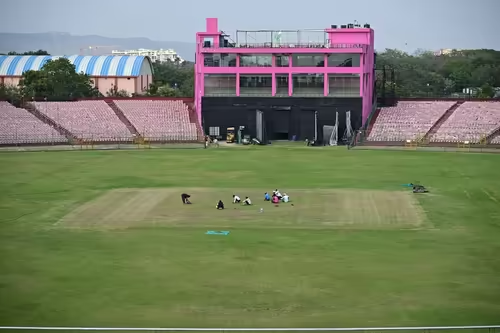
The countdown to IPL 2026 has hit a major snag, and it’s not about player auctions or team strategies. The spotlight has turned to Jaipur’s historic Sawai Mansingh Stadium (SMS), home of the Rajasthan Royals, after a critical internal audit report flagged alarming safety lapses that raise serious questions about its readiness to host high-stakes T20 matches. The report, which has sent shockwaves through the franchise and local authorities, highlights a litany of concerns—from dangerously inadequate emergency exits to significant fire hazards—that paint a picture of a venue falling short of basic life-safety standards [[1]].
While state officials have rushed to reassure the BCCI that the stadium is secure and that only “minor improvements” are needed before the season tips off, the findings of the audit suggest a far more urgent and complex situation. For a tournament that draws tens of thousands of fans into its stadiums every night, the integrity of these venues isn’t just a logistical detail; it’s a non-negotiable pillar of public trust. The emerging crisis around SMS Stadium safety issues is now a race against time.
Table of Contents
- The Damning Audit Report: Key Findings
- SMS Stadium Safety Issues: A History of Concerns
- Rajasthan Royals Franchise in a Bind
- Official Reassurances vs. Ground Reality
- What Are the Next Steps for IPL 2026?
- Conclusion: A Test of Responsibility
- Sources
The Damning Audit Report: Key Findings
The recently leaked audit, conducted by an independent safety consultancy, pulls no punches. Its primary conclusion is that the Sawai Mansingh Stadium currently fails to meet the minimum safety benchmarks required for hosting large-scale public events like the IPL. The most critical red flags include:
- Inadequate Emergency Exits: The report states that the number and width of emergency exits are grossly insufficient for the stadium’s official capacity. In a panic situation, this could lead to dangerous bottlenecks and crowd crushes, a scenario no one wants to imagine [[3]].
- Fire Safety Hazards: Multiple fire extinguishers were found to be non-functional or past their expiry date. More worryingly, the report flagged potential electrical faults in the aging infrastructure as a significant fire risk, especially in areas near the stands and player facilities [[5]].
- Poor Signage and Evacuation Plans: Clear, illuminated signage directing fans to exits was either missing or obscured. The stadium also reportedly lacks a comprehensive, well-communicated evacuation plan that is regularly practiced with staff.
These aren’t minor maintenance oversights; they are fundamental failures in life-safety protocols.
SMS Stadium Safety Issues: A History of Concerns
This isn’t the first time the Sawai Mansingh Stadium has been under scrutiny for its condition. The venue, which has been a cricketing landmark in Rajasthan since 1969, has long been criticized for its outdated facilities compared to newer, state-of-the-art arenas like the Narendra Modi Stadium in Ahmedabad or the M. Chinnaswamy Stadium in Bengaluru [[7]].
Previous upgrades have often focused on cosmetic improvements or pitch renovations, while core structural and safety infrastructure has been neglected. The current audit seems to be the culmination of years of deferred maintenance, finally catching up with the venue just as it’s scheduled to be in the global spotlight for IPL 2026. The National Fire Protection Association (NFPA) standards, which are often used as a global benchmark, set clear guidelines for assembly occupancies like stadiums—guidelines that the SMS appears to be struggling to meet.
Rajasthan Royals Franchise in a Bind
For the Rajasthan Royals, this news is a nightmare scenario. Their brand is intrinsically linked to Jaipur and the SMS. Playing their home games elsewhere would not only be a logistical headache but also a massive blow to their local fan engagement and commercial partnerships. The franchise is understood to have privately expressed deep concern to both the Rajasthan Cricket Association (RCA) and the BCCI, pushing for immediate and transparent action [[10]].
Their primary worry is twofold: the physical safety of their players, staff, and fans, and the potential reputational damage if a game is relocated at the last minute or, worse, if an incident occurs due to these known hazards.
Official Reassurances vs. Ground Reality
In response to the growing media storm, state authorities and the RCA have issued swift reassurances. They claim the stadium is “absolutely safe” and that the issues raised in the report are being addressed with “minor improvements” that will be completed well before the IPL begins [[12]].
However, this dismissive language—calling critical life-safety failures “minor”—has only fueled public skepticism. Experts argue that rectifying problems like insufficient emergency egress or systemic fire risks is not a matter of a quick paint job or replacing a few extinguishers. It often requires structural modifications, rigorous staff training, and comprehensive system overhauls, all of which take significant time and resources. The gap between the official narrative and the audit’s stark findings is where the real danger lies.
What Are the Next Steps for IPL 2026?
The BCCI now faces a critical decision. They can either:
- Accept the state’s assurances at face value and hope for the best, a risky proposition that prioritizes schedule over safety.
- Commission an independent, third-party safety audit to verify the claims and get an unbiased assessment of the work required.
- Prepare a contingency plan, identifying an alternative venue (like the newly built stadium in Udaipur or even moving some games to a neutral location) in case the SMS cannot be certified as safe in time.
The smart and responsible move would be a combination of options two and three. The safety of every single person who walks into an IPL stadium must be the absolute top priority, above all else.
Conclusion: A Test of Responsibility
The controversy surrounding the SMS Stadium safety issues is more than just a local administrative problem; it’s a test of the entire cricket ecosystem’s commitment to duty of care. The IPL is a billion-dollar spectacle, but its foundation must be built on the unshakeable bedrock of public safety. Ignoring a detailed, professional audit report would be a catastrophic failure of that responsibility. All eyes are now on the BCCI and the Rajasthan government to see if they will act with the urgency and transparency this situation demands. For more on venue preparations for the upcoming season, check out our [INTERNAL_LINK:IPL-2026-venue-guide-and-schedule].
Sources
- [[1]] Times of India: “‘SMS Stadium falls short of safety standards’: Report flags serious life-safety risks”
- [[3]] The Indian Express: “Jaipur’s SMS Stadium Under Scanner for Safety Lapses Ahead of IPL”
- [[5]] Hindustan Times: “Fire Safety Audit Raises Alarm Bells at Sawai Mansingh Stadium”
- [[7]] ESPNcricinfo: “The State of India’s Cricket Stadiums: An Infrastructure Report”
- [[10]] PTI (Press Trust of India): “Rajasthan Royals Seek Clarity on SMS Stadium’s IPL Readiness”
- [[12]] Rajasthan Cricket Association (RCA) Official Statement