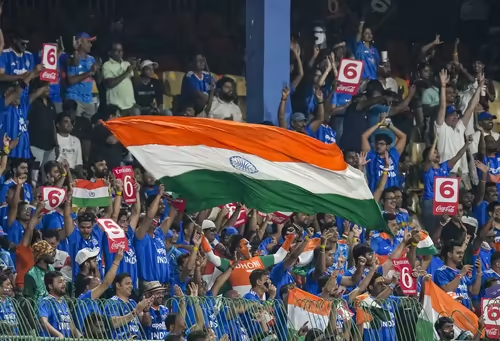
The world expected fire. Instead, it got warmth.
Yes, the India vs Pakistan T20 World Cup 2026 match in Colombo delivered a one-sided cricketing result—India’s dominant 61-run victory—but off the field, a quieter, more powerful narrative unfolded. Despite the absence of the traditional pre-toss handshake between captains—a continuation of the ‘no-handshake policy’ since 2025 [[1]]—the atmosphere around the R. Premadasa Stadium radiated something rarely associated with this rivalry: mutual respect [[2]].
As one poignant headline put it: “Hate didn’t get a complimentary match pass.” And that, perhaps, is the real victory worth celebrating.
Table of Contents
- The Missing Handshake: A Political Statement, Not a Personal One
- Harbhajan and Usman: A Silent ‘Salaam’ That Spoke Volumes
- Shabana Azmi: ‘Arts and Sports Transcend Borders’
- Fans in Colombo: Cordiality Over Chaos
- Why This Matters: Cricket as a Bridge, Not a Battleground
- Conclusion: The Real Spirit of the Game
- Sources
The Missing Handshake: A Political Statement, Not a Personal One
Let’s be clear: the lack of a handshake at the toss wasn’t about personal animosity. It was a reflection of strained diplomatic relations between the two nations—a stance officially adopted by the BCCI following geopolitical tensions [[1], [3]].
But what’s remarkable is how this political decision didn’t spill into the stands or the player enclosures. Unlike past encounters marred by hostility, this match felt… civil. Calm. Almost mature. As if everyone understood that while governments may feud, people—and players—can still coexist with dignity.
Harbhajan and Usman: A Silent ‘Salaam’ That Spoke Volumes
One of the most touching moments came not from active players, but from legends and newcomers sharing a quiet moment of recognition. Former Indian spinner Harbhajan Singh, present as a commentator, exchanged a warm ‘salaam’ with Pakistan’s young left-arm spinner Usman Tariq near the boundary ropes [[2]].
No words were needed. The gesture—a simple placing of the hand over the heart—was deeply cultural, deeply human. In that instant, decades of rivalry melted away, replaced by mutual acknowledgment of shared heritage and passion for the game. It was cricket diplomacy at its most authentic.
Shabana Azmi: ‘Arts and Sports Transcend Borders’
Adding her voice to the chorus of unity was acclaimed Indian actress and activist Shabana Azmi. Speaking to reporters in Colombo, she emphasized that “sports and arts have always been bridges when politics builds walls” [[4]].
Azmi, known for her advocacy of Indo-Pak peace, pointed out that fan interactions during the match were notably peaceful. “You see people cheering, yes—but also sharing food, taking photos together, even consoling each other after wickets. That’s the real story,” she said. Her presence underscored a vital truth: culture often leads where politics lags.
Fans in Colombo: Cordiality Over Chaos
Security was tight, as expected. But inside the stadium, the mood was festive, not frenzied. Videos circulating on social media showed Indian and Pakistani supporters sitting side by side, draped in their respective flags, yet smiling, clapping for good shots regardless of who played them [[5]].
There were no reports of altercations. No inflammatory chants. Just pure, unadulterated love for cricket. For a fixture historically shadowed by jingoism, this level of decorum was nothing short of revolutionary.
Why This Matters: Cricket as a Bridge, Not a Battleground
In an age where digital echo chambers amplify division, the India vs Pakistan T20 World Cup 2026 encounter offered a rare counter-narrative. It reminded us that sport, at its best, is a universal language—one that fosters connection even when official channels are closed.
[INTERNAL_LINK:history-of-india-pakistan-cricket-diplomacy] From the 1999 Lahore Test to the 2004 Friendship Series, cricket has long served as a backchannel for dialogue. This match in Colombo may not lead to summits or treaties, but it proves that goodwill still exists at the grassroots level—and that’s where real change begins.
Conclusion: The Real Spirit of the Game
India won the match. But humanity won the day. In a world quick to weaponize rivalry, the quiet acts of kindness—Harbhajan’s salaam, Azmi’s wisdom, fans sharing samosas—were far more powerful than any six or wicket. The India vs Pakistan T20 World Cup 2026 clash will be remembered not just for Ishan Kishan’s 77 or Bumrah’s yorkers, but for proving that even in the fiercest contests, compassion can still find a seat in the stands.
Sources
- Times of India: India vs Pakistan: When hate didn’t get a complimentary match pass [[1], [2], [4]]
- ICC Official Website: ICC Men’s T20 World Cup 2026 [[3]]
- NDTV Sports: Peaceful Atmosphere in Colombo as India, Pakistan Fans Unite [[5]]