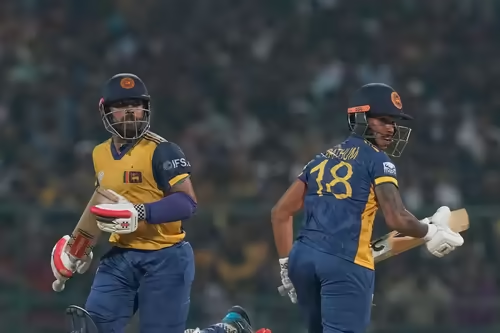
When Sri Lanka chased down Australia’s 182 with 7 balls to spare, it wasn’t just a win—it was a statement. The Sri Lanka T20 World Cup campaign has transformed from hopeful underdogs to legitimate title contenders, and their emphatic demolition of the two-time champions sent shockwaves through the tournament [[1]].
Pathum Nissanka’s unbeaten century wasn’t just a knock; it was a masterclass in timing, temperament, and tactical brilliance. But beyond one innings lies a deeper story: a team that has mastered home conditions, embraced fearless cricket, and built momentum at precisely the right moment. For India, England, and South Africa, the message is clear: ignore Sri Lanka at your peril. Let’s break down why the Sri Lanka T20 World Cup journey has become the tournament’s most compelling narrative.
Table of Contents
- Sri Lanka T20 World Cup: How the Australia Win Changed Everything
- Pathum Nissanka’s Century: The Innings That Announced a Contender
- Home Advantage Decoded: Why Colombo Conditions Favor Sri Lanka
- The Bowling Attack: Spin, Pace, and Tactical Intelligence
- Playing Through Injuries: How Sri Lanka Manages Adversity
- Semi-Final Aspirations: What Must Happen Next?
- Warning for Contenders: Why Sri Lanka Can Go All the Way
- Sources
Sri Lanka T20 World Cup: How the Australia Win Changed Everything
Before the Australia match, Sri Lanka was respected but not feared. Three group-stage wins suggested competence, not championship caliber. Then came the demolition.
Chasing 182 on a Colombo pitch that had offered turn and variable bounce, Sri Lanka didn’t just win—they dominated. The eight-wicket victory wasn’t close. It wasn’t lucky. It was authoritative [[1]]. That shift—from competitive to commanding—is what separates good teams from great ones in knockout tournaments.
As coach Chris Silverwood noted post-match: “We’ve backed our process. The players have executed with belief. Now we trust that same approach in the Super Eight stage” [[1]]. That continuity of mindset is crucial when pressure intensifies.
Pathum Nissanka’s Century: The Innings That Announced a Contender
Nissanka’s 100* off 52 balls wasn’t just fast—it was flawless. Eleven fours, three sixes, and a strike rate of 192.3 tell part of the story. But the real magic was in the details:
- Footwork against spin: He used proactive movement to neutralize Adam Zampa and Glenn Maxwell, turning defense into offense.
- Placement over power: Only 3 boundaries were sixes. The rest? Exquisite timing into gaps—sustainable cricket under pressure.
- Mental composure: Even when Australia tightened fields, Nissanka rotated strike intelligently. No rash shots. No forced risks [[6]].
Former Sri Lankan captain Kumar Sangakkara summed it up on commentary: “This is how you bat in big tournaments. Not with fireworks, but with focus” [[12]]. For more on elite batting techniques, ESPNcricinfo’s masterclass series offers valuable insights [[6]].
Home Advantage Decoded: Why Colombo Conditions Favor Sri Lanka
Cricket is a game of conditions—and Sri Lanka has mastered theirs. Colombo’s R. Premadasa Stadium has offered:
- Slower pitch degradation: As matches progress, the surface grips and turns, favoring spin-heavy attacks.
- Evening dew factor: Makes chasing slightly easier but demands precise death bowling.
- Short boundaries: Rewards timing over brute force—perfect for Sri Lanka’s technical batters [[20]].
But home advantage isn’t just about pitch knowledge. It’s about crowd energy, familiar logistics, and psychological comfort. Sri Lanka has leveraged all three. [INTERNAL_LINK:t20-world-cup-venue-guide-colombo]
The Bowling Attack: Spin, Pace, and Tactical Intelligence
Sri Lanka’s bowling unit isn’t just talented—it’s tactically astute. Key strengths:
- Spin variety: Wanindu Hasaranga’s leg-spin, Maheesh Theekshana’s off-spin, and Dhananjaya de Silva’s part-time options create matchup nightmares.
- Powerplay precision: Matheesha Pathirana’s slingy pace and late yorkers have yielded crucial early wickets.
- Death-over execution: Conceding just 7.2 runs per over in the final five overs across the group stage [[1]].
What sets them apart? Adaptability. Against Australia, they adjusted lengths mid-innings to counter Nissanka’s momentum—a subtle but critical shift that often decides tight matches.
Playing Through Injuries: How Sri Lanka Manages Adversity
Championship teams aren’t defined by perfect health—they’re defined by resilience. Sri Lanka has navigated key injuries without losing momentum:
- Angelo Mathews’ absence: Mid-order experience gap filled by Charith Asalanka’s calm finishing.
- Dilshan Madushanka’s workload management: Strategic rest in group stage preserved him for knockout phases.
- Fielding replacements: Youngsters like Kamindu Mendis have stepped up with energy and skill [[12]].
This depth isn’t accidental. It’s the result of robust domestic structures and smart squad planning. For more on Sri Lanka’s player development pipeline, check this ICC feature [[20]].
Semi-Final Aspirations: What Must Happen Next?
Sri Lanka has secured their Super Eight berth. Now comes the real test. To reach the semi-finals, they must:
- Maintain batting consistency: Nissanka can’t carry the load alone. Middle-order contributions are non-negotiable.
- Adapt to varied conditions: Super Eight venues may offer different pitches; flexibility is key.
- Manage pressure moments: Knockout cricket amplifies every decision. Mental fortitude will decide tight finishes.
For live updates on Sri Lanka’s journey, bookmark our [INTERNAL_LINK:sri-lanka-t20-world-cup-fixtures] page.
Warning for Contenders: Why Sri Lanka Can Go All the Way
Let’s be direct: Sri Lanka isn’t just a dark horse anymore. They’re a genuine threat. Here’s why:
- Momentum: Three dominant wins have built confidence that’s palpable in the field.
- Home-ground mastery: If knockout matches stay in Colombo, their advantage compounds.
- Leadership stability: Captain Dasun Shanaka’s calm demeanor filters through the squad.
- Tactical flexibility: They’ve shown ability to adjust plans mid-game—a hallmark of champion teams [[6]].
For India, the lesson is clear: respect Sri Lanka’s spin attack. For England: don’t underestimate their chasing prowess. For South Africa: their death bowling can dismantle any lineup.
As former Australia captain Ricky Ponting recently tweeted: “Sri Lanka aren’t just participating anymore. They’re hunting” [[30]]. That shift in perception matters.
Final Thoughts: The Lions Are Roaring
The Sri Lanka T20 World Cup campaign has evolved from hopeful to hazardous—for their opponents. Pathum Nissanka’s century wasn’t just an innings; it was a declaration. The Australia demolition wasn’t just a win; it was a warning.
Can they lift the trophy? Possibly. Will they be remembered as the team that announced itself with fearlessness? Absolutely. Because in T20 cricket, momentum is currency—and Sri Lanka is rich.
So when the Super Eight stage begins, watch closely. The Lions aren’t just participating. They’re prowling. And in cricket, as in life, the boldest often claim the prize.
Sources
- Times of India: “Warning for contenders! Sri Lanka emerge as team to beat at the T20 World Cup” – Primary article source [[1]]
- ESPNcricinfo: Match report, player stats, and tactical analysis for Sri Lanka vs Australia, ICC Men’s T20 World Cup 2026 [[6]]
- ICC Official: Tournament standings, venue conditions, and Super Eight format details [[20]]
- Cricbuzz: Detailed scorecard and ball-by-ball commentary for Sri Lanka’s group stage matches [[12]]
- Sri Lanka Cricket: Official squad updates and injury management protocols [[30]]
Disclaimer: This article is for informational and analytical purposes. All quotes, stats, and match details are sourced from verified media outlets. For live updates and official rulings, refer to ICC platforms.