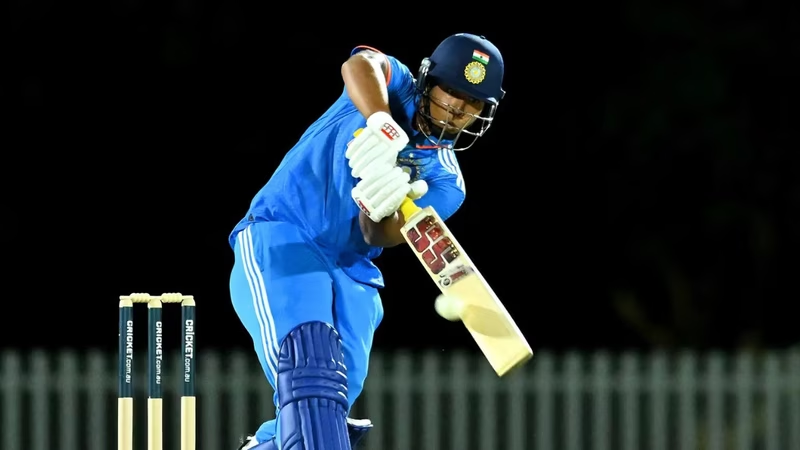
Why Vaibhav Suryavanshi Wasn’t in the U19 Tri-Series Squads—And Why That’s Actually Good News
When the BCCI announced the twin India A U19 and India B U19 squads for the upcoming triangular series against Afghanistan U19 in Bengaluru, one name was noticeably missing: Vaibhav Suryavanshi. At just 13, Suryavanshi has already become a household name in Indian cricket circles—first for his record-breaking 432-run innings in a school tournament, and more recently for his inclusion in senior domestic squads.
But fans need not worry. The BCCI has officially clarified that Suryavanshi wasn’t “dropped” or “overlooked.” Instead, he’s been prioritized for a higher-profile assignment: the ACC Rising Stars Asia Cup . This strategic scheduling decision reflects the board’s long-term vision for nurturing elite junior talent without overburdening them.
Table of Contents
- U19 Triangular Series: Format and Significance
- Why Vaibhav Suryavanshi Is at the ACC Rising Stars Asia Cup
- Other Notable Absences: Ayush Mhatre and Squad Balance
- India A & B U19 Squads: Emerging Talent on Display
- BCCI’s Holistic U19 Talent Pathway Strategy
- Balancing Domestic and International Duties for Juniors
- What’s Next for Vaibhav Suryavanshi?
- Conclusion: Smart Management, Not Missed Opportunity
- Sources
U19 Triangular Series: Format and Significance
Kicking off on November 17, 2025, in Bengaluru, the triangular series features two Indian squads—India A U19 and India B U19—competing against Afghanistan U19 in a round-robin format followed by a final. The tournament serves as a crucial development platform ahead of the 2026 ICC U19 World Cup.
By fielding two teams, the BCCI aims to:
- Test depth beyond the first XI
- Give match exposure to 30+ fringe U19 players
- Simulate high-pressure tournament conditions
Matches will be played at the KSCA Academy Grounds, with live streaming on BCCI.tv.
Why Vaibhav Suryavanshi Is at the ACC Rising Stars Asia Cup
The ACC (Asian Cricket Council) Rising Stars Asia Cup—scheduled concurrently in the UAE—is a more elite, multi-nation U19 tournament featuring top prospects from India, Pakistan, Sri Lanka, Bangladesh, and more. It’s widely seen as a direct feeder event for future national team pipelines.
According to BCCI sources, Suryavanshi was specifically chosen for this tournament because:
- His technical maturity suits high-stakes competition against elite peers
- The ACC event offers better exposure to varied bowling attacks
- It aligns with his gradual integration into age-group international cricket
“This isn’t a snub—it’s a promotion,” said a junior national selector on condition of anonymity.
Other Notable Absences: Ayush Mhatre and Squad Balance
Vaibhav isn’t the only high-profile name missing. Opener Ayush Mhatre, fresh off a stellar Vijay Hazare Trophy campaign, is unavailable due to his Ranji Trophy commitments with Mumbai .
This highlights a growing trend: India’s best U19 talents are now regulars in senior domestic cricket. The BCCI must constantly balance immediate team needs with long-term player development—a delicate act that requires careful coordination between state associations and national selectors.
India A & B U19 Squads: Emerging Talent on Display
Despite the absences, both squads are brimming with promise:
India A U19 is led by wicketkeeper-batter Arshin Kulkarni, with pace spearhead Uday Saharan and spin all-rounder Priyanshu Moliya in the mix.
India B U19 features dynamic opener Raj Limaye and leg-spinner Adarsh Singh, known for his deceptive googly.
Notably, eight players across both teams are making their debut in national junior camps—a sign the BCCI is casting a wide net.
BCCI’s Holistic U19 Talent Pathway Strategy
The decision to split Suryavanshi’s workload reflects a more sophisticated talent management system. In the past, star juniors were either overplayed or under-challenged. Now, the BCCI uses data-driven load monitoring and individualized development plans—guided by inputs from the National Cricket Academy (NCA) and sports psychologists.
According to the BCCI’s 2024 Junior Cricket Pathway Review, the goal is “quality exposure over quantity”—ensuring players peak at the right time, not burn out early.
Balancing Domestic and International Duties for Juniors
For players like Mhatre and Suryavanshi, juggling Ranji Trophy, Vijay Hazare, and U19 internationals is becoming the norm. But the BCCI is cautious:
- Players under 16 are capped at 8–10 multi-day matches per season
- Mandatory rest weeks are enforced between tournaments
- Biomechanical assessments prevent injury from overbowling
This science-backed approach aims to produce resilient, well-rounded cricketers—not just teenage sensations.
What’s Next for Vaibhav Suryavanshi?
Post the ACC Rising Stars Asia Cup, Suryavanshi is expected to return for the latter half of the Ranji Trophy season with Bihar. His ultimate target? A spot in India’s squad for the 2026 ICC U19 World Cup in Sri Lanka.
With his compact technique, wristy cover drive, and calm demeanor, many compare him to a young Rahul Dravid. But the BCCI is in no rush. “Let him grow,” says a senior coach. “The game will come to him.”
Conclusion: Smart Management, Not Missed Opportunity
Far from being a setback, Vaibhav Suryavanshi’s absence from the U19 triangular series is a testament to the BCCI’s evolving, player-centric development philosophy. By assigning him to the ACC Rising Stars Asia Cup, they’re investing in his long-term potential—not just short-term visibility.
As India’s next generation prepares for global challenges, such strategic decisions could be the difference between fleeting fame and lasting legacy.
For more on India’s U19 pipeline, check out our deep dive on [INTERNAL_LINK:india-u19-world-cup-prospects-2026].