For over two decades, Sachin Tendulkar carried the hopes of a billion fans on his shoulders. But in the quiet moments before India’s historic 2011 World Cup campaign, it wasn’t roaring crowds or tactical meetings that anchored him—it was a silent, spiritual encounter that told him, without words, this would be his last dance in World Cup colors.
In a rare and moving reflection, the cricketing icon recently revealed how a simple yet profound interaction with spiritual guru Sathya Sai Baba during the team’s preparatory camp in Bangalore left an indelible mark on his heart—and foreshadowed the end of his One-Day International journey.
What was this moment? Why did it resonate so deeply? And how did it influence his mindset during India’s triumphant run on home soil? Let’s step back into one of the most emotional chapters of modern cricket history.
Table of Contents
- The Bangalore Camp & Sai Baba’s Gift
- “I Knew It Was My Last” – Sachin’s Realization
- How That Moment Fueled India’s 2011 World Cup Run
- Sachin Tendulkar’s Lifelong Spiritual Connection
- Lifting the Trophy: “The Most Emotional Moment”
- Why the 2011 Win Still Echoes Today
- Conclusion: A Journey Closed with Grace
- Sources
The Bangalore Camp & Sai Baba’s Gift
Before India’s 2011 World Cup campaign began, the team gathered at the National Cricket Academy in Bangalore for an intensive preparatory camp. It was during this period that Sathya Sai Baba, whom Sachin had long revered, visited the facility.
According to Tendulkar, Sai Baba handed him a book—no grand speech, no fanfare—just a quiet, personal gesture. “He gave me a book,” Sachin recalled. “I didn’t even look at the title right away. But I felt an overwhelming sense of calm.”
That calm, he explained, wasn’t just about relaxation—it was a deep inner certainty. In that moment, he sensed the weight of destiny shifting.
“I Knew It Was My Last” – Sachin’s Realization
“I knew it was going to be my last,” Sachin said, reflecting on the encounter. “Not because I planned it, but because something inside me just knew.”
This revelation is especially poignant given that Sachin had participated in six World Cups—the most by any player in history. The 2011 tournament wasn’t just another event; it felt like a cosmic finale. For a player who had shouldered national expectation since age 16, this intuitive clarity was both liberating and bittersweet.
Unlike other retirements that follow decline or injury, Sachin’s departure from ODI cricket came at the peak of emotional fulfillment—on his own terms, in his homeland, with the ultimate prize in hand.
How That Moment Fueled India’s 2011 World Cup Run
Armed with that quiet resolve, Sachin played a pivotal role in India’s campaign:
- He scored 482 runs in 9 matches, including two centuries.
- His 111 against South Africa in Nagpur set the tone for India’s aggressive batting.
- Even in the final, his early dismissal didn’t dampen the team’s spirit—he was the emotional nucleus.
Teammates like Yuvraj Singh and Zaheer Khan later admitted that Sachin’s composed presence—free from desperation or fear—was contagious. “He wasn’t chasing records anymore,” one insider noted. “He was just playing for joy.”
Sachin Tendulkar’s Lifelong Spiritual Connection
This wasn’t an isolated incident. Sachin has often spoken about the role of spirituality in his life. He’s a devotee of Lord Ganesha and has visited numerous temples before major matches. His connection with Sathya Sai Baba dates back to the early 2000s, and he’s credited the guru with helping him maintain mental equilibrium through career highs and lows.
In an era where athletes rely on sports psychologists and data analytics, Sachin’s grounding in faith offered a different kind of edge—one rooted in humility and acceptance. This balance between intense competitiveness and inner peace is what made his 2011 performance so extraordinary.
Lifting the Trophy: “The Most Emotional Moment”
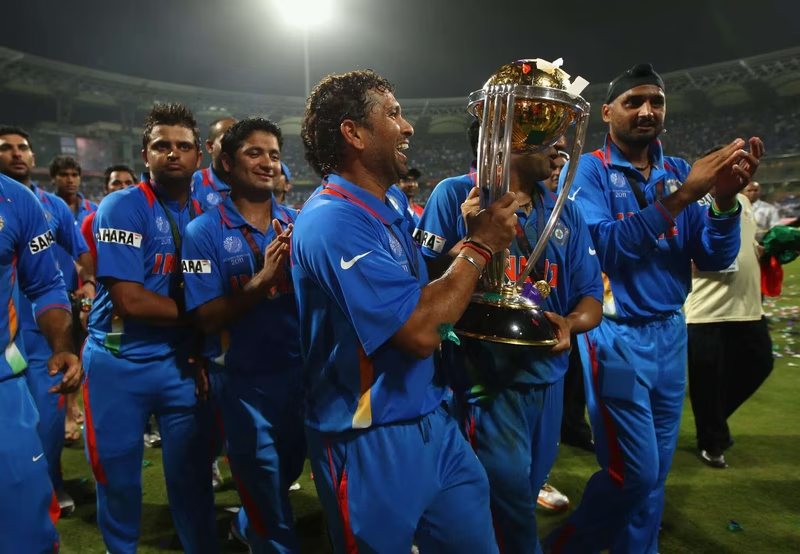
When MS Dhoni struck that six at Wankhede on April 2, 2011, the nation erupted. But for Sachin Tendulkar, the true catharsis came moments later—when his teammates carried him on their shoulders and placed him first in the trophy-lifting line.
“That was the most emotional moment of my career,” he said. “Not because we won, but because they honored me that way. After 14,000 runs, two World Cup finals, and years of near-misses… they gave me that closure.”
Photos of a tearful Sachin embracing Dhoni remain iconic—not just as sports history, but as a symbol of generational respect and collective triumph.
Why the 2011 Win Still Echoes Today
More than just a title, the 2011 World Cup victory marked a cultural watershed. It was India’s first World Cup win on home soil, ending a 28-year wait. For millennials and Gen Z fans, it was their “Tendulkar moment”—a shared national memory akin to 1983 for their parents.
Today, as young players like Shubman Gill and Yashasvi Jaiswal rise, they often cite that victory as their earliest cricketing inspiration. The emotional arc—anchored by Sachin’s journey—gave the win a mythic quality that statistics alone can’t capture.
Conclusion: A Journey Closed with Grace
Sachin Tendulkar’s story with the 2011 World Cup wasn’t just about runs or records—it was about destiny, faith, and closure. The quiet book from Sathya Sai Baba wasn’t a prop; it was a mirror reflecting the end of an epic chapter.
In a world obsessed with stats and highlights, this deeply human moment reminds us that sport’s greatest victories are often won in the silence between the noise. As fans, we witnessed the legend—but in that Bangalore camp, Sachin met his peace.
For more on India’s historic tournament, explore our [INTERNAL_LINK:india-2011-world-cup-full-match-recap].