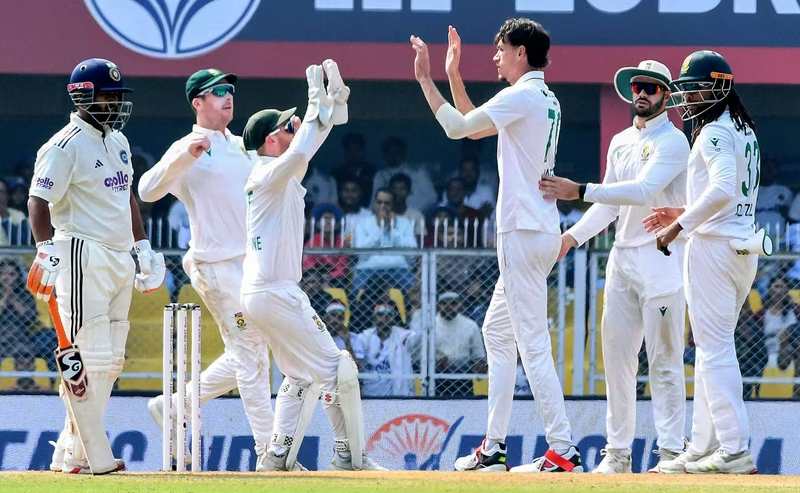
India’s Batting Collapse Hands SA Dominance in Guwahati
The haunting ghosts of Indian batting frailties resurfaced with a vengeance in Guwahati. On a pitch offering variable bounce, India’s top and middle order didn’t just crumble—they vanished. This latest India batting collapse has placed the hosts in a near-impossible position in the second Test against South Africa, staring down the barrel of a series defeat on home soil.
Table of Contents
- The Jansen Juggernaut
- From 93 Runs to 6 Wickets: A Complete Performance
- A Historic Home Series Loss Looms
- What’s Next for Team India?
- Conclusion
- Sources
The Jansen Juggernaut
South Africa’s towering left-arm quick, Marco Jansen, was the architect of India’s misery. He masterfully exploited the pitch’s uneven nature, generating steep, awkward bounce that left the Indian batsmen clueless and in constant peril. His spell was surgical, dismantling the Indian batting lineup with a mesmerizing mix of pace, bounce, and accuracy.
The result was a devastating bowling figure of 6 for 48—a performance that didn’t just break a few wickets but shattered India’s confidence and their hopes for the match . Jansen’s ability to target the body and force the batsmen into playing false shots proved to be the perfect strategy on a tricky Guwahati surface .
From 93 Runs to 6 Wickets: A Complete Performance
This wasn’t just a great bowling day for Jansen; it was a statement of his all-round prowess. In the first innings, he had already contributed a crucial 93 runs with the bat, laying the foundation for South Africa’s formidable total of 489. To then return and single-handedly dismantle the Indian batting order showcased a level of dominance rarely seen in modern Test cricket .
His performance has placed him firmly among the elite all-rounders in the game. With 56 wickets in just 14 Tests at a stellar average of 20.17, Jansen is rapidly becoming South Africa’s most potent weapon . For India, figuring out how to handle his dual threat will be their biggest challenge going forward.
A Historic Home Series Loss Looms
The context of this collapse makes it even more alarming. India’s fortress at home has been virtually impenetrable for over a decade, with a record 15 consecutive home Test series wins . That streak was just broken by New Zealand in October 2024 , and now, just a month later, they are on the brink of a second consecutive home series loss—a scenario that was unthinkable not so long ago.
The Guwahati Test saw India bundled out for a paltry 201 in their first innings, handing South Africa a massive 288-run lead. In their second innings, despite a 93-run stand from Jansen, South Africa extended their advantage to a commanding 314 runs with two full days of play remaining . The task for India now is not just to save the match but to salvage their reputation as a dominant home force.
Why These Collapses Keep Happening
This isn’t an isolated incident. Recent history shows a worrying trend of dramatic batting implosions at home:
- Just weeks ago, India lost 7 wickets for a mere 15 runs against New Zealand at home .
- Their batting has shown a consistent vulnerability against quality pace bowling that can extract bounce, even on traditionally spin-friendly Indian pitches .
This recurring issue points to a deeper problem in technique and temperament against the short ball, a weakness that top teams like New Zealand and now South Africa have ruthlessly exposed.
What’s Next for Team India?
The immediate future is bleak. Chasing a 314-run lead with an entire innings to bat is a herculean task, and India’s best hope is now a miraculous fight for a draw. Players like Yashasvi Jaiswal and Washington Sundar, who showed some resilience, will need to lead from the front .
However, the bigger picture is far more critical. The Indian selectors and think-tank must address the glaring technical flaws in the batting unit before their next major challenge. The confidence of a generation of batsmen, built on the back of easy home victories, has been shaken. Rebuilding it will require more than just a few net sessions; it will demand a fundamental shift in their approach to Test match batting.
For more on India’s recent home performance, check out our deep dive into their home Test series history.
Conclusion
The India batting collapse in Guwahati is more than just a bad day at the office; it’s a symptom of a deeper crisis. Marco Jansen’s brilliance was the catalyst, but the underlying issues have been festering for some time. With their home dominance now shattered twice in quick succession, the Indian cricket team stands at a crossroads. The path they choose next will define their identity in Test cricket for years to come. The dream of an invincible home record is over; now, it’s time for a hard, honest rebuild.
Sources
- Associated Press. “Marco Jansen’s 6-48 helps South Africa to commanding lead over India in the second cricket test.” [Source]
- “India vs South Africa Highlights, 2nd Test Day 3.” [Source]
- “India lose first home Test series since 2012.” ESPN Cricinfo.
- “South Africa’s Jansen Relishes 6-48 In India Test With Bounce-Pace Plan.” [Source]
- “Jansen too hot for India as SA start dreaming of series sweep.” [Source]
- “Stats – India third for most Test wins at home.” [Source]
- “India have now lost four of their last six home Tests.” [Source]
- “Marco Jansen now has the third-best Test bowling figures.” [Source]
- “Marco Jansen’s six-wicket haul vs India creates history.” [Source]