ISPL: The Secret Talent Factory IPL Scouts Can’t Ignore
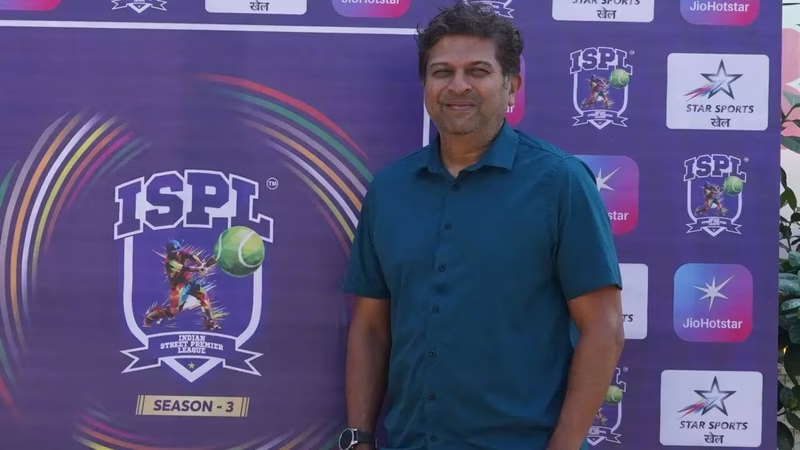
Move over traditional academies and state trials—there’s a new, electrifying pipeline for cricketing talent in India, and it’s playing out on concrete pitches, gully grounds, and makeshift stadiums across 101 cities. Enter the Indian Street Premier League (ISPL)—a tournament that’s rapidly evolving from a local spectacle into a serious scouting ground for elite cricket. And according to former India cricketer and current ISPL Head of Selection Committee Jatin Paranjpe, IPL franchises would be foolish to overlook it. “If I was an IPL scout,” he boldly declared, “I’d make sure my team watches the ISPL simulations” .
Table of Contents
- What Is the Indian Street Premier League?
- Jatin Paranjpe’s Bold Endorsement
- Why ISPL Is a Game-Changer for Indian Cricket
- The Talent Pipeline: From Streets to the Spotlight
- How ISPL Differs from Traditional Domestic Cricket
- What This Means for IPL and Beyond
- Conclusion
- Sources
What Is the Indian Street Premier League?
Launched as a platform to democratize cricket, the Indian Street Premier League was designed to unearth raw talent from India’s vast hinterland—places rarely visited by national selectors or IPL scouts. Now in its third season, the ISPL has dramatically expanded its footprint from a handful of cities to an impressive 101 cities nationwide . This massive scale ensures that no cricket-crazed corner of the country is left behind.
The format blends street cricket’s raw energy with professional structure. Players compete in simulated match scenarios using leather balls—crucial for developing skills that translate directly to first-class and T20 cricket. Many participants already have experience in local club tournaments or age-group cricket but lacked the exposure to break into the mainstream system.
Jatin Paranjpe’s Bold Endorsement
A right-handed batter who represented India in the 1990s, Jatin Paranjpe brings decades of cricketing insight to his role as Head of Selection for the ISPL. His recent comments reflect a growing confidence in the league’s quality: “The depth and quality of players we’re seeing now is incredible,” he said. “Many have prior leather-ball experience, and their performances under pressure are match-ready” .
Paranjpe isn’t just praising the league—he’s issuing a direct challenge to IPL franchises: start watching. In an ecosystem where franchises spend crores on overseas stars, he’s highlighting a domestic goldmine that’s been overlooked for too long.
Why ISPL Is a Game-Changer for Indian Cricket
The significance of the Indian Street Premier League extends far beyond entertainment. It addresses a critical gap in India’s cricketing infrastructure: accessibility. While metros dominate selection pathways, millions of talented players in tier-2 and tier-3 cities never get a fair shot.
Consider these impacts:
- Democratization: ISPL’s city-based trials allow scouts to evaluate talent in familiar, high-pressure local environments.
- Real-World Readiness: Using leather balls and T20 formats means skills are immediately transferable to domestic leagues like the Vijay Hazare Trophy or Syed Mushtaq Ali.
- Scalability: With 101 cities in Season 3, the league casts the widest net possible, increasing the odds of finding the next Jasprit Bumrah or Rinku Singh—both late bloomers from non-traditional backgrounds.
The Talent Pipeline: From Streets to the Spotlight
Paranjpe emphasized that many ISPL participants aren’t raw novices—they’re seasoned performers in local circuits who simply lacked visibility. “These are players who’ve been grinding it out for years,” he noted. “Now, they have a stage that mimics real professional conditions.”
This model mirrors successful global talent pipelines. In England, the ECB’s grassroots programs feed into county cricket. In Australia, the Big Bash League scouts from state second XIs. The Indian Street Premier League could become India’s answer—a structured, scalable bridge between gully cricket and the Ranji Trophy.
How ISPL Differs from Traditional Domestic Cricket
Unlike the Ranji Trophy or CK Nayudu Trophy, which are steeped in tradition and often slow-moving, ISPL is built for speed, visibility, and relevance:
- Format: T20 simulations with broadcast-quality production.
- Selection: Open trials in every city, judged by former first-class and international players.
- Goal: Not just to crown a winner, but to identify 50–100 high-potential players annually for further development.
This modern approach resonates with today’s athletes and scouts alike.
What This Means for IPL and Beyond
If IPL teams take Paranjpe’s advice seriously, the ripple effects could be transformative. Franchises constantly seek cost-effective, homegrown talent to bolster their squads under salary caps. An ISPL standout could be the next uncapped Indian to light up the IPL—like Tilak Varma or Vaibhav Suryavanshi.
Moreover, state associations could partner with ISPL to fast-track promising players into their Ranji squads. For fans tracking [INTERNAL_LINK:Players] on the rise, ISPL is now a must-watch proving ground.
Conclusion
The Indian Street Premier League is no longer just a passion project—it’s a powerful, scalable engine for Indian cricket’s future. Backed by credible voices like Jatin Paranjpe and fueled by talent from 101 cities, it represents a seismic shift in how we discover and nurture cricketing greatness. As the IPL enters a new era of data-driven scouting, ignoring the streets might mean missing the next superstar. The message is clear: the future of Indian cricket isn’t just in stadiums—it’s on the streets.
Sources
- Times of India: ‘If I was an IPL scout, I’d make sure my team watches the ISPL simulations’: Paranjpe
- ECB Official Website: https://www.ecb.co.uk/
- [INTERNAL_LINK:Cricket talent pathways in India]