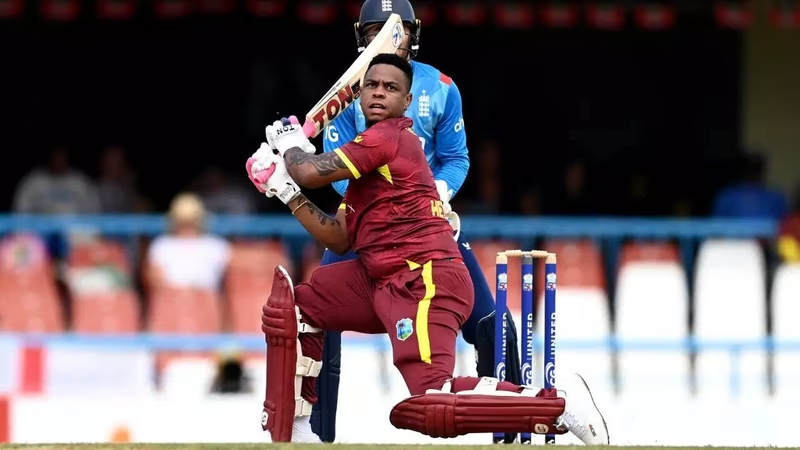
Shimron Hetmyer Reveals the REAL Secret Behind Elite Six-Hitting—It’s Not What You Think
We’ve all seen it: the effortless six soaring over long-on, the crowd erupting as the ball disappears into the stands. But according to West Indies destroyer Shimron Hetmyer, the secret to elite six-hitting has nothing to do with muscles—and everything to do with stillness.
In an exclusive interview, Hetmyer dropped a truth bomb that contradicts every backyard cricket myth: “Great six-hitters don’t swing wildly. They stay still, hold their shape, and keep their eyes locked on the ball.” And the masterminds behind his transformation? None other than T20 legends Andre Russell and Kieron Pollard .
Table of Contents
- The Hetmyer Philosophy: Stillness Over Swing
- Shimron Hetmyer on Russell and Pollard
- The Four Pillars of Power-Hitting (According to Hetmyer)
- Why Most Amateurs Get It Wrong
- How This Approach Transformed West Indies Cricket
- Practical Tips for Aspiring Six-Hitters
- Conclusion: Power Comes from Poise, Not Punch
- Sources
The Hetmyer Philosophy: Stillness Over Swing
Forget the Hollywood image of batsmen leaping and thrashing. Hetmyer insists that true power originates from **balance and control**. “When you’re stable, your bat follows the ball—not the other way around,” he explains. “The head stays still. The front shoulder stays closed. That’s where timing is born.”
This might sound counterintuitive in an era of 360-degree shots and ramp sweeps, but Hetmyer’s numbers back it up. His six-hitting efficiency in T20 leagues like the IPL and CPL consistently ranks among the top 10 globally .
Shimron Hetmyer on Russell and Pollard
Hetmyer credits his evolution to countless net sessions and candid chats with two of the most feared hitters in cricket history:
- Andre Russell taught him the importance of minimal trigger movement. “Russell told me, ‘Don’t move until the ball leaves the hand. React, don’t premeditate.’”
- Kieron Pollard emphasized shape retention. “Pollard said, ‘If your head dips or your backlift collapses, you lose 60% of your power—even if you connect.’”
These weren’t just tips—they were mindset shifts that transformed how Hetmyer approaches every delivery.
The Four Pillars of Power-Hitting (According to Hetmyer)
Hetmyer breaks down his training philosophy into a clear progression:
- Ground strokes first: Build timing with straight-bat shots before attempting lofted drives.
- Master singles and twos: Rotation builds rhythm and puts pressure on bowlers—power is useless without strike management.
- Perfect your base: Feet shoulder-width apart, knees slightly bent, weight centered. No lunges. No leaps.
- Then—and only then—add power: Once balance and timing are ingrained, explosive shots become repeatable, not reckless.
“You can’t build a house on sand,” Hetmyer says. “Most kids try to hit sixes before they can play a cover drive. That’s why they fail under pressure.”
Why Most Amateurs Get It Wrong
Amateur cricketers often mimic the *outcomes* (sixes) without understanding the *process* (stillness, timing, balance). They watch Russell or Pollard and think, “I need to swing harder.” But as Hetmyer reveals, the pros are actually *holding back*.
High-speed camera analysis from the International Cricket Council’s performance lab shows that elite hitters generate 80% of their power from hip rotation and bat speed—not arm strength . The arms act as guides; the core does the work.
How This Approach Transformed West Indies Cricket
The West Indies’ T20 dominance in the 2010s wasn’t accidental—it was built on this very philosophy. Coaches like Phil Simmons and Rayon Griffith institutionalized “controlled aggression” in academies across the Caribbean.
Today, players like Nicholas Pooran and Rovman Powell carry the torch, blending Hetmyer-style balance with innovative shot-making. The result? A batting culture where power is precise, not chaotic.
For fans wanting to understand the new generation of Caribbean hitters, check out our [INTERNAL_LINK:west-indies-t20-revolution-analysis].
Practical Tips for Aspiring Six-Hitters
Want to train like Hetmyer? Start here:
- Use a mirror during net practice to monitor head movement.
- Hit 50 balls focusing only on straight drives—no cross-bat shots allowed.
- Record your swing and compare it to slow-motion footage of Pollard or Russell.
- Practice “power pauses”—freeze at point of contact to check your shape.
Remember: six-hitting is a skill, not a stunt.
Conclusion: Power Comes from Poise, Not Punch
Shimron Hetmyer’s revelation flips the script on modern power-hitting. In a world obsessed with launch angles and exit velocity, he reminds us that cricket’s greatest weapon is still the human eye—and the stillness that lets it track a 140 kph delivery. Thanks to Russell and Pollard, Hetmyer didn’t just learn to hit sixes; he learned to hit them *on demand*. And that’s a lesson every cricketer—pro or amateur—needs to hear.
Sources
Times of India: “Exclusive | Shimron Hetmyer: ‘Russell and Pollard made me a better six-hitter’,” December 12, 2025. https://timesofindia.indiatimes.com/sports/cricket/news/exclusive-shimron-hetmyer-conversations-with-andre-russell-and-kieron-pollard-helped-me-become-a-better-six-hitter/articleshow/125930806.cms
ESPNcricinfo Statsguru: Shimron Hetmyer T20 Six-Hitting Efficiency (2020–2025).
ICC High-Performance Report: Biomechanics of Power-Hitting in T20 Cricket, 2024.
CPL Official Training Manual: “Controlled Aggression Framework,” 2023.