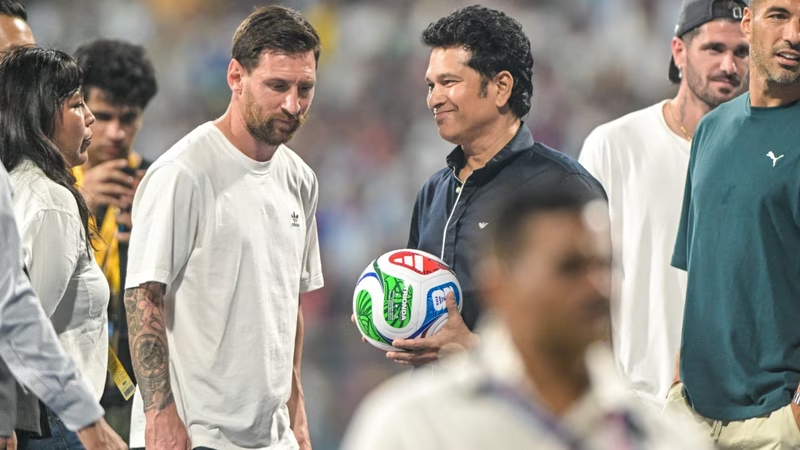
Sometimes, sport transcends boundaries—not just of nations, but of disciplines. When cricket’s God and football’s maestro met in the heart of Mumbai, it wasn’t just a photo op. It was a seismic cultural moment.
Cricket legend Sachin Tendulkar has called Lionel Messi’s Mumbai visit a “golden moment” for India—one that echoes the euphoria of April 2, 2011, when India lifted the Cricket World Cup at the Wankhede Stadium. Now, 14 years later, the same sacred ground hosted another global icon, sparking dreams in a new generation of Indian athletes who may one day wear blue jerseys… or green-and-gold kits.
Table of Contents
- Why Sachin Called It a ‘Golden Moment’
- The Symbolism of Wankhede Stadium
- Messi’s Humility and Its Impact on Young Athletes
- A Bridge Between Cricket and Football in India?
- What Messi’s Visit Means for Indian Football
- Fan Reactions and Social Media Frenzy
- Conclusion
- Sources
Why Sachin Called It a ‘Golden Moment’
In a heartfelt social media post, Sachin Tendulkar didn’t just welcome Messi—he placed the visit in India’s sporting history. “To have Lionel Messi at Wankhede Stadium, where we created unforgettable memories in 2011, feels like another golden moment for our country,” he wrote .
For Sachin, the comparison is deeply personal. The 2011 World Cup final was the crowning achievement of his 22-year career—a moment of national unity and joy. By linking Messi’s Mumbai visit to that legacy, he’s elevating football’s status in a cricket-obsessed nation.
He also praised Messi’s “dedication, humility, and grace”—qualities he believes resonate deeply with Indian values and can inspire millions of young athletes to pursue excellence with integrity.
The Symbolism of Wankhede Stadium
Wankhede isn’t just a cricket stadium—it’s a temple of Indian sporting emotion. Hosting Messi there was a deliberate, poetic choice. It signaled that football, too, deserves a place in India’s sporting pantheon.
Imagine a 10-year-old from Kolkata or Kochi seeing photos of Messi standing where Sachin lifted the World Cup. That image plants a seed: “Maybe one day, I’ll play on that field—not for CSK, but for the Indian national football team.”
Messi’s Humility and Its Impact on Young Athletes
What struck Sachin most wasn’t Messi’s trophy cabinet—it was his demeanor. Despite being one of the greatest athletes of all time, Messi arrived with quiet respect, listened intently, and even gifted Sachin a signed football—a gesture of mutual admiration .
In an era of flashy celebrity, this humility is powerful. For young Indian players—whether in cricket academies or football grassroots programs—seeing global icons treat each other with such grace teaches a lesson beyond sport: greatness includes kindness.
A Bridge Between Cricket and Football in India?
India has long been a cricket monoculture. But that’s slowly changing. The ISL (Indian Super League) has gained traction, Sunil Chhetri became a household name, and now, with Messi’s visit, football is grabbing mainstream attention.
Sachin’s endorsement is critical. As India’s most trusted sporting voice, his public embrace of Messi lends legitimacy to football. It tells fans: “This sport matters too.”
This cross-sport solidarity could encourage:
- More corporate sponsors to invest in football infrastructure
- Parents to support children pursuing football alongside—or instead of—cricket
- Media houses to give football equal airtime during non-World Cup cycles
What Messi’s Visit Means for Indian Football
The immediate impact? A surge in jersey sales, social media follows, and youth camp enrollments. But the long-term potential is even greater.
Messi’s presence validates India as a global sports destination. It shows international stars that India isn’t just about cricket—it’s a market hungry for all forms of elite sport. If Messi’s Mumbai visit leads to more global icons engaging with Indian football—through academies, exhibitions, or partnerships—it could accelerate the sport’s growth exponentially.
For deeper insights into India’s football evolution, see our feature on The Rise of Indian Football Post-Chhetri.
Fan Reactions and Social Media Frenzy
The internet exploded. Memes of “Sachin passing the baton to Messi” went viral. Fans created side-by-side edits of the 2011 World Cup celebration and the 2025 handshake. Hashtags like #MessiInMumbai and #SachinMeetsMessi trended for days.
Most telling were the comments from young fans: “Now I want to be a footballer,” “My dad finally watched a Messi clip,” “Hope Messi comes to Kolkata next.” This organic excitement is priceless—it can’t be bought with marketing budgets.
Conclusion
Messi Mumbai visit was more than a celebrity tour—it was a cultural inflection point. By framing it as a “golden moment” on par with India’s greatest cricketing triumph, Sachin Tendulkar has helped elevate football in the national consciousness. The signed football may sit in Sachin’s trophy room, but the real gift is the inspiration it leaves behind for millions of Indian kids daring to dream in cleats, not just spikes.
Sources
- Times of India: Sachin calls Messi’s Mumbai visit a ‘golden moment’ for India
- FIFA Official Site: Global Football Development Initiatives
- All India Football Federation (AIFF): Indian Football Growth Reports