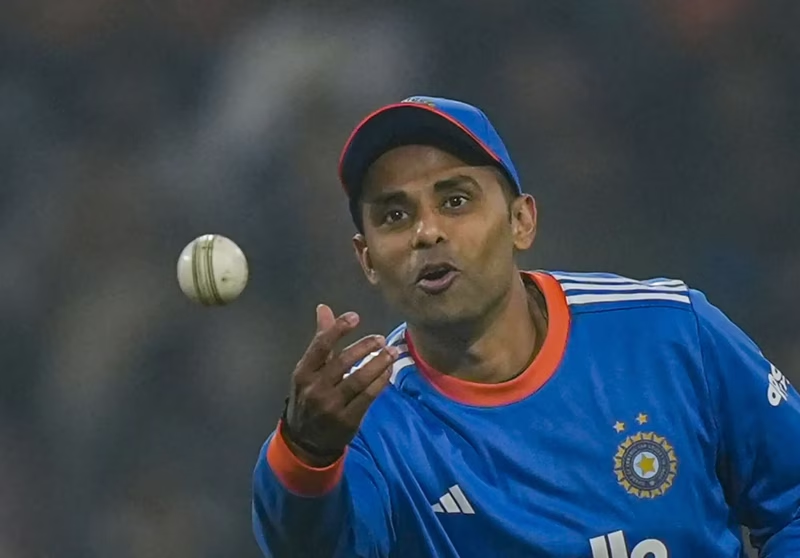
Everyone’s talking about Shubman Gill’s batting woes—but they’re missing the real crisis. According to former India star and 2002 U19 World Cup-winning captain Mohammad Kaif, the far more dangerous problem for Team India lies with Suryakumar Yadav. In a sharp, no-holds-barred assessment, Kaif declared that SKY’s current form slump—and his dual role as captain and batting linchpin—poses a greater threat to India’s T20 World Cup 2026 ambitions than Gill’s recent failures. “India has 10 opening options,” Kaif said. “But you can’t just replace your captain and No. 3 batter overnight.” With the IND vs SA series hanging in the balance and the World Cup less than a year away, this warning couldn’t be more urgent.
Table of Contents
- Why Kaif Believes Suryakumar Yadav Is the Bigger Concern
- The Numbers Behind SKY’s Alarming T20I Slump
- Gill’s Struggles vs. Yadav’s Crisis: A False Equivalence?
- How Captaincy Is Amplifying SKY’s Batting Struggles
- What This Means for India’s T20 World Cup 2026 Blueprint
- When Star Captains Lost Their Spark—And What Happened Next
- Can Suryakumar Yadav Turn It Around in Time?
- Conclusion: Leadership Without Runs Is a Dangerous Equation
- Sources
Why Kaif Believes Suryakumar Yadav Is the Bigger Concern
Mohammad Kaif’s argument hinges on replaceability. Shubman Gill, despite being a regular opener, operates in a role India has historically filled with multiple alternatives—think Yashasvi Jaiswal, Prithvi Shaw, or even Ruturaj Gaikwad. But Suryakumar Yadav? He’s not just the captain; he’s the designated No. 3 batter in high-pressure chases, the 360-degree innovator, and the emotional heartbeat of India’s T20I middle order. “You can shuffle openers,” Kaif emphasized in his interview with Times of India. “But who walks in at No. 3, faces the new ball in a chase, and takes on the spinners with the same fearlessness? That’s irreplaceable.”
The Numbers Behind SKY’s Alarming T20I Slump
The stats don’t lie. In his last 8 T20I innings, Suryakumar Yadav has scored: 4, 12, 7, 18, 9, 22, 5, and 15—an average of just 11.50 and a strike rate below 120. For a player who once held the No. 1 T20I batter ranking and averaged over 40 with a 170+ strike rate, this is a dramatic fall. More concerning? He’s fallen to soft dismissals—slogging to mid-wicket, misreading lengths, and showing uncharacteristic hesitation. In the recent second T20I against South Africa, he admitted, “I should have taken more responsibility.” That self-awareness is good—but results matter more.
Gill’s Struggles vs. Yadav’s Crisis: A False Equivalence?
Let’s compare the two slumps objectively:
- Shubman Gill (last 5 T20Is): Avg 9.20, SR 108 — primarily struggling with intent and pace adaptation.
- Suryakumar Yadav (last 5 T20Is): Avg 10.60, SR 116 — failing in high-leverage No. 3 role with captaincy pressure.
While both are concerning, Yadav’s position is structurally more critical. India can—and likely will—rotate openers. But the No. 3 spot in T20Is has been SKY’s domain since 2022. No other Indian batter has the same mix of creativity, strike rotation, and boundary-hitting under pressure in that role. Losing him as a run-scorer also means losing half the captain’s strategic clarity—since leaders bat with tactical awareness that impacts team flow.
How Captaincy Is Amplifying SKY’s Batting Struggles
Captaincy in T20Is is a double-edged sword. While it can elevate a player’s focus, it also magnifies personal failure. Every dot ball SKY faces isn’t just a personal setback—it’s seen as a team leadership lapse. Former India coach Ravi Shastri once noted, “A captain who doesn’t score runs loses moral authority in the dressing room.” With India’s top order collapsing repeatedly, SKY’s inability to anchor the innings undermines his on-field decisions. Field placements, bowling changes, and power-hitting calls all feel less convincing when the skipper himself isn’t converting starts.
What This Means for India’s T20 World Cup 2026 Blueprint
The ICC Men’s T20 World Cup 2026 will be played across the USA and West Indies—conditions favoring high tempo, innovation, and middle-order firepower. India’s entire strategy has been built around SKY as the pivot. If he remains out of form, the team must either:
- Risk sticking with him, hoping for a turnaround, or
- Radically rethink the batting order—potentially moving Tilak Varma or Rinku Singh to No. 3, which disrupts chemistry.
Neither option is ideal. As the ICC’s 2025 performance review notes, “Teams with a reliable No. 3 batter win 68% more T20Is in global tournaments.” India can ill afford to gamble.
When Star Captains Lost Their Spark—And What Happened Next
History offers cautionary tales. In 2014, MS Dhoni’s batting form dipped during the T20 World Cup, and India lost in the semi-finals. In 2022, Aaron Finch’s slump led Australia to drop him mid-tournament. But there’s also hope: Virat Kohli rebounded from a 2019 World Cup slump to dominate the 2021 T20 World Cup. The difference? Time and support. SKY has only a few months before the next major event—making every innings from here critical.
Can Suryakumar Yadav Turn It Around in Time?
Yes—but it requires brutal honesty. He must simplify his game: fewer reverse sweeps, more orthodox drives, and a focus on rotating strike early. The Dharamsala pitch for the 3rd T20I offers good bounce, perfect for his trademark ramp shots—if he picks the right moments. Mentally, he needs to separate captaincy from batting: “First, be a batter. Then, be a leader.” For deeper tactical advice, see our strategy guide on How T20 Captains Overcome Batting Slumps.
Conclusion: Leadership Without Runs Is a Dangerous Equation
Mohammad Kaif’s warning isn’t just about stats—it’s about structure. India can survive Gill’s slump. But if Suryakumar Yadav doesn’t rediscover his spark soon, the entire T20 World Cup 2026 campaign could unravel from the middle. The captain’s bat must lead before his voice can inspire. The clock is ticking, and Dharamsala might be his last chance to reset before the global stage.
Sources
- Times of India: ‘Surya’s form is bigger concern than Gill’s’: Ex-India cricketer sounds alarm
- ESPNcricinfo Statsguru: Suryakumar Yadav T20I Batting Record
- ICC Performance Review 2025: T20 World Cup Team Strategy Analysis
- PTI Interview Excerpts: Mohammad Kaif on India’s T20I Concerns (Dec 2025)