Sometimes, the best cricket stories aren’t about sixes or wickets—they’re about trust, timing, and a little bit of playful drama.
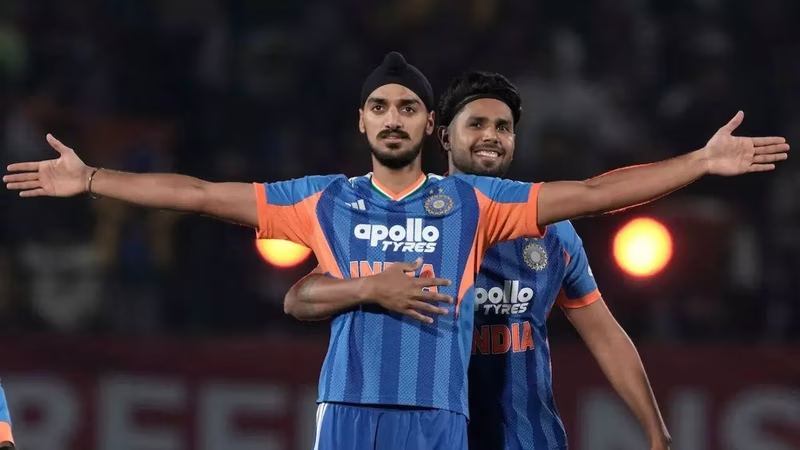
In the aftermath of India’s series-clinching T20I win over South Africa, Arshdeep Singh didn’t just celebrate his Player of the Match performance (a sensational 2/13 in 4 overs). He spilled the beans on one of the match’s most talked-about moments: captain Suryakumar Yadav’s seemingly unnecessary DRS review.
“He just wanted some suspense,” Arshdeep revealed with a laugh—exposing the human, humorous side of high-stakes cricket. But behind the banter lies a deeper narrative: a bowler’s redemption, a team’s return to basics, and the icy conditions of Dharamsala that tested every player’s resolve.
Table of Contents
- The DRS Moment: What Happened and Why SKY’s Call Was Playful
- Arshdeep Singh: Return to Form Through Simplicity
- Why Dharamsala Was a Bowler’s Dream
- Varun Chakaravarthy Hits 50 T20I Wickets in Icy Conditions
- Team Culture: Honest Talk and Focusing on Strengths
- What This Means for India’s T20I Future
- Conclusion
- Sources
The DRS Moment: What Happened and Why SKY’s Call Was Playful
During South Africa’s chase, Arshdeep bowled a delivery that struck Aiden Markram on the pad. The on-field umpire said not out. Captain Suryakumar Yadav immediately signaled for a review—even though replays showed it was sliding down leg.
It was a puzzling move. But as Arshdeep later explained, it wasn’t tactical—it was theatrical. “SKY told me later, ‘I just wanted some suspense!’” he shared, smiling . “We all knew it wasn’t out, but he thought, why not keep the crowd guessing?”
That moment captured the relaxed, confident vibe within the Indian camp—a team no longer burdened by pressure, but playing with freedom and joy.
Arshdeep Singh: Return to Form Through Simplicity
Arshdeep’s figures—2 wickets for just 13 runs—were devastating. But more impressive was his process. After an uncharacteristically expensive outing in the previous match, he didn’t overhaul his action or try new tricks. He went back to basics.
“I just bowled simple lines—good length, hitting the deck hard,” he said . “In Dharamsala, the ball was swinging, so I didn’t need to do much.”
His discipline was evident: 3 dot balls in his first over, a wicket-maiden in his third, and constant pressure that forced errors. This wasn’t just a good spell—it was a masterclass in controlled aggression.
Why Dharamsala Was a Bowler’s Dream
At 1,457 meters above sea level, Dharamsala’s cold, crisp evening created ideal conditions for seam and swing. The pitch had a slight green tinge, offering extra bounce and movement off the surface.
While dew often neutralizes bowling in night games, it was absent this time. “The ball was gripping, and it was swinging both ways,” Arshdeep noted. “You just had to pitch it up and trust the conditions.”
This natural advantage amplified India’s disciplined lines, turning a good bowling unit into an unplayable one.
Varun Chakaravarthy Hits 50 T20I Wickets in Icy Conditions
While Arshdeep stole the spotlight, Varun Chakaravarthy quietly etched his name in history: becoming the second-fastest Indian to 50 T20I wickets (in just 29 matches), behind only Yuzvendra Chahal .
But it wasn’t easy. “It was freezing out there,” Varun admitted. “Gripping the ball was tough, especially with my fingers going numb.”
Despite the cold, his mystery spin remained potent. He bowled with control, mixing googlies and sliders to keep batters guessing. His 1/16 in 4 overs complemented Arshdeep perfectly—proving India’s spin-bowl depth is now a major strength.
Team Culture: Honest Talk and Focusing on Strengths
Both bowlers highlighted the team’s post-loss culture. After their defeat in the second T20I, there were no blame games—just “honest conversations,” as Varun put it.
“We spoke about where we went wrong, but more importantly, we reminded each other of our strengths,” Arshdeep added. “SKY kept saying, ‘Just be yourselves. Stick to your plans.’”
This psychological reset—focusing on identity over panic—was pivotal. It’s a hallmark of mature T20 sides, and India appears to have found that equilibrium under SKY’s leadership.
What This Means for India’s T20I Future
With Arshdeep back in rhythm and Varun crossing milestones, India’s bowling attack now has layers: Bumrah for death, Arshdeep for powerplays, and Varun for middle-over strangulation.
For more on India’s new bowling blueprint, check out our analysis on India’s T20I Bowling Attack Evolution in 2025.
And with the official ICC website tracking player milestones, fans can follow Varun’s rise in real time.
Conclusion
Arshdeep Singh’s 2/13 wasn’t just about numbers—it was about mindset. Paired with Varun Chakaravarthy’s historic 50th wicket and a captain who uses DRS for “suspense,” India’s T20I unit is playing with clarity, chemistry, and a touch of fun. In a format often dominated by batsmen, this match proved that when bowlers click, even 120 is enough. And if this is the new normal, the rest of the cricketing world should be very, very worried.
Sources
- Times of India: ‘Wanted some suspense’: Arshdeep spills the story behind Suryas DRS call
- ICC Player Stats: Varun Chakaravarthy T20I Wicket Milestone
- ESPNcricinfo: India vs South Africa T20I Series 2025