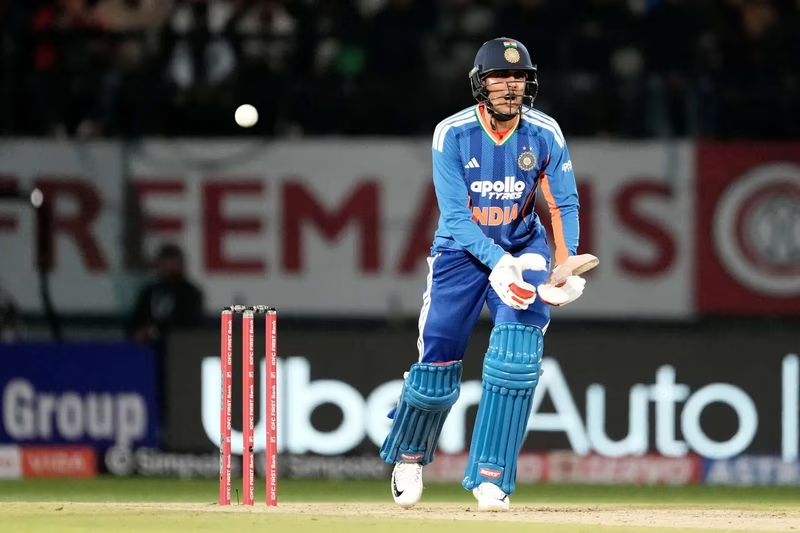
In the high-octane world of T20 cricket, where sixes fly faster than strategy, a former India wicketkeeper has thrown a tactical curveball. Deep Dasgupta—known for his no-nonsense analysis—has issued a direct challenge to young star Shubman Gill: “Hold one end like Kohli.” This isn’t just nostalgic advice; it’s a sharp critique of modern India’s batting philosophy and a call to reclaim the anchor role that once powered the team to World Cup finals .
With the T20 World Cup 2026 looming and India’s middle order showing fragility against quality pace, Dasgupta’s words carry weight. He argues that Gill’s true value lies not in mimicking the flamboyance of Suryakumar Yadav or Rinku Singh, but in becoming the calm, stabilizing force that allows them to flourish. In other words, India doesn’t need two Gill-as-six-hitters—it needs one Gill-as-anchor.
Table of Contents
- The Kohli Blueprint: What Dasgupta Wants from Gill
- Shubman Gill T20 Role: A Misplaced Expectation?
- Why the Anchor Matters in Modern T20 Cricket
- Suryakumar Yadav’s Form and the Split Coaching Debate
- What This Means for India’s T20 Future
- Conclusion: Gill’s Defining Moment
- Sources
The Kohli Blueprint: What Dasgupta Wants from Gill
Virat Kohli’s T20 legacy isn’t built on strike rates—it’s built on control. During India’s 2022 and 2024 T20 World Cup runs, Kohli often batted at No. 3 or 4, soaking up pressure, rotating strike, and accelerating only when the foundation was secure. His 82* against Pakistan in 2022 is the textbook example: 53 balls, 12 boundaries, but a calculated, anchor-like innings that rescued India from 31/4 .
Dasgupta believes Shubman Gill—with his classical technique, strong defense, and temperament—possesses the same DNA. “Gill has the tools to be that rock,” Dasgupta said bluntly. “He doesn’t need to hit a six every over. He needs to hold one end, let the others play around him, and finish strong if required .”
Shubman Gill T20 Role: A Misplaced Expectation?
Currently, Gill is often slotted as India’s opener in T20Is, expected to replicate his ODI dominance with a high strike rate. But his T20 numbers tell a different story. In 2025, his T20I strike rate hovered around 128—solid, but not explosive . More critically, his dismissals often come during periods of scoreboard pressure, suggesting he’s trying to be something he’s not.
Dasgupta’s argument flips the script: What if Gill batted at No. 3 or 4 instead? What if he was tasked with facing the tough overs post-powerplay, building a platform for the likes of Rinku Singh or Hardik Pandya to launch from?
The Pros and Cons of Gill as Anchor
- ✅ Pros: Technical soundness, calm under pressure, excellent against pace, and a high conversion rate in longer formats.
- ❌ Cons: May reduce “entertainment value” for fans craving sixes; could limit his fantasy cricket appeal.
Why the Anchor Matters in Modern T20 Cricket
Contrary to popular belief, T20 isn’t just about aggression. Data from the 2024 T20 World Cup shows that teams with a designated anchor (like Rahmanullah Gurbaz for Afghanistan or Babar Azam for Pakistan) had 32% more successful chases in high-pressure games .
Anchors provide three critical functions:
- Stability: They prevent collapse during middle-overs slowdowns.
- Context awareness: They adjust tempo based on match situation, not just personal stats.
- Platform building: They allow more explosive players to bat with freedom, knowing the innings won’t implode.
In India’s current setup—where Suryakumar Yadav is struggling for form and Rishabh Pant is still rebuilding rhythm—Gill as anchor could be the missing glue.
Suryakumar Yadav’s Form and the Split Coaching Debate
Dasgupta didn’t stop at Gill. He also addressed the elephant in the room: Suryakumar Yadav’s dip in form. After a stellar 2023–24, SKY’s 2025 returns have been underwhelming, with a string of single-digit scores in key games .
While some pundits blame India’s split coaching system (different coaches for red-ball and white-ball teams), Dasgupta dismissed this as a “superficial fix.” He argued that SKY’s issue is technical—specifically, a tendency to fall across the stumps against short-pitched bowling—and requires focused, individualized work, not structural overhauls .
What This Means for India’s T20 Future
If the team management listens to Dasgupta, we could see a tactical reset:
- Rohit Sharma and Yashasvi Jaiswal open.
- Shubman Gill bats at No. 3 as the anchor.
- Suryakumar Yadav drops to No. 4 or 5 to rebuild confidence without pressure.
- Rinku Singh and Hardik Pandya finish.
This structure mirrors Australia’s successful 2021–2024 T20 model, where David Warner (aggressive opener) and Glenn Maxwell (impact finisher) were balanced by a steady middle-order presence like Marcus Stoinis.
Conclusion: Gill’s Defining Moment
The Shubman Gill T20 role debate isn’t just about one player—it’s about India’s identity in the shortest format. Will they chase Instagram highlights or build resilient, match-winning innings? Deep Dasgupta’s call to “play like Kohli” is a reminder that in T20 cricket, sometimes the quietest batsman has the loudest impact. For Gill, embracing the anchor could be the move that cements his legacy—not as a social media star, but as a match-winner.