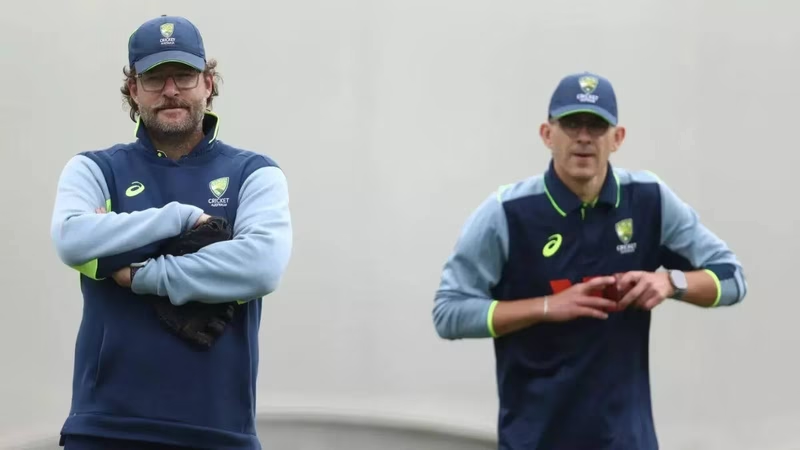
Cricket is a game of contradictions—but few moments in recent Ashes history are as baffling as this: Australia plays a Test match at the Sydney Cricket Ground (SCG) with **no specialist spinner**, even as its own head coach declares that **“spin is incredibly important.”**
With veteran off-spinner Nathan Lyon sidelined due to a hamstring injury, the Australian selectors opted for an all-pace attack in the fifth Ashes Test. This marked the **first time since 1888**—over 135 years ago—that Australia went without a spinner at the SCG, a pitch historically known for offering turn as the match progresses.
The irony? Head coach Andrew McDonald, speaking just before the match, emphasized the growing role of spin in Test cricket. So why did the team do the exact opposite? Let’s unpack the strategy, the history, and the potential fallout of this bold—and risky—call.
Table of Contents
- Why Australia No Spinner Sydney Test?
- Australia No Spinner Sydney Test: A Historic Anomaly
- What the Coach Said: “Spin Is Incredibly Important”
- The Alternatives: Why No Backup Spinner?
- SCG Pitch Conditions and Tactical Trade-Offs
- How England Might Exploit the Absence of Spin
- Broader Implications for Australian Cricket
- Conclusion: A Bold Gamble or a Tactical Blunder?
- Sources
Why Australia No Spinner Sydney Test?
The immediate reason is straightforward: **Nathan Lyon**, Australia’s most capped Test spinner and the lynchpin of their spin attack for over a decade, suffered a **hamstring strain** during the Melbourne Test. His absence left a gaping hole.
But instead of calling up a like-for-like replacement—such as Todd Murphy, Ashton Agar, or young up-and-comer Tanveer Sangha—the selectors doubled down on pace. Pat Cummins, Josh Hazlewood, Mitchell Starc, and Scott Boland formed the four-pronged fast-bowling unit, with part-time tweakers like Marnus Labuschagne and Steve Smith expected to cover overs.
According to team management, the decision was based on **pitch reports and weather forecasts** suggesting a hard, bouncy SCG surface favoring seam and swing early on.
Australia No Spinner Sydney Test: A Historic Anomaly
This isn’t just unusual—it’s **unprecedented in the modern era**. The last time Australia went without a specialist spinner at the SCG was in **1888**, when the game itself looked nothing like it does today.
Even during the dominant eras of Warne or Lyon, Australia always carried at least one frontline spinner in Sydney. The pitch’s tendency to **crack and offer sharp turn on days 4 and 5** makes it a spinner’s paradise in the latter stages. By omitting a specialist, Australia is betting the match will be decided before spin becomes a factor—a high-risk assumption.
What the Coach Said: “Spin Is Incredibly Important”
In the lead-up to the Test, head coach **Andrew McDonald** told reporters: *“Spin bowling is incredibly important in Test cricket, especially in subcontinental conditions—but also in home conditions as pitches age.”*
His statement makes the selection even more puzzling. If spin is “incredibly important,” why not prepare for it? Analysts suggest internal disagreements within the selection panel, or perhaps overconfidence in the pace quartet’s ability to dominate early.
The Alternatives: Why No Backup Spinner?
Several capable spinners were available:
- Todd Murphy: Played in India and showed grit, though inconsistent.
- Ashton Agar: Offers batting depth and left-arm orthodox control.
- Tanveer Sangha: A leg-spinning prodigy with X-factor potential.
None were picked. Some insiders speculate the management wanted to **avoid “disrupting” the pace-heavy rhythm** that won them the series so far. But as [INTERNAL_LINK:australia-spin-crisis-post-lyon] explores, this reflects a deeper lack of investment in spin depth.
SCG Pitch Conditions and Tactical Trade-Offs
Early indicators showed a **greenish tinge and firm bounce**, supporting the fast-bowling theory. But historical data tells another story:
| Year | Top SCG Wicket-Taker | Type |
|---|---|---|
| 2022 | Nathan Lyon | Spinner |
| 2019 | Nathan Lyon | Spinner |
| 2018 | Nathan Lyon | Spinner |
| 2015 | Nathan Lyon | Spinner |
For over a decade, Lyon has **consistently been the leading wicket-taker** at the SCG. Ignoring that trend is a massive gamble.
How England Might Exploit the Absence of Spin
England’s batting lineup features several players **vulnerable to spin**—Joe Root, Harry Brook, and even Ben Stokes on turning tracks. Without a frontline spinner, Australia loses a key weapon to break partnerships on day 4.
Worse, if England posts a big total and forces Australia to bat last on a deteriorating surface, the **lack of a second spinner** could hurt them in the field—since they’ll have no one to contain runs or build pressure from one end while the quicks rotate.
Broader Implications for Australian Cricket
This decision highlights a **systemic issue**: Australia’s overreliance on pace and chronic underdevelopment of spin talent. While nations like India, England, and even New Zealand invest heavily in spin academies, Australia’s pipeline remains thin beyond Lyon.
As Lyon nears retirement, this Sydney Test may be a wake-up call—or a warning of future vulnerabilities, especially in overseas conditions. For more on this trend, see the ICC’s Global Spin Bowling Report.
Conclusion: A Bold Gamble or a Tactical Blunder?
The phrase **“Australia no spinner Sydney Test”** may go down as either a masterstroke of aggressive fast-bowling dominance—or a historic misjudgment that handed England a lifeline in a dead-rubber Test. Coach McDonald’s own words hang heavy in the air: if spin is “incredibly important,” then ignoring it at the SCG isn’t just unusual—it’s potentially reckless.
Only time—and the state of the pitch on days 4 and 5—will tell.
Sources
Times of India. (2026, January 4). Aus coach says ‘spin incredibly important’ as team goes without spinner in Sydney. https://timesofindia.indiatimes.com/…
ESPNcricinfo. (2026). Australia’s SCG spinner drought dates back to 1888. https://www.espncricinfo.com
Cricket Australia. (2026). Post-match presser: Andrew McDonald on bowling options. https://www.cricket.com.au
ICC Research & Innovation – Spin Bowling Trends