Table of Contents
- Ajmal’s Explosive Claim: Is the ICC Truly ‘Unnecessary’?
- The Elephant in the Room: BCCI Dominance
- India, Pakistan, and the ICC’s Powerless Stance
- A History of Silence: Why Other Nations Stay Quiet
- What Does This Mean for the Future of Cricket?
- Conclusion
- Sources
Ajmal’s Explosive Claim: Is the ICC Truly ‘Unnecessary’?
In a statement that has sent shockwaves through the cricketing world, former Pakistan off-spinner Saeed Ajmal has declared the ICC an ‘unnecessary’ entity. His core argument? The global governing body has lost all semblance of impartiality and is now effectively controlled by the Board of Control for Cricket in India (BCCI). “Cricket cannot be run at the behest of one country,” Ajmal stated, highlighting a growing sentiment among many in the sport .
Ajmal’s frustration stems from what he sees as the ICC‘s complete inability to enforce its own rules or mediate fairly between its member nations. For a body tasked with the global development and regulation of the game, such a loss of authority is a damning indictment.
The Elephant in the Room: BCCI Dominance
The crux of Ajmal’s criticism lies in the undeniable financial and political clout wielded by the BCCI. It’s no secret that the Indian board is the financial engine of world cricket. Between 2024 and 2027, the BCCI is projected to earn a staggering $230 million annually from the ICC, which amounts to a colossal 38.5% share of the ICC’s total annual earnings of $600 million .
This financial leverage translates directly into political influence. While the ICC is supposed to be a council of equals, the reality is that decisions often appear to be made with the BCCI’s interests at the forefront. This perceived BCCI dominance creates an uneven playing field where smaller nations feel their voices are drowned out by the sheer economic power of the Indian board. The irony is further deepened by the fact that Jay Shah, the current ICC Chairman, is also the Secretary of the BCCI, a situation that many critics argue presents a clear conflict of interest .
India, Pakistan, and the ICC’s Powerless Stance
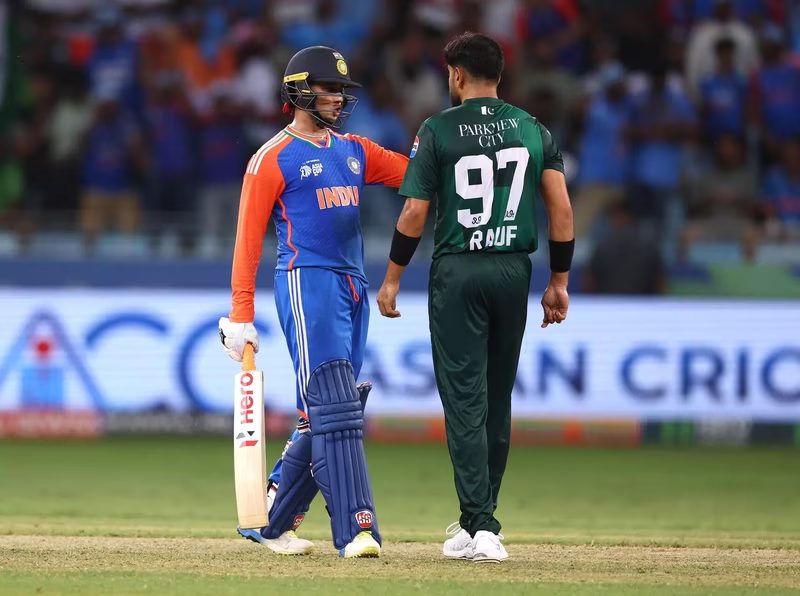
Ajmal pointed to the most glaring example of the ICC‘s impotence: the ongoing bilateral deadlock between India and Pakistan. Since the 2008 Mumbai terror attacks, India has refused to play any bilateral cricket series in Pakistan, a stance dictated by its government rather than its cricket board .
While the two teams still meet in ICC events, the refusal to tour Pakistan has significant consequences. It deprives the Pakistan Cricket Board (PCB) of crucial revenue from a marquee series and prevents fans in Pakistan from witnessing their heroes play against their biggest rivals on home soil. Despite this clear breach of the spirit of international sport, the ICC has been powerless to intervene, effectively allowing a political decision to dictate the sporting calendar. As Ajmal noted, this failure to ensure fair play for all nations is what renders the council’s role “insignificant” .
A History of Silence: Why Other Nations Stay Quiet
One of the most intriguing aspects of Ajmal’s outburst is his assertion that many other cricketing nations privately agree with his assessment but are too afraid to speak out. This culture of silence is rooted in fear—fear of losing lucrative tours to India, fear of being sidelined in future tournament scheduling, and fear of financial repercussions.
The BCCI’s control over the IPL, the world’s richest T20 league, gives it immense power over players from every nation. A public criticism could potentially jeopardize a player’s chances of being picked for an IPL franchise, creating a powerful deterrent against dissent. This dynamic has created a system where challenging the status quo is seen as a career-limiting move, both for administrators and players alike.
What Does This Mean for the Future of Cricket?
Ajmal’s comments raise profound questions about the future of the sport:
- Can the ICC regain its authority? Without a fundamental restructuring of its funding model to reduce reliance on a single board, its ability to act as a neutral arbiter remains in serious doubt.
- Will other nations find their voice? For real change to happen, a coalition of other Full Member nations would need to collectively demand a more equitable governance structure.
- Is a two-tier system inevitable? The current trajectory suggests a future where the ‘Big Three’ (India, Australia, England) operate in a separate financial and political sphere from the rest of the cricketing world, further marginalizing already struggling boards like the PCB.
Conclusion
Saeed Ajmal’s declaration that the ICC is ‘unnecessary’ is less a call for its abolition and more a desperate plea for it to reclaim its original purpose. His criticism, centered on BCCI dominance and the council’s failure to ensure a level playing field, resonates with a widespread feeling of disenfranchisement among many cricket-loving nations. Until the ICC can demonstrate true independence and enforce its rules impartially—especially in politically sensitive matters like the India-Pakistan standoff—it will continue to face accusations of being a mere figurehead for the sport’s wealthiest power broker. The health of international cricket depends on its ability to answer this challenge.
Sources
- Times of India: ‘ICC’s existence is unnecessary’: Ex-Pakistan cricketer’s explosive attack on BCCI dominance
- ESPNCricinfo: BCCI set to get nearly 40% of ICC’s annual net earnings
- The Guardian: ‘ICC should not schedule India-Pakistan matches until they play bilaterally’
- ICC Official Website: Governance Structure