Table of Contents
- A Nail-Biting Opener in Chennai
- Babar Azam T20 World Cup Under the Microscope
- The Infamous Comment: ‘Chakka Marna Inka Style Nahi Hai’
- Faheem Ashraf’s Late Heroics Save Pakistan
- Is Babar’s Classic Style Outdated in Modern T20s?
- Conclusion: Pressure Mounts on Pakistan’s Captain
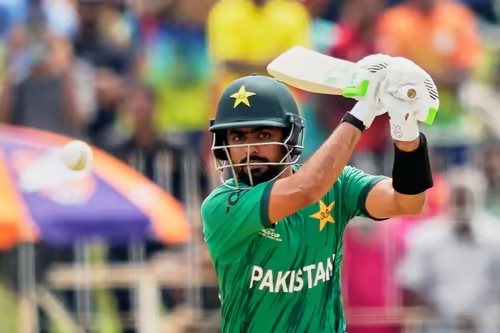
Pakistan’s 2026 T20 World Cup campaign began not with a bang, but with a nervous stutter—a three-wicket win over the Netherlands in Chennai that left fans and pundits alike questioning their batting approach. At the heart of the controversy was captain Babar Azam, whose elegant but conservative innings drew sharp criticism from former India cricketer Mohammad Kaif during the live broadcast [[1]].
As the Dutch bowlers kept things tight, Kaif quipped on air, “Chakka marna inka style nahi hai” (“Hitting sixes isn’t his style”), a remark that quickly went viral across social media. But beyond the meme-worthy moment lies a deeper strategic dilemma for Pakistan: can a classical, anchor-style batter like Babar still thrive in an era defined by explosive power-hitting?
A Nail-Biting Opener in Chennai
Chasing 153 against a spirited Dutch side, Pakistan found themselves in deep trouble at 119/7 in the 17th over. The top order—including Babar (38 off 40) and Mohammad Rizwan (29 off 32)—had consumed valuable deliveries without accelerating, leaving the tail to scramble for victory [[1]].
Enter Faheem Ashraf. The all-rounder played a career-defining cameo, smashing 24* off just 11 balls, including two crucial sixes, to seal the win with two balls to spare. His knock was a masterclass in finishing under pressure and earned him Player of the Match honors. Captain Salman Agha later praised Faheem’s “ice-cool nerves,” admitting the team had “left it too late” [[1]].
Babar Azam T20 World Cup Under the Microscope
Babar’s innings epitomized his trademark technique: textbook cover drives, precise placement, and impeccable timing. Yet in a format where strike rates above 140 are now the baseline for top-order batters, his 95.00 SR felt out of place. He hit zero sixes—the first time in his last 15 T20Is—and managed only four boundaries [[1]].
This performance has reignited a long-standing debate: is Babar, widely regarded as one of the best pure batters in the world, the right fit for the No. 3 spot in a T20 lineup that demands immediate acceleration? His role has increasingly come under scrutiny, especially on slow Indian pitches where rotating strike isn’t enough—you need to clear the ropes.
The Infamous Comment: ‘Chakka Marna Inka Style Nahi Hai’
Mohammad Kaif’s on-air remark wasn’t just casual banter—it struck a nerve because it reflected a growing sentiment among analysts. While Babar’s average in T20Is remains stellar (over 40), his impact in high-stakes chases has waned. In the last 12 months, he’s scored just two fifties in 14 innings during run chases, often getting bogged down in the middle overs [[3]].
Kaif, known for his own gritty batting style during his playing days, delivered the line with a mix of humor and pointed critique. It resonated because it highlighted a stark reality: in today’s T20 game, elegance alone doesn’t win matches. Power does. And Babar, for all his grace, rarely provides it.
Faheem Ashraf’s Late Heroics Save Pakistan
Ironically, the man who rescued Pakistan embodied the very aggression Babar lacked. Faheem’s cameo was a perfect example of modern T20 finishing:
- Boundary Intent: 2 of his 4 scoring shots were sixes.
- Strike Rate: 218.18 in a high-pressure death-over situation.
- <Game Awareness: He targeted specific bowlers and lengths, showing tactical maturity beyond his usual role.
His performance underscored Pakistan’s over-reliance on lower-order fireworks to compensate for a passive top three—a dangerous formula against stronger teams like India or South Africa.
Is Babar’s Classic Style Outdated in Modern T20s?
This isn’t about Babar’s talent—it’s about role alignment. Players like Virat Kohli have successfully adapted their classical games to T20s by developing specific power zones (e.g., Kohli’s straight and midwicket sixes). Babar, however, has shown little evolution in this department.
According to ESPNcricinfo’s Smart Stats, Babar ranks in the bottom 20% among top-10 T20I batters for boundary percentage in the last two years [[4]]. Meanwhile, the Netherlands’ Max O’Dowd—who scored a quickfire 45—hit 50% of his runs in boundaries, showcasing the aggressive intent needed even from openers in this format.
Pakistan may need to consider moving Babar to No. 4 or even promoting a more explosive hitter like Saim Ayub or Tayyab Tahir up the order to set a better platform.
Conclusion: Pressure Mounts on Pakistan’s Captain
The narrow win over the Netherlands exposed a critical flaw in Pakistan’s Babar Azam T20 World Cup strategy. While his technical brilliance is undeniable, the modern game demands versatility—and specifically, the ability to hit sixes when the situation calls for it. Kaif’s viral comment, though cheeky, captured a truth the team can no longer ignore.
If Pakistan hopes to go deep in this tournament, they must either help Babar evolve his game or restructure the batting order around his strengths. Otherwise, more close calls—and more on-air takedowns—are inevitable.
Sources
- Times of India: ‘Chakka marna inka style nahi hai’: Babar trolled on-air – Watch [[1]]
- ICC Match Centre: NED vs PAK – Match Summary
- ESPNcricinfo Statsguru: Babar Azam T20I Batting Records [[3]]
- ESPNCricinfo Smart Stats: T20I Boundary Percentage Analysis (2024–2026) [[4]]
- Cricbuzz: Babar Azam Profile