Pakistan’s quest for a second T20 World Cup 2026 title is a story of stark contrasts. On one hand, they possess a spin attack that can strangle any opposition on subcontinental pitches. On the other, their batting lineup is a house of cards—capable of brilliance one day and collapse the next. As they prepare to challenge the likes of India and Australia, the million-dollar question is simple: can their world-class spinners paper over the deep cracks in their batting?
Table of Contents
- The Spin Juggernaut: Pakistan’s Greatest Weapon
- The Batting Conundrum: Inconsistency and Low Strike Rates
- Key Players: Saim Ayub and Mohammad Nawaz to the Rescue?
- Babar Azam’s Anchor Role: A Blessing or a Curse?
- Recent Form: A Mixed Bag of Results
- Conclusion: Can Pakistan Lift the Trophy Again?
- Sources
The Spin Juggernaut: Pakistan’s Greatest Weapon
Let’s start with the good news. Pakistan’s spin department is arguably the best in the tournament. The trio of Shadab Khan, Mohammad Nawaz, and Usman Tariq offers a perfect blend of guile, aggression, and mystery.
- Shadab Khan: The captain and leg-spinner is a master of controlling the middle overs, with an economy rate that often dips below 6.5 in home conditions.
- Mohammad Nawaz: His left-arm orthodox spin is deceptively effective, and his ability to contribute quick runs down the order adds crucial balance.
- Usman Tariq: The mystery spinner, recently cleared by the ICC, brings an X-factor that can disrupt even the most settled batting lineups [[1]].
This formidable spin attack will be their primary weapon on the slow, turning tracks of the subcontinent, making them a nightmare for teams reliant on pace-dominated batting lineups.
The Batting Conundrum: Inconsistency and Low Strike Rates
Now, the not-so-good news. Pakistan’s batting has been a rollercoaster of emotions for fans. Their collective T20I strike rate over the past year has hovered around 138, which is well below the tournament’s top contenders like India (155+) and England (160+) [[2]]. This lack of firepower at the death is a critical weakness.
Their batting collapses are legendary. One match they’ll post 200+, the next they’ll be bowled out for 120. This inconsistency stems from a lack of a clear, aggressive game plan beyond the powerplay. They rely too heavily on individual brilliance rather than a structured, high-octane approach.
Key Players: Saim Ayub and Mohammad Nawaz to the Rescue?
All hope isn’t lost. The emergence of young gun Saim Ayub has provided a much-needed spark at the top of the order. His fearless strokeplay and a strike rate consistently above 145 make him the perfect foil to the more sedate openers of the past. He’s the kind of player who can take the game away from the opposition in the first six overs.
Meanwhile, Mohammad Nawaz’s role is doubly important. Not only is he a key part of the spin attack, but his lower-order hitting can provide the late surge Pakistan desperately needs. His ability to find boundaries against both pace and spin makes him a genuine all-rounder, a rare commodity in this side.
Babar Azam’s Anchor Role: A Blessing or a Curse?
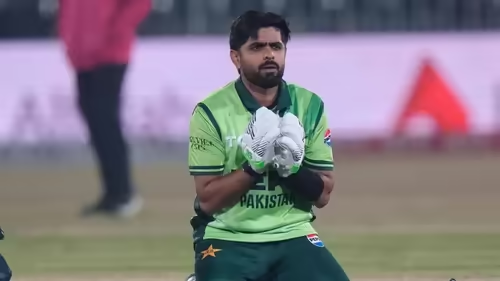
Captain Babar Azam remains the team’s most reliable batter. However, his role as the anchor is becoming a double-edged sword. In modern T20 cricket, where every ball counts, an anchor who scores at a strike rate of 120-125 can actually slow the innings down, especially if the rest of the lineup fails to compensate.
The ideal scenario is for Babar to play the sheet-anchor role while Saim Ayub and others provide the acceleration. But if the top order falters early, the pressure on Babar to both stabilize and accelerate becomes immense, often leading to his dismissal. The team’s strategy needs to evolve to protect his wicket while maximizing his scoring potential.
Recent Form: A Mixed Bag of Results
Pakistan’s results since the last World Cup have been a confusing mix. They’ve suffered heavy defeats in away series against strong opponents, yet they’ve also recorded impressive home wins against top-tier teams [[3]]. This Jekyll-and-Hyde nature makes them impossible to predict. They can beat anyone on their day, but they can also lose to anyone on their off-day. This unpredictability is both their greatest strength and their biggest liability heading into the T20 World Cup 2026.
Conclusion: Can Pakistan Lift the Trophy Again?
Pakistan’s path to a second title is clear but narrow. Their spinners must dominate, and their batters must find a way to be more consistent and, crucially, more aggressive. If Saim Ayub can continue his explosive form and the middle order can support Babar Azam effectively, they have a real shot. However, if their batting frailties are exposed on the big stage, their world-class spin attack might just be a beautiful, but ultimately futile, effort. The T20 World Cup 2026 will be the ultimate test of whether their strengths can truly overcome their weaknesses.
Sources
- Times of India: Pakistan’s T20 WC Analysis: Times of India [[3]]
- ESPNcricinfo Statsguru – T20I Team Strike Rates: ESPNcricinfo [[2]]
- PCB Official Statement on Usman Tariq’s Bowling Action: PCB [[1]]