Table of Contents
- More Than a Trophy: A Homeland Dream
- Rashid Khan Afghanistan Cricket Dream Explained
- Why Afghanistan Can’t Host International Cricket
- The Domestic League Deficit
- Natural Talent vs. Structured Development
- Global Support and the Path Forward
- Conclusion: A Dream Worth Fighting For
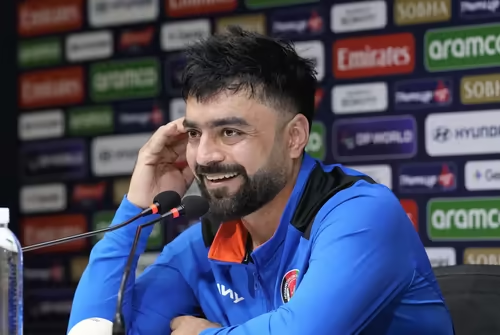
In a world where cricketers chase trophies, rankings, and billion-dollar contracts, Rashid Khan has a different kind of ambition—one that transcends sport. Speaking ahead of the 2026 T20 World Cup, the Afghan superstar revealed that his greatest dream isn’t hoisting the World Cup; it’s something far more profound: playing an official international match on home soil [[1]].
“It’s bigger than the World Cup,” Rashid said with quiet conviction. This simple yet powerful statement cuts to the heart of Afghan cricket’s paradox: a team that regularly defeats Test-playing nations on foreign pitches but has never hosted a single men’s ODI or T20I in its own country. Let’s explore why this dream remains unfulfilled—and what it would mean if it ever came true.
More Than a Trophy: A Homeland Dream
For most nations, hosting international cricket is routine. But for Afghanistan, it’s a symbol of normalcy, stability, and national pride. The team’s rise from refugee camps in Pakistan to the upper echelons of world cricket is one of sport’s greatest underdog stories. Yet their journey has been entirely nomadic—playing “home” games in India, UAE, Sri Lanka, and Zimbabwe.
Rashid, now 27, has spent his entire career representing Afghanistan without ever doing so in front of a home crowd. Imagine carrying your nation’s hopes across continents while knowing you can’t share your triumphs with the people who need them most. That’s the emotional weight behind his words.
Rashid Khan Afghanistan Cricket Dream Explained
Rashid’s dream isn’t just about nostalgia—it’s about legacy and infrastructure. In his recent interview, he emphasized two critical needs for Afghan cricket’s future:
- Hosting international matches in Afghanistan: To inspire the next generation and prove the country can be safe and welcoming for global sport.
- Building a robust domestic league: To move beyond reliance on raw talent and create a sustainable pipeline of skilled, tactically aware players.
“We have natural ability,” Rashid noted, “but without proper competition at home, we’re always playing catch-up.” This candid admission reveals a deeper truth: talent alone isn’t enough in modern cricket [[1]].
Why Afghanistan Can’t Host International Cricket
The barriers are primarily political and security-related. Despite the ICC granting Afghanistan Full Member status in 2017, no international team has toured the country since the Taliban’s return to power in 2021. Key concerns include:
- Security Risks: Foreign governments maintain strict travel advisories against visiting Afghanistan, making player safety a non-negotiable issue for boards like BCCI, CA, and ECB.
- Lack of Infrastructure: While Kabul’s Ghazi Stadium has hosted domestic matches, it lacks the facilities (media centers, floodlights, accreditation zones) required for international fixtures.
- Political Isolation: The current regime’s international recognition remains limited, complicating diplomatic clearances for tours.
As a result, Afghanistan’s “home” series are played in the UAE—a logistical and emotional compromise that distances players from their roots.
The Domestic League Deficit
Rashid’s call for a stronger domestic structure is equally urgent. Currently, Afghanistan’s top competition—the Shpageeza Cricket League—is a short, six-team T20 tournament held annually in Kabul. While it showcases local talent, it lacks:
- Multi-format exposure (no first-class or List A structure)
- Consistent scheduling and funding
- Integration with regional pathways (e.g., connections to Asian or ICC development programs)
Compare this to India’s Ranji Trophy or England’s County Championship—systems that produce technically sound, adaptable players over decades. Without such a foundation, Afghan cricketers rely heavily on instinct, which works brilliantly in T20s but falters in longer formats.
Natural Talent vs. Structured Development
Afghanistan’s golden generation—Rashid, Mohammad Nabi, Mujeeb Ur Rahman—learned cricket in Peshawar’s refugee camps, using taped tennis balls and makeshift stumps. Their genius was forged in adversity. But as Rashid himself acknowledges, this model isn’t scalable.
“Today’s kids need coaches, gyms, video analysis—not just passion,” he said [[1]]. The next Rashid Khan might be in Kandahar right now, but without access to structured coaching or competitive leagues, that potential could go unrealized. This is why investing in grassroots and domestic cricket is as vital as dreaming of home internationals.
Global Support and the Path Forward
There are glimmers of hope. The ICC has allocated $5 million in annual funding to Afghanistan’s cricket board (ACB) for development [[3]]. Additionally, neutral venues like Oman and Sri Lanka have offered to co-host “Afghan home” series with symbolic elements—local fans, Dari commentary, Afghan flags.
But real progress requires bolder steps:
- The ICC could pilot a “safe-zone” exhibition match in Kabul with local spectators only.
- Neighboring boards (like Pakistan or Bangladesh) could initiate bilateral talks for future tours.
- Private investment in a franchise-based league (similar to the Lanka Premier League) could professionalize the domestic scene.
For more on how other nations rebuilt cricket post-conflict, see our feature on [INTERNAL_LINK:cricket-revival-in-sri-lanka-post-war].
Conclusion: A Dream Worth Fighting For
Rashid Khan’s longing to play for Afghanistan in Afghanistan isn’t just personal—it’s national. It’s about reclaiming identity, inspiring youth, and proving that sport can thrive even after decades of war. While the Rashid Khan Afghanistan cricket dream may seem distant today, it’s not impossible. With sustained investment, global empathy, and political will, the day could come when the roar of a home crowd greets Afghanistan’s heroes—not in Sharjah or Colombo, but in Kabul itself.
Sources
- Times of India: ‘Bigger than WC’: Rashid Khan’s one dream Afghanistan cricket still can’t fulfil [[1]]
- ICC Official Site: ICC Announces Funding for Member Nations (2026) [[3]]
- ESPNcricinfo: Afghanistan Cricket Board’s Development Roadmap
- Al Jazeera: Can Afghanistan Ever Host International Cricket?
- Wisden: Rashid Khan on the Future of Afghan Cricket