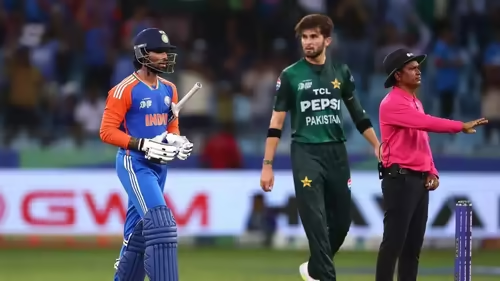
The most anticipated fixture of the ICC Men’s T20 World Cup 2026 is just days away—and the mind games have already begun. In a candid admission that sent ripples through cricket circles, India’s assistant coach Ryan ten Doeschate acknowledged that Pakistan may hold a subtle but significant edge ahead of their February 15 blockbuster in Colombo. “Going to Colombo will be a challenge,” he said, pointing to Pakistan’s smoother logistics and acclimatization as key factors [[1]].
Yet, in the same breath, Ten Doeschate shut down speculation that off-field distractions or venue uncertainty have derailed India’s preparations for the India vs Pakistan T20 World Cup 2026 showdown. “We’ve always been mentally prepared for this game,” he emphasized, reinforcing a message of focus and discipline from within the camp [[1]].
Table of Contents
- Why Colombo Poses a Unique Challenge for India
- Pakistan’s Logistical Advantage: What Ten Doeschate Meant
- “Always Mentally Prepared”: India’s Mindset Revealed
- Abhishek Sharma’s Illness Adds Selection Headache
- Sanju Samson: The Likely Replacement?
- Tactical Outlook: How India Can Neutralize Pakistan’s Edge
- Conclusion: More Than Just a Game—A Test of Nerves
- Sources
Why Colombo Poses a Unique Challenge for India
While both teams are based in India for the initial leg of the tournament, the India-Pakistan match is scheduled at the R. Premadasa Stadium in Colombo, Sri Lanka—a neutral venue chosen by the ICC amid security and diplomatic considerations [[3]].
For India, this means last-minute travel, unfamiliar hotel arrangements, and limited practice time on the actual pitch. In contrast, Pakistan has been using Colombo as a secondary base since early February, playing warm-up matches and even their Group A opener against the USA there [[4]]. This gives them crucial familiarity with pitch behavior, outfield speed, and local conditions—advantages that can’t be overstated in T20 cricket.
Pakistan’s Logistical Advantage: What Ten Doeschate Meant
Ten Doeschate’s comment wasn’t about skill—it was about setup. “They’ve been there. They’ve played there. We’re coming in cold,” he implied [[1]].
This logistical head start translates into tangible benefits:
- Pitch knowledge: Pakistan knows how the ball grips, turns, or skids on the Premadasa surface.
- Routine stability: No jet lag, no new food, no disrupted sleep cycles.
- Fielding comfort: Familiarity with boundary dimensions and dew patterns in evening games.
In a contest expected to be decided by fine margins, these micro-advantages could prove decisive.
“Always Mentally Prepared”: India’s Mindset Revealed
Despite the external hurdles, Ten Doeschate was adamant that internal focus remains razor-sharp. “The narrative around this game is always loud, but inside the dressing room, it’s just another match we need to win,” he stated [[1]].
This reflects head coach Gautam Gambhir’s philosophy: treat every game with equal intensity, regardless of opponent. The Indian squad has reportedly held specialized simulation sessions—mimicking Colombo’s pitch reports and crowd noise—to bridge the experience gap. Mental conditioning, not just physical readiness, is their counter-strategy.
Abhishek Sharma’s Illness Adds Selection Headache
Complicating matters further is the fitness of opener Abhishek Sharma, who missed India’s final training session in Delhi due to a stomach bug [[5]]. After scoring a golden duck against the USA and exiting the field early, his availability for the Pakistan clash is now in serious doubt.
While Ten Doeschate didn’t confirm a replacement, he hinted at flexibility: “We have multiple options who can step up.” With only two days between the Namibia and Pakistan matches, resting Abhishek—even if he recovers—could be a smart move to ensure full match fitness for the bigger battle.
Sanju Samson: The Likely Replacement?
All signs point to Sanju Samson slotting in if Abhishek is ruled out. Samson offers explosive batting, wicketkeeping cover, and calm temperament under pressure—qualities vital for a high-stakes encounter.
His inclusion could also allow India to rejig the batting order, perhaps promoting Rishabh Pant to open or using Yashasvi Jaiswal as a floater. Either way, India’s depth gives them a luxury few teams enjoy.
Tactical Outlook: How India Can Neutralize Pakistan’s Edge
To overcome Pakistan’s home-like advantage in Colombo, India must execute three key strategies:
- Early wickets: Target Babar Azam and Mohammad Rizwan with Jasprit Bumrah and Arshdeep Singh in the powerplay.
- Spin control: Use Kuldeep Yadav and Axar Patel to stifle middle-overs acceleration on a pitch that may offer turn.
- Aggressive starts: Regardless of who opens, India must chase or set a tempo that denies Pakistan psychological control.
If they nail this trifecta, the logistical edge becomes irrelevant.
Conclusion: More Than Just a Game—A Test of Nerves
The India vs Pakistan T20 World Cup 2026 clash is never just about runs and wickets—it’s a global spectacle steeped in history, emotion, and expectation. Ryan ten Doeschate’s honesty about Pakistan’s Colombo advantage shows India isn’t underestimating the challenge. But their unwavering mental preparation, tactical depth, and ability to adapt could be the ultimate equalizers. As fans count down to February 15, one truth remains: in cricket’s greatest rivalry, heart often beats logistics.