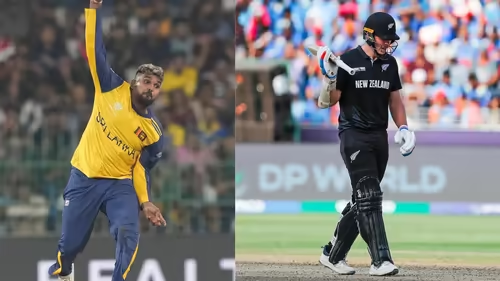
The ICC Men’s T20 World Cup 2026 has taken a dramatic turn with a double injury blow that could reshape the fate of two top contenders. In a development that sent shockwaves through the cricketing world, **Sri Lanka and New Zealand T20 World Cup injury** crises have sidelined their most valuable all-rounders—Wanindu Hasaranga and Michael Bracewell—just as the tournament enters its critical phase [[1]].
Table of Contents
- Hasaranga’s Hamstring Tear: A Devastating Loss for Sri Lanka
- Bracewell’s Calf Strain: New Zealand’s Mid-Tournament Nightmare
- Meet the Replacements: Hemantha and McConchie Step Up
- Tactical Fallout: How Squad Changes Alter Game Plans
- Group Stage Pressure Mounts Amid Replacement Uncertainty
- Conclusion: Resilience Tested in High-Stakes Tournament
- Sources
Hasaranga’s Hamstring Tear: A Devastating Loss for Sri Lanka
Wanindu Hasaranga isn’t just a player—he’s the heartbeat of Sri Lanka’s T20 setup. The leg-spinning all-rounder, known for his match-winning spells and explosive lower-order hitting, suffered a **grade 2 hamstring tear** during training ahead of Sri Lanka’s crucial Group B fixture [[3]].
Medical scans confirmed the severity, ruling him out for the remainder of the tournament. His absence creates a massive void: not only does Sri Lanka lose their primary wicket-taking spinner, but they also forfeit a finisher who can clear boundaries under pressure. In a format where balance is everything, losing such a dual-threat player is catastrophic.
Bracewell’s Calf Strain: New Zealand’s Mid-Tournament Nightmare
Across the bracket, New Zealand faces a parallel crisis. Michael Bracewell, their dependable left-arm spinner and middle-order stabilizer, has been ruled out due to a **calf muscle strain** sustained during their last match [[5]].
Bracewell’s role was multifaceted: he controlled the middle overs with his economical spin and often anchored chases with calm, calculated batting. Without him, the Black Caps lose crucial depth in both departments—a luxury few teams can afford in a high-intensity global event like the T20 World Cup.
Meet the Replacements: Hemantha and McConchie Step Up
Both teams have moved swiftly to name replacements approved by the ICC:
- Sri Lanka has called up off-spinner Dushan Hemantha, a seasoned domestic performer with experience in subcontinental conditions. While not as explosive as Hasaranga, Hemantha offers control and can chip in with the bat [[7]].
- New Zealand has turned to utility all-rounder Cole McConchie, who brings seam-bowling versatility and gritty batting. He’s played limited international cricket but is known for his composure in pressure situations [[8]].
Neither replacement replicates the exact skill set of the injured stars, forcing both coaching staffs to rethink their core strategies.
Tactical Fallout: How Squad Changes Alter Game Plans
The impact goes beyond personnel—it reshapes entire game plans:
- For Sri Lanka: They may now rely more heavily on Maheesh Theekshana and Jeffrey Vandersay in the spin department, while promoting Dasun Shanaka or Dunith Wellalage higher up the order to compensate for lost firepower.
- For New Zealand: With Bracewell gone, Mitchell Santner will shoulder extra overs, and Glenn Phillips might need to take on more responsibility in the middle order. The team could also consider a three-seamers-plus-one-spinner approach, which is unusual for them in Asian conditions [[10]].
These adjustments come at a time when consistency is key—making adaptation a high-risk gamble.
Group Stage Pressure Mounts Amid Replacement Uncertainty
Both Sri Lanka and New Zealand sit in competitive groups where every point matters. Sri Lanka is in Group B alongside India, Australia, and Afghanistan, while New Zealand battles it out in Group A with Pakistan, South Africa, and the USA [[12]].
Losing key players mid-tournament disrupts rhythm, chemistry, and confidence. New call-ups like Hemantha and McConchie will need immediate integration—a tall order in a short-format global event. Fantasy cricket managers and fans alike are watching closely to see if these squads can weather the storm without their linchpins.
Conclusion: Resilience Tested in High-Stakes Tournament
The Sri Lanka and New Zealand T20 World Cup injury setbacks are a stark reminder of cricket’s physical toll and unpredictability. While Hasaranga and Bracewell’s absence is a severe blow, it also presents an opportunity for emerging talents to rise. History shows that World Cup winners aren’t just built on star power—they’re forged through adversity, adaptability, and collective grit. Whether Colombo or Christchurch fans can find solace in that remains to be seen—but one thing’s certain: the road to the Super 8s just got a lot tougher for both sides.