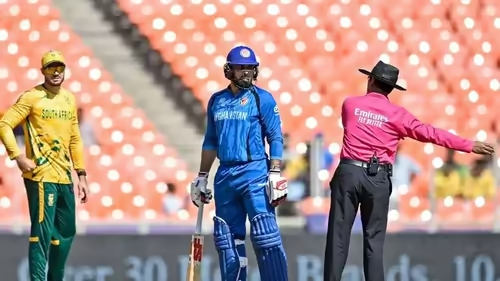
It was a match for the ages—a nail-biting, nerve-shredding epic that pushed the T20 format to its absolute limits, requiring not one, but two Super Overs to separate Afghanistan and South Africa. In the end, the Proteas emerged victorious, but the real story that has captured the cricketing world’s attention is the costly moment of dissent from Afghanistan’s veteran all-rounder, Mohammad Nabi [[1]].
Amidst the high drama of the extended contest, Nabi found himself at the center of a controversial confrontation with the on-field umpires. The issue? A seemingly innocuous wristband on a South African bowler. What followed was a chain of events that led to a formal sanction, adding a bitter footnote to an already heartbreaking loss for the Afghans.
Table of Contents
- The Epic Double Super Over Thriller
- The Mohammad Nabi Umpire Dispute Explained
- The Official Sanction and Its Implications
- Why the Wristband Rule Matters in T20 Cricket
- The Psychological Impact on Afghanistan
- Conclusion: A Costly Moment in an Unforgettable Match
- Sources
The Epic Double Super Over Thriller
Before the controversy, there was pure, unadulterated sporting theatre. Both teams were locked in a fierce battle, showcasing exceptional skill and resilience. The match ended in a tie, forcing a first Super Over. That too ended level, leading to the rare spectacle of a second Super Over—a scenario so uncommon it had only happened a handful of times in international cricket history [[2]].
South Africa, displaying remarkable composure under immense pressure, held their nerve in the second decider to secure a famous victory. The match will be remembered for its sheer intensity and the incredible skill on display from both sides.
The Mohammad Nabi Umpire Dispute Explained
The controversy erupted during the tense final overs of the main match. Nabi, who was captaining the side in the absence of the regular skipper, noticed that a South African bowler was wearing a wristband that he believed violated ICC regulations regarding external objects that could potentially be used to alter the condition of the ball [[3]].
Nabi approached the umpires to lodge a formal complaint. However, the situation escalated when he allegedly continued to argue and disobey the umpires’ instructions to return to his fielding position and cease his protest. His persistent dissent, in the heat of a high-stakes World Cup match, crossed the line from passionate captaincy into a breach of the ICC’s Code of Conduct.
The Official Sanction and Its Implications
The ICC acted swiftly. Mohammad Nabi was charged with a Level 1 offence for “showing serious dissent at an umpire’s decision during an International Match” [[4]]. He accepted the charge without requesting a formal hearing and was consequently handed a 15% fine of his match fee and received one demerit point on his disciplinary record.
While the financial penalty is relatively minor, the demerit point is a more significant consequence. Accumulating demerit points over a 24-month period can lead to suspensions, which would be a major blow for Afghanistan, who rely heavily on Nabi’s experience and leadership. This incident serves as a stark reminder to all players about the importance of respecting the umpires’ authority, no matter how high the stakes.
Why the Wristband Rule Matters in T20 Cricket
The core of Nabi’s protest wasn’t mere pettiness; it touched on a critical aspect of the game’s integrity. The ICC has strict rules about what players can wear because certain materials (like abrasive fabrics or sticky substances) can be used to illegally shine one side of the ball, aiding swing bowling—a practice known as ball-tampering.
In T20 cricket, where every run and wicket is magnified, even a marginal advantage can be decisive. Captains have a duty to protect the spirit of the game, but they must do so within the framework of the rules. Nabi’s error was not in raising the concern, but in how he chose to pursue it once the umpires had made their on-field ruling.
The Psychological Impact on Afghanistan
Beyond the official sanction, the incident likely had a profound psychological impact on the Afghan team. In the crucial moments of a tied match, their leader was embroiled in a heated argument, potentially distracting the players and disrupting their focus. The energy spent on the dispute could have been channeled into the strategic planning needed for the upcoming Super Overs [[5]].
For a team that has often punched above its weight on the international stage, this loss, compounded by the off-field controversy, will sting deeply. It’s a harsh lesson in how a single moment of lost composure can have far-reaching consequences in elite sport.
Conclusion: A Costly Moment in an Unforgettable Match
The Afghanistan vs South Africa clash will go down as one of the most dramatic matches in T20 World Cup history. While South Africa celebrated a hard-fought win, Afghanistan was left to rue what might have been. At the heart of their disappointment lies the actions of Mohammad Nabi. His passion for his team is undeniable, but his failure to manage it in that critical moment proved to be a costly mistake, both personally and for his nation’s World Cup hopes.
Sources
- [[1]] Times of India: “Umpire row costs Nabi as SA edge Afghanistan in double Super Over epic”
- [[2]] ESPNcricinfo: “South Africa vs Afghanistan: A historic double Super Over thriller”
- [[3]] Cricbuzz: “Nabi’s protest over SA bowler’s wristband leads to ICC charge”
- [[4]] ICC Cricket: “Mohammad Nabi sanctioned for dissent during T20 World Cup match”
- [[5]] Sportstar: “The psychology of a double Super Over: How pressure breaks teams”
- International Cricket Council (ICC)