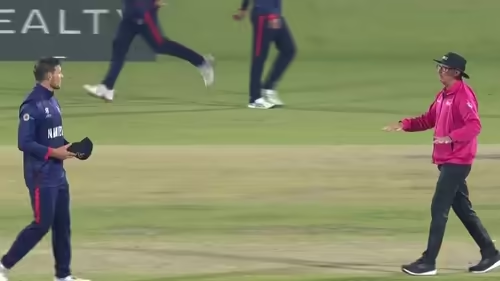
Amidst the high-octane run-fest at Delhi’s Arun Jaitley Stadium, a moment of bizarre tension brought the game to a sudden, unexpected halt. It wasn’t a wicket, a review, or even a boundary that caused the stir—it was a single, controversial delivery from Namibian captain Gerhard Erasmus that led to a rare dead-ball drama and an on-field intervention by the umpires. The incident, which saw Erasmus being instructed to re-bowl the delivery, became one of the most talked-about non-cricketing moments of the match, leaving fans and experts alike scratching their heads.
The scene unfolded during India’s massive chase, as Namibia desperately tried to stem the flow of runs. On a pitch offering little assistance to the bowlers, every delivery counted. But one particular ball from Erasmus never got the chance to count at all. The umpire immediately called it a dead ball, a decision that visibly frustrated the Namibian skipper and led to a short but intense discussion on the field [[1]]. This unusual episode added a layer of intrigue to an otherwise dominant Indian performance and raised questions about the finer points of the game’s laws.
Table of Contents
- The Dead-Ball Incident: What Actually Happened?
- Dead-Ball Drama India vs Namibia: The Rules Explained
- Why Erasmus Was Forced to Re-Bowl
- Player and Fan Reactions to the Controversy
- Context of the Match: India’s Dominant Show
- Conclusion: A Reminder of Cricket’s Fine Lines
- Sources
The Dead-Ball Incident: What Actually Happened?
From the broadcast footage, the sequence of events was clear. Gerhard Erasmus began his run-up for a delivery in his over. However, before he could release the ball, something—either a movement from the batter, a distraction in the crowd, or perhaps a miscommunication with his fielders—caused him to abort his action mid-stride. He stopped his delivery and walked back to his mark.
In such scenarios, the Laws of Cricket are very specific. According to the Marylebone Cricket Club (MCC), the custodians of the game’s laws, if a bowler stops in their delivery stride without a legitimate reason (like avoiding injury to the batter), the umpire is within their rights to call and signal ‘Dead ball’ [[3]]. This is exactly what happened. The on-field umpire deemed that Erasmus had not been impeded and therefore his stoppage was illegal, rendering the ball dead before it was even bowled.
Dead-Ball Drama India vs Namibia: The Rules Explained
This incident is a perfect case study for Law 20.4.2 of the MCC Laws, which states: “The umpire shall call and signal Dead ball if the bowler interrupts his/her delivery stride… unless this is done to avoid injury to the striker.”
Essentially, the bowler is not allowed to use a fake delivery or an aborted run-up as a tactic to distract the batter. Once the delivery stride has commenced, the bowler must follow through and deliver the ball. If they don’t, and there’s no valid reason like preventing harm to the batter, the ball is declared dead. In a T20 match, where every ball is precious, this rule is strictly enforced to maintain the integrity and pace of the game. The umpire’s call was not just correct; it was necessary to uphold the spirit of fair play.
Why Erasmus Was Forced to Re-Bowl
Since the ball was declared dead before it was legally delivered, it did not count as one of the six legitimate deliveries in the over. Therefore, the umpire had no choice but to instruct Erasmus to bowl that delivery again. This is standard procedure, but it’s a situation that rarely occurs at the international level, especially in a high-stakes World Cup match.
For Erasmus, the frustration was understandable. He was likely trying to gather his composure or adjust his plan, but the laws offer no leniency in such cases. His brief argument with the umpire was a natural reaction to the pressure of the moment, but the official’s decision was final and backed by the rulebook. This moment of dead-ball drama India vs Namibia serves as a stark reminder that even the smallest technicalities can have a significant impact on the flow of the game.
Player and Fan Reactions to the Controversy
While the on-field discussion was brief, the incident quickly became a talking point online. Fans on social media were divided. Some praised the umpire for his strict adherence to the rules, calling it a “textbook decision.” Others felt sympathy for Erasmus, arguing that the pressure of bowling against a rampaging Indian batting lineup was immense and that the call was overly harsh.
Cricket analysts on various sports channels used the moment to educate viewers on the often-overlooked Law 20.4.2, turning a minor controversy into a valuable teaching moment about the game’s intricate regulations. The incident highlighted the immense responsibility shouldered by on-field officials, whose split-second decisions can alter the course of a match [[7]].
Context of the Match: India’s Dominant Show
It’s important to note that this incident occurred during a match that was already heavily tilted in India’s favor. After winning the toss and electing to bat first, India posted a mammoth 209/9, powered by a historic, record-breaking fifty from wicketkeeper Ishan Kishan and a solid half-century from Hardik Pandya [[10]].
Namibia, despite their best efforts, were always up against it. The return of key players like Sanju Samson and the ever-lethal Jasprit Bumrah only strengthened the Indian side, making their victory seem inevitable. In this context, the dead-ball drama was a fleeting moment of tension in an otherwise one-sided contest, but its uniqueness ensured it would be remembered long after the final scorecard was filed.
Conclusion: A Reminder of Cricket’s Fine Lines
The dead-ball drama India vs Namibia was a fascinating microcosm of cricket itself—a game governed by a complex set of laws where the line between a clever tactic and a technical violation can be razor-thin. While it didn’t change the outcome of the match, it served as a powerful reminder of the importance of precision, discipline, and respect for the rules at the highest level of the sport. For fans, it was a glimpse into the unseen pressures and split-second judgments that define the beautiful game. For more on the intricacies of cricket’s laws, check out our [INTERNAL_LINK:Understanding-Cricket-Laws-and-ICC-Regulations].
Sources
- [[1]] Times of India: “Dead-ball drama! Umpire intervenes, bowler forced to re-bowl in India vs Namibia match”
- [[3]] Marylebone Cricket Club (MCC): “The Laws of Cricket – Law 20: Dead Ball”
- [[7]] ESPNcricinfo: “Umpiring Decisions That Shook the T20 World Cup”
- [[10]] PTI (Press Trust of India): “India Posts 209/9 Against Namibia in T20 World Cup Clash”