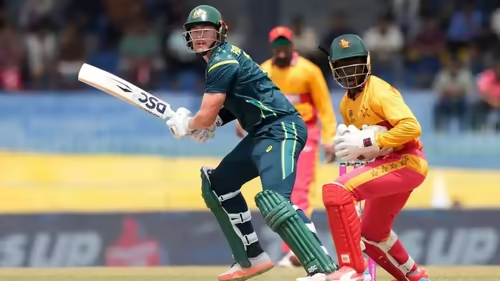
In a stunning upset at the ICC Men’s T20 World Cup 2026, Zimbabwe defeated Australia by 23 runs at the R. Premadasa Stadium in Colombo [[1]]. The immediate post-match chatter predictably turned to the pitch—a slow, spin-friendly surface that has characterized many games in the Sri Lankan leg of the tournament [[3]]. But one man firmly shut the door on that narrative: Australian batter Matt Renshaw.
Table of Contents
- The Shock Defeat and the Pitch Narrative
- Matt Renshaw’s No-Excuses Verdict
- Inside the R. Premadasa Stadium Pitch
- Why Renshaw’s Stance Matters for Australia
- Conclusion: Accountability Over Alibis
- Sources
The Shock Defeat and the Pitch Narrative
The loss was a major blow to Australia’s campaign in Group B. Chasing a modest target of 167, the Australian top order crumbled, losing early wickets that put them on the back foot from the start [[8]]. While the pitch at the R. Premadasa Stadium was indeed slow and offered assistance to the slower bowlers, it was a surface both teams had to play on [[5]]. Historically, such conditions in the subcontinent have been used as a convenient scapegoat by visiting teams struggling to adapt.
Matt Renshaw’s No-Excuses Verdict
However, in a display of remarkable maturity and accountability, Matt Renshaw, who scored a fighting 54 in a losing cause, refused to point fingers at the playing conditions. At the post-match press conference, he delivered a line that should resonate throughout the Australian camp: “I think that’s just the nature of cricket. You get a sub-continent team come to Australia and you don’t get them complaining about the bounce or the pace,” [[13]].
This statement is more than just a quote; it’s a philosophy. Renshaw was highlighting the double standard that often exists in international cricket. Teams are expected to adapt to different conditions around the world, and using the pitch as an excuse undermines the opponent’s skill and your own preparation. He doubled down on this, stating the team simply “wasn’t good enough” on the day [[11]]. His focus was on the team’s failure to build partnerships and manage the chase effectively, not on external factors [[7]].
Inside the R. Premadasa Stadium Pitch
For context, the R. Premadasa Stadium pitch in Colombo has a well-documented reputation. During the T20 World Cup, it has consistently played slow, with a tendency to grip and turn as the match progresses [[3]]. This naturally favors teams with strong spin attacks and batters who can use their feet or play innovative shots to keep the scoreboard ticking.
Zimbabwe’s strategy was built around this. Their bowlers, led by Blessing Muzarabani and Brad Evans, executed their plans perfectly, exploiting the conditions to dismantle Australia’s batting lineup [[1]]. The pitch didn’t misbehave; it simply demanded a different, more nuanced approach—one that Australia failed to deliver.
Key Pitch Characteristics:
- Slow Pace: The ball comes onto the bat slowly, making timing difficult and big hits harder to execute.
- Spin-Friendly: Offers significant grip for finger spinners and wrist spinners, especially in the middle overs.
- Low Bounce: Can keep low at times, trapping batters in front or forcing them to adjust their shot selection.
Why Renshaw’s Stance Matters for Australia
Renshaw’s comments are a breath of fresh air and a critical lesson for a team that has sometimes been criticized for its inflexibility in subcontinental conditions. By refusing to make excuses, he has set a high standard for professionalism and sportsmanship. This attitude is crucial for a team looking to bounce back from a demoralizing loss.
His perspective also shifts the focus to where it belongs: on Australia’s own performance. The real issues were self-inflicted—poor shot selection, a lack of intent in the powerplay, and an inability to handle the pressure of a chase on a tricky surface. These are areas the coaching staff, led by [INTERNAL_LINK:australia-cricket-coach-profile], must address immediately if they hope to progress in the tournament.
Furthermore, Renshaw’s respect for the opposition is noteworthy. He acknowledged that Zimbabwe, particularly in the T20 format, should no longer be seen as easy beats [[15]]. This shows a level of strategic awareness that is essential for modern international cricket.
Conclusion: Accountability Over Alibis
The story of Australia’s loss to Zimbabwe in the Australia Zimbabwe T20 World Cup clash won’t be remembered for the pitch, but for the stark contrast in mindset between the two teams. While one side looked for reasons outside their control, the other, through the voice of Matt Renshaw, took full responsibility. In the high-stakes environment of a World Cup, this culture of accountability is often the difference between a team that merely participates and one that truly contends. Renshaw’s verdict isn’t just about one game; it’s a blueprint for how champions should respond to adversity.
Sources
- Sportstar – T20 World Cup 2026: Shouldn’t complain about sub-continental conditions, says Renshaw [[13]]
- The Quint – Zimbabwe defeat Australia in T20 World Cup 2026 [[1]]
- ESPNcricinfo – Aus vs Zim Live Match Blog [[3], [7]]
- Cricket Australia – ‘Weren’t good enough’: Renshaw reflects on Zimbabwe loss [[11]]
- Fox Sports – ‘Not that hard’: Glaring issue for Aussies after WC capitulation [[15]]
- Britannica – 2026 T20 World Cup Overview