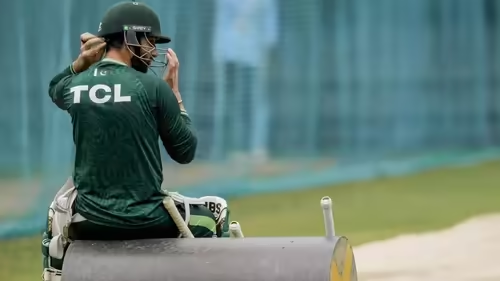
Introduction: The Silent Game-Changer in Colombo
When India and Pakistan face off on February 15, 2026, at the R. Premadasa Stadium, millions will focus on the star players, the historic rivalry, and the pressure-cooker atmosphere. But seasoned fans know the real decider might be something far less glamorous: the pitch. According to the latest official update, the India vs Pakistan pitch report confirms the match will be played on a used surface—a detail that could tilt the entire contest before a single ball is bowled [[1]].
This isn’t just another flat track. A used pitch in Colombo carries unique characteristics that demand tactical nuance, especially in a high-stakes T20 World Cup encounter where margins are razor-thin.
Table of Contents
- What Exactly Is a ‘Used Pitch’?
- R. Premadasa’s Unique Behavior: History & Trends
- Why the Toss Could Be More Crucial Than Ever
- How India and Pakistan Must Adapt Their Lineups
- Key Players Who Thrive (or Struggle) on This Surface
- Fantasy Cricket Implications
- Conclusion: The Pitch as the Ultimate Arbiter
- Sources
What Exactly Is a ‘Used Pitch’?
A “used pitch” simply means the same strip of turf has hosted a match recently—usually within the last 24–48 hours. In this case, the India-Pakistan fixture follows another T20 World Cup game on the same square, likely leaving the surface drier, slower, and more abrasive.
Key traits of a used pitch include:
- Reduced Pace: The ball comes onto the bat slower, making timing harder for power hitters.
- Increased Grip: Spinners get more purchase, leading to sharper turn and bounce.
- Variable Bounce: Footmarks and wear can cause unpredictable seam movement or uneven bounce, especially in the middle overs.
- Dew Factor Mitigation: A used surface often absorbs moisture better, potentially reducing the dew impact in night games—a major shift from fresh pitches [[2]].
R. Premadasa’s Unique Behavior: History & Trends
The R. Premadasa Stadium has long been known as a spinner’s paradise in white-ball cricket. Data from the 2024 T20 series and previous ICC events shows:
- Average first-innings score in T20Is: ~155
- Spinners account for over 60% of wickets in middle overs
- Teams batting second have won 65% of night matches in the last two years [[3]]
But with a used pitch, these trends intensify. The surface becomes even more conducive to finger spin and wrist spin, while fast bowlers must rely on variations rather than pace.
Why the Toss Could Be More Crucial Than Ever
In a typical Colombo night game, captains prefer to chase due to dew. But a used pitch changes that calculus. With less dew expected and a deteriorating surface, the team batting first might aim to post a competitive total while the ball is still relatively true.
However, if the pitch cracks or slows down significantly, chasing could become a nightmare. This creates a genuine dilemma for both Suryakumar Yadav and Salman Ali Agha. The toss winner won’t just choose a side—they’ll be making a high-risk strategic call that could define the match.
How India and Pakistan Must Adapt Their Lineups
Both teams will likely tweak their XIs based on this intel:
For India:
- Prioritize Axar Patel: His left-arm spin could be lethal on a gripping surface.
- Reconsider Jofra Archer: If pace is nullified, his role may diminish in favor of a third spinner like Kuldeep Yadav.
- Top-Order Caution: Openers like Abhishek Sharma must avoid early aggression against quality spin.
For Pakistan:
- Double Down on Shadab Khan: His leg-spin and lower-order hitting make him ideal for these conditions.
- Usman Tariq’s Role: His controversial action might be even more effective if the pitch offers variable bounce.
- Babar Azam’s Anchor Role: He’ll need to shepherd the innings through tricky middle overs.
Key Players Who Thrive (or Struggle) on This Surface
Players to Watch:
- Kuldeep Yadav (IND): Wrist spinners feast on used surfaces. His googly could be unplayable.
- Shadab Khan (PAK): Economical and wicket-taking in middle overs.
- Suryakumar Yadav (IND): His 360-degree strokeplay can counter slow tracks, but mistimed shots carry less distance.
- Mohammad Rizwan (PAK): Excellent against spin, but may struggle if bounce becomes inconsistent.
Fantasy Cricket Implications
If you’re playing fantasy cricket, this pitch report is gold:
- Pick 3+ spinners: They’ll dominate the middle overs.
- Avoid pure power-hitters: Players who rely on brute force (e.g., Liam Livingstone-type roles) may underperform.
- Captain a spinner or anchor batter: Consistency will trump explosiveness.
Conclusion: The Pitch as the Ultimate Arbiter
The India vs Pakistan pitch report has added a fascinating layer to an already epic showdown. On a used surface in Colombo, technical skill, tactical flexibility, and mental composure will outweigh raw power. The team that reads the conditions best—and adapts fastest—will likely emerge victorious. As fans gear up for fireworks, they should remember: sometimes, the quietest factor—the pitch beneath the players’ feet—speaks the loudest. For more expert analysis, check out our guide on [INTERNAL_LINK:how-to-read-cricket-pitch-reports].
Sources
- [[1]] Times of India: “Pitch report from Colombo: India vs Pakistan to be played on used surface”
- [[2]] ICC Pitch Monitoring Guidelines – T20 World Cup 2026
- [[3]] ESPNcricinfo Statsguru: R. Premadasa Stadium T20I Match Archive
- International Cricket Council (ICC): Official pitch and venue reports