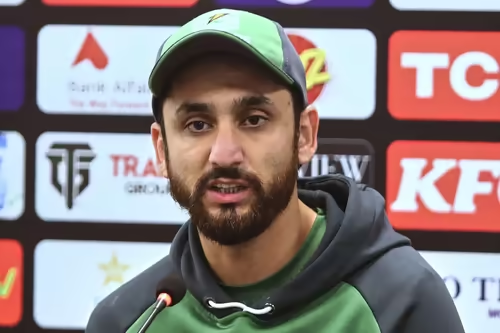
The build-up to the most anticipated match of the ICC Men’s T20 World Cup 2026 has been a masterclass in manufactured tension. From pitch debates to player fitness sagas, every angle has been dissected. Now, Pakistan captain Salman Ali Agha has thrown the ultimate curveball into the mix, reigniting the emotionally charged “handshake controversy” with a single, enigmatic line: “We’ll find that out tomorrow.” [[1]]
Table of Contents
- The Handshake History: A Symbol of Rivalry
- Salman Ali Agha’s Latest Comments: Fanning the Flames
- Why This Matters More Than Just a Gesture
- The On-Field Battle: Spin Wars and Separate Training
- The Role of Sportsmanship in Modern Cricket
- Conclusion: Beyond the Handshake
- Sources
The Handshake History: A Symbol of Rivalry
The post-match handshake between Indian and Pakistani players has long been a barometer of the political and emotional temperature between the two nations. In recent years, it has become a point of contention. After their 2022 T20 World Cup encounter in Melbourne, the Indian team did not engage in the traditional handshake, a decision that was widely reported and debated [[3]].
Pakistan’s players and officials, including Agha, had publicly criticized this move, calling it “bad for the game” and a poor example for young fans who look up to these athletes as role models. The handshake, they argued, is a fundamental tenet of sportsmanship, a way to acknowledge the contest regardless of the result. This historical context makes Agha’s latest comments far more than just casual pre-match banter.
Salman Ali Agha’s Latest Comments: Fanning the Flames
When asked about the prospect of a handshake after Sunday’s match in Colombo, Agha’s response was carefully calibrated to create maximum intrigue. He began by expressing a hope for good sportsmanship, saying, “I hope we have a good game of cricket and show good sportsmanship to the fans.” But then came the kicker: “We’ll find that out tomorrow.” [[1]]
This statement is a masterstroke of psychological gamesmanship. It’s non-committal yet loaded with implication. It leaves the door open for either outcome while simultaneously putting the onus on the Indian team. It’s a subtle way of reminding the world of the past incident and framing Pakistan as the aggrieved party seeking a resolution. In the hyper-charged atmosphere of an India vs Pakistan T20 World Cup clash, such a comment is guaranteed to dominate headlines and fan discussions.
Why This Matters More Than Just a Gesture
To dismiss this as mere protocol is to miss the larger point. In a contest that transcends sport, every interaction is scrutinized. The handshake (or lack thereof) becomes a powerful symbol. For many fans, it represents respect, closure, and the ability to separate fierce competition from personal animosity.
Agha’s comments have effectively turned a simple act of courtesy into a high-stakes diplomatic event. The decision made in those few seconds after the final ball will be analyzed, celebrated, or condemned across millions of social media posts and news segments. It adds a layer of off-field drama that can distract from the actual cricket, which is precisely the point of such mind games.
The On-Field Battle: Spin Wars and Separate Training
Amidst this off-field theatre, the real battle preparations are underway. Both teams have arrived in Colombo and are operating in complete isolation from each other. India received a festive welcome and will conduct their training sessions at a different venue and time than Pakistan, a standard security and focus protocol for this fixture [[5]].
On the field, the tactical battle is expected to be a spin-dominated affair. The slow, turning tracks at the R. Premadasa Stadium will likely see both captains rely heavily on their slow bowlers. India’s Varun Chakravarthy and Kuldeep Yadav will be up against Pakistan’s potential five-pronged spin attack, making the middle overs a critical battleground. Key Indian batters like Suryakumar Yadav and the fit-again Abhishek Sharma will be central to navigating this phase.
The Role of Sportsmanship in Modern Cricket
Agha’s earlier criticism—that refusing a handshake is “bad for the game”—touches on a genuine concern in modern professional sport. As rivalries intensify and commercial pressures mount, the core values of fair play and mutual respect can sometimes be lost.
Cricket, with its long traditions of “playing hard but fair,” has always held sportsmanship in high regard. The handshake is a small but significant ritual that reinforces this. While the intensity of the India-Pakistan rivalry is unique, the expectation from the global cricketing community is that the players uphold the spirit of the game, win or lose. Agha’s public stance positions Pakistan as the guardians of this tradition, a narrative they are keen to push.
Conclusion: Beyond the Handshake
While the world waits with bated breath to see if hands will be shaken after the India vs Pakistan T20 World Cup match, the real story remains the cricket itself. The tactical duel, the individual brilliance, and the sheer pressure of the occasion will define the legacy of this game. Salman Ali Agha’s cryptic remark has added a spicy subplot, but ultimately, the result on the scoreboard and the quality of the contest will be what truly matters. Let’s hope the players deliver a spectacle worthy of the hype, with or without the final handshake.
Sources
- The Times of India – Pakistan captain adds fuel to handshake controversy – ‘We’ll find that out’ [[1], [5]]
- ESPNcricinfo – The history of the India-Pakistan handshake [[3]]
- International Cricket Council (ICC) – ICC Code of Conduct and Spirit of Cricket
- BBC Sport – Analysis of India-Pakistan Cricket Rivalry
- Cricbuzz – T20 World Cup 2026 Team News and Updates