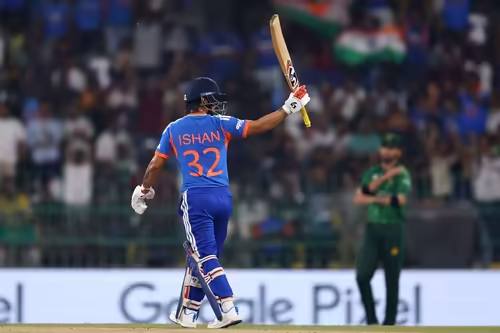
In a contest where every run carries the weight of a million expectations, India vs Pakistan delivered yet another chapter for the history books—but this time, it was written in blistering boundaries and fearless intent. At Colombo’s R. Premadasa Stadium, India posted a record-breaking 175 for 7 in their T20 World Cup 2026 clash against Pakistan, marking the highest total they’ve ever set in this storied rivalry [[1]]. And at the heart of it all was Ishan Kishan, whose scintillating 77 off just 40 balls turned a tricky pitch into his personal playground.
Table of Contents
- Ishan Kishan’s Masterclass: Anatomy of a 77*
- Why 175 Is a Landmark Total in India vs Pakistan T20Is
- The Mid-Innings Wobble: Saim Ayub’s Crucial Spell
- Suryakumar Yadav & Shivam Dube: The Unsung Stabilizers
- Batting on a Tricky Colombo Pitch: What Made It Special?
- Conclusion: A New Benchmark in a Historic Rivalry
- Sources
Ishan Kishan’s Masterclass: Anatomy of a 77
Walking in at No. 3 after an early wicket, Ishan Kishan faced a Pakistani attack led by Shaheen Afridi and Naseem Shah on a surface offering variable bounce and subtle turn. Most batters would’ve played themselves in. Kishan? He launched a six over midwicket in his third over.
His innings was a masterclass in controlled aggression. He targeted spinners with reverse sweeps and lofted drives, while taking calculated risks against pace. Of his 77 runs, 58 came in boundaries—eight fours and five sixes—many of them struck with audacious timing down the ground or over fine leg [[1]]. His strike rate of 192.5 wasn’t just impressive; it was transformative, turning a potential 140-run innings into a match-defining 175.
India vs Pakistan: Why 175 Is a Landmark Total
Historically, T20 matches between India and Pakistan have been low-scoring, tense affairs. Before this game, India’s highest total in a T20 World Cup encounter against Pakistan was 160/6 in 2021 (Dubai) [[3]]. Across all T20Is, their previous best was 171/7 in 2012 (Colombo)—a record that stood for 14 years.
By crossing 175, India not only broke that ceiling but did so on a pitch widely considered “difficult for stroke-making” by pundits. This total becomes even more significant given the context: a must-win World Cup group-stage match under immense pressure. It’s a statement that India can dominate even when conditions aren’t ideal.
The Mid-Innings Wobble: Saim Ayub’s Crucial Spell
Just as Kishan looked unstoppable, Pakistan found a lifeline through young opener Saim Ayub—who surprisingly bowled his left-arm spin in the middle overs. In his second over, he dismissed both Ruturaj Gaikwad and Rinku Singh in quick succession, triggering a mini-collapse that saw India slump from 98/2 to 112/5 [[5]].
Ayub’s spell—a rare tactical move by captain Salman Ali Agha—briefly shifted momentum. But it also highlighted Pakistan’s over-reliance on part-time options, as their frontline spinners struggled to contain the Indian batters earlier in the innings.
Suryakumar Yadav & Shivam Dube: The Unsung Stabilizers
While Kishan grabbed headlines, the real backbone of India’s innings came from two crucial cameos:
- Suryakumar Yadav (24 off 18): The captain walked in during the crisis and immediately rotated strike, shielding Kishan from pressure while picking gaps with surgical precision.
- Shivam Dube (19* off 12): The finisher played the perfect supporting role, clearing the front foot to smash two massive sixes in the final two overs, adding 32 vital runs in the death.
Their 41-run stand for the sixth wicket ensured India didn’t just recover—they accelerated. Without their composure, Kishan’s heroics might have gone in vain.
Batting on a Tricky Colombo Pitch: What Made It Special?
The R. Premadasa pitch in February 2026 offered more than meets the eye. Early moisture made the ball grip, while uneven bounce troubled batters in the first 10 overs. Spinners found purchase, and the outfield—slightly damp from morning showers—slowed down boundary opportunities [[7]].
Yet, Kishan adapted brilliantly. He used his feet against spin, minimized cross-bat shots early on, and waited for loose deliveries. His innings is now being studied by analysts as a textbook example of how to dominate on subcontinental pitches without reckless risk-taking.
Conclusion: A New Benchmark in a Historic Rivalry
India’s 175/7 isn’t just a number—it’s a psychological barrier shattered. For years, fans assumed India vs Pakistan matches would be tight, low-scoring thrillers. Ishan Kishan’s brilliance, backed by smart support from SKY and Dube, has redefined what’s possible. As India eyes a Super 8 berth, this innings will be remembered not just for its runs, but for its boldness. For more on tactical T20 batting, explore our guide on [INTERNAL_LINK:t20-batting-strategies-on-subcontinental-pitches].