Pakistan vs Sri Lanka: Cricket Triumphs Amid Tragedy in Rawalpindi
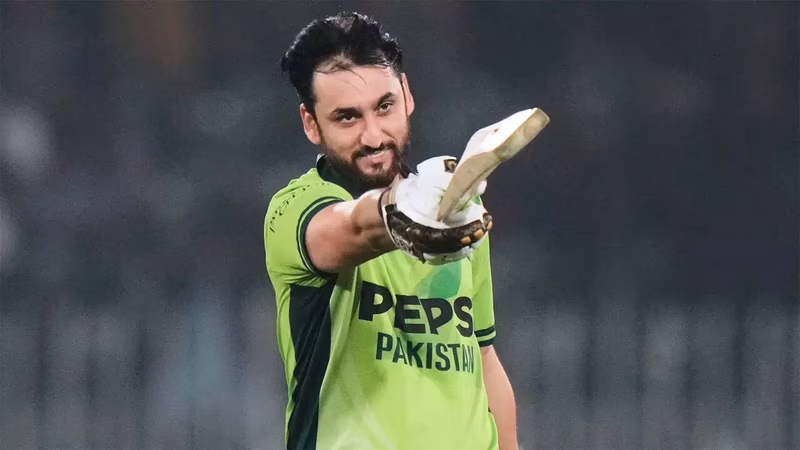
In one of the most emotionally charged matches in recent cricket history, Pakistan vs Sri Lanka went ahead as scheduled on Tuesday despite a deadly suicide attack in nearby Islamabad earlier that day—claiming at least 12 lives . Under extraordinary security and immense psychological pressure, Pakistan pulled off a nerve-wracking six-run victory, powered by an unbeaten century from Salman Agha and a devastating four-wicket burst by Haris Rauf.
The Pakistan Cricket Board (PCB) confirmed that security around the Sri Lankan team was immediately heightened after the blast, with armed personnel visibly increased at the Rawalpindi Cricket Stadium . Yet, in a powerful show of resilience, both teams took the field—delivering a contest that blended sporting excellence with human courage.
Table of Contents
- The Attack: What Happened Near Islamabad?
- A Match Played Under Unimaginable Stress
- Salman Agha’s Career-Defining Knock
- Haris Rauf’s Game-Sealing Spell
- How Cricket Authorities Responded
- Pakistan’s History of Playing Through Crisis
- What This Win Means for Pakistan’s Campaign
- Sources
The Attack: What Happened Near Islamabad?
Earlier on match day, a suicide bombing targeted a security checkpoint in the Pahari area of Islamabad, just 25 kilometers from the Rawalpindi stadium . Initial reports from the Interior Ministry confirmed at least 12 fatalities, including several police officers, with over 20 injured .
The attack sent shockwaves across the nation—raising immediate questions about whether the Pakistan vs Sri Lanka T20I should proceed. However, after consultations with security agencies and the Sri Lankan team management, the PCB decided to continue, citing “national resolve” and “the unifying power of sport” .
A Match Played Under Unimaginable Stress
Fans were barred from entry, and the stadium stood eerily empty—save for team officials, media, and armed security. Yet, the players delivered a performance worthy of a full house.
Opting to bat first, Pakistan posted 182/5 in 20 overs—a total built almost entirely on Salman Agha’s unbeaten 102 off 61 balls. With wickets falling at the other end, Agha remained calm, striking 8 fours and 6 sixes, often rotating strike under pressure .
His partnership with Iftikhar Ahmed (24 off 18) for the fifth wicket proved decisive in pushing Pakistan past 180.
Salman Agha’s Career-Defining Knock
Before Tuesday, Salman Agha was known more as a domestic stalwart than an international star. But his composed, counter-attacking century—under the shadow of tragedy—has catapulted him into the spotlight.
Key highlights of his innings:
- Reached his maiden T20I century in his 12th match
- Scored 78 of Pakistan’s last 90 runs
- Remained unbeaten despite losing three partners in 25 balls
- Hit the winning runs in spirit—even though his team was batting first
“In such times, you play not just for runs, but for your country’s dignity,” Agha said post-match—a sentiment echoed across social media .
Haris Rauf’s Game-Sealing Spell
If Agha lit the fuse, Haris Rauf exploded it. Chasing 183, Sri Lanka looked dangerous at 98/2 in the 12th over—thanks to Pathum Nissanka (54) and Kusal Mendis (37).
Then came Rauf.
In a four-over spell of raw pace and precision, he ripped through the middle order:
- Trapped Mendis LBW with a searing yorker
- Had Charith Asalanka caught behind off a bouncer
- Castled Dhananjaya de Silva with an inswinging toe-crusher
- Finished with 4/27—his best figures in 2025
His final over—defending 13 runs—sealed the win and sparked an emotional outburst from players and staff alike.
How Cricket Authorities Responded
The Pakistan Cricket Board (PCB) issued a statement affirming that “the safety of players and officials remains paramount” and that “additional layers of military-grade security were deployed within 60 minutes of the attack” .
Sri Lankan team manager Charith Senanayake praised Pakistan for its handling of the crisis: “We felt secure at all times. This match was a tribute to the victims.”
International observers, including the ICC, have commended both nations for proceeding with the game—a stance that underscores cricket’s role in moments of national grief.
Pakistan’s History of Playing Through Crisis
This isn’t the first time Pakistan has played cricket amid adversity:
- In 2009, the Lahore attack on the Sri Lankan team halted international cricket for a decade.
- During the 2019 World Cup, Pakistan played under emotional strain following Christchurch shootings.
- In 2022, matches in Peshawar proceeded despite nearby militant activity.
Each time, Pakistan used sport as a form of defiance—and healing. Tuesday’s Pakistan vs Sri Lanka clash continues that legacy.
What This Win Means for Pakistan’s Campaign
The victory gives Pakistan a 1-0 lead in the three-match T20I series—and more importantly, a psychological boost. With the ICC Men’s T20 World Cup 2026 looming, performances like Agha’s and Rauf’s could shape selection debates.
Moreover, it sends a global message: Pakistan will not let terror dictate its sporting life.
For fans, the takeaway is clear—cricket isn’t just a game here. It’s a statement.
Follow our coverage with [INTERNAL_LINK:pakistan-t20-squad-analysis] and [INTERNAL_LINK:sri-lanka-tour-pakistan-2025].
Sources
- Times of India: Deadly suicide attack near Rawalpindi, but Pakistan hold nerves to beat Sri Lanka
- Al Jazeera: Suicide Bombing Near Islamabad Kills 12
- ICC Official Statement (via Press Release): International Cricket Council
- PCB Media Briefing Transcript, November 12, 2025