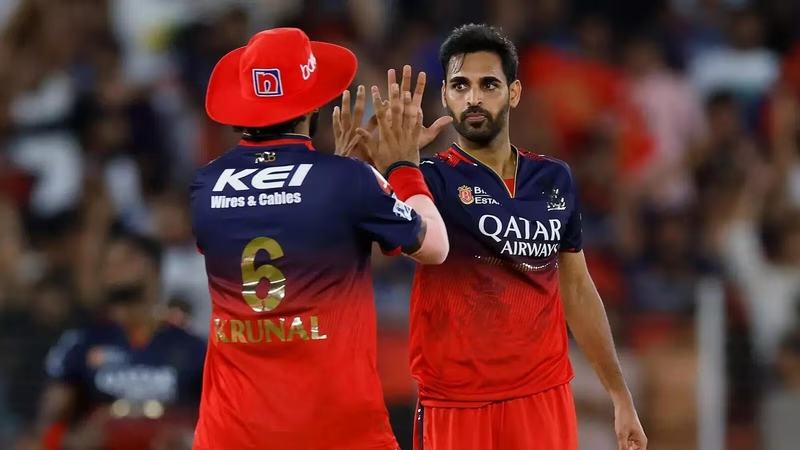
“He is not a machine.”
That simple, powerful statement from Bhuvneshwar Kumar cuts through the noise of an era obsessed with T20 stardom, 150+ kph speeds, and relentless match calendars. In an exclusive interview with Times of India, the Indian swing maestro opens up with remarkable honesty about the physical and mental toll of modern cricket—and why ‘workload management’ isn’t a luxury, but a necessity for longevity.
At 35, with over 200 international wickets across formats and a body that’s endured countless niggles and recoveries, Bhuvneshwar speaks from hard-earned experience. His insights aren’t just personal reflections—they’re a roadmap for India’s next generation of pacers navigating a high-stakes, high-burnout landscape.
Table of Contents
- “He Is Not a Machine”: The Reality of Workload
- Is Swing Bowling Dying? Bhuvneshwar’s View
- Why Test Cricket Is Now a ‘Conscious Career Choice’
- Bhuvneshwar’s Advice for Young Indian Fast Bowlers
- Common Misconceptions About Workload Management
- Conclusion: Wisdom From a Veteran
- Sources
“He Is Not a Machine”: The Reality of Workload
Bhuvneshwar Kumar doesn’t mince words: “People think because you’re fit, you can bowl every day. But fast bowling—especially swing bowling—requires precision, rhythm, and recovery. You can’t force it.”
He points out that workload isn’t just about match count; it’s about cumulative stress, travel fatigue, pitch conditions, and even mental sharpness. “After a long IPL season, your body might say ‘yes,’ but your action starts betraying you. That’s when injuries creep in.”
This perspective is crucial in a system where young bowlers are often fast-tracked into multiple leagues without adequate rest. Bhuvneshwar’s own career has seen him miss major tournaments due to back and side strains—proof that even the most economical bowler isn’t immune to breakdowns.
Is Swing Bowling Dying? Bhuvneshwar’s View
Once the backbone of India’s overseas success, swing bowling seems increasingly rare in an age of pace and reverse-swing specialists. But Bhuvneshwar insists the art isn’t dead—it’s just misunderstood.
“Swing isn’t about speed. It’s about seam position, wrist alignment, and reading the atmosphere,” he explains. “Young bowlers today chase pace because T20 rewards it. But in red-ball cricket, that extra 5 kph means nothing if you can’t move the ball.”
He believes academies should reintroduce swing-focused coaching early in development. “You can’t teach swing at 25. You have to feel it at 15.”
Why Test Cricket Is Now a ‘Conscious Career Choice’
Perhaps his most striking observation? “Test cricket is no longer the default path. It’s a conscious choice.”
With T20 leagues offering life-changing contracts and shorter commitments, Bhuvneshwar acknowledges that many players now weigh Test cricket as a personal and financial decision—not an automatic honor. “You give up 3–4 months of your year for one series. You earn far less. You risk injury with little safety net.”
Yet, he remains a staunch advocate for the format. “If you want to be remembered as a great bowler—not just a great performer—Test cricket is where legends are made.”
Bhuvneshwar’s Advice for Young Indian Fast Bowlers
For India’s emerging quicks—many of whom idolize Bumrah or Siraj—Bhuvneshwar offers grounded, no-nonsense guidance:
- Master your basics first: Don’t obsess over pace. Nail your line, length, and seam before chasing speed.
- Listen to your body: Soreness is normal; sharp pain isn’t. Rest early, not after the injury.
- Embrace red-ball cricket: It teaches patience, planning, and resilience no T20 can replicate.
- Manage your career like a business: Off-seasons are for recovery, not extra tournaments.
He specifically warns against over-bowling in age-group cricket. “I’ve seen kids bowl 30 overs in a day. That’s criminal.”
Common Misconceptions About Workload Management
Bhuvneshwar tackles popular myths head-on:
- Myth: Workload = laziness → Truth: It’s strategic preservation of skill and body.
- Myth: Only injured players need rest → Truth: Prevention is better than cure—especially for bowlers.
- Myth: More matches = better development → Truth: Quality reps with recovery beat quantity every time.
He credits the BCCI’s current medical and monitoring protocols—like GPS trackers, biomechanical assessments, and individualized plans—for helping extend careers. Still, he says cultural change is needed: “Fans and media must stop calling a rested player ‘uncommitted.’”
Conclusion: Wisdom From a Veteran
Bhuvneshwar Kumar’s interview is more than a reflection on his journey—it’s a wake-up call for Indian cricket. In a system racing toward commercialization and short-form dominance, his voice reminds us that sustainable success requires balance, patience, and respect for the craft.
As India grooms its next generation of pace stars, his message is clear: Bhuvneshwar Kumar may not be a machine, but his wisdom is engineered for longevity. And that’s worth its weight in wickets.
For deeper insights into India’s pace evolution, explore our [INTERNAL_LINK:indian-fast-bowlers-rise-analysis].