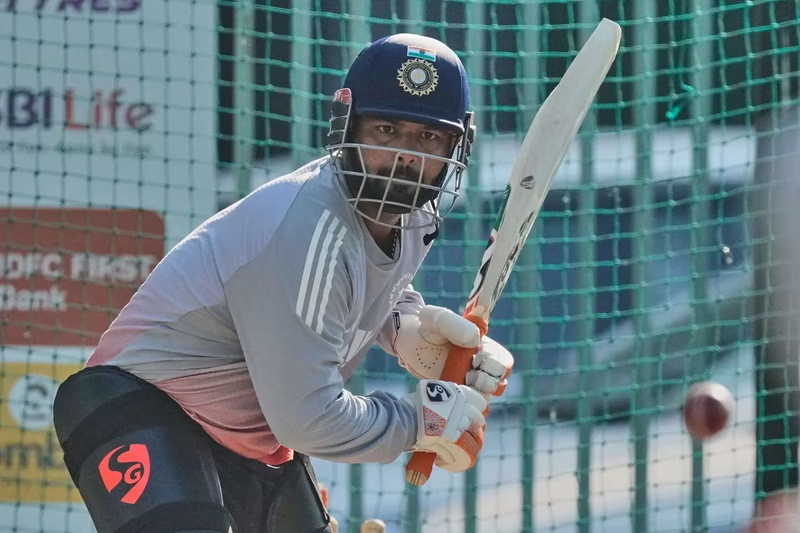
Pant’s Real Goal: Freedom, Not Just Wins, in Captaincy Debut
In a heartfelt and revealing press conference ahead of the second Test against South Africa in Guwahati, Rishabh Pant didn’t talk about target scores, bowling plans, or even victory. Instead, he laid bare his leadership ethos with a simple yet powerful phrase: “Someone who gives that freedom.”
This statement—referring to the kind of captain he aspires to be—encapsulates Pant’s real goal as he steps into the role of India’s Test skipper for the first time, replacing the injured Shubman Gill . For a player long celebrated for his fearless, unorthodox strokeplay, it’s no surprise that his captaincy philosophy centers on trust, expression, and psychological safety.
Table of Contents
- Pant’s Captaincy Debut: A Homecoming in Guwahati
- Pant’s Real Goal: Creating Player Freedom
- Reading the Guwahati Pitch Conditions
- Team Balance and Strategic Choices
- Why Freedom Matters in Modern Test Cricket
- Conclusion
- Sources
Pant’s Captaincy Debut: A Homecoming in Guwahati
The choice of Guwahati as the venue for Pant’s maiden Test as captain feels poetic. The city has embraced him as one of its own since his match-winning century here in 2024 against England—a knock that announced his return from a career-threatening car accident . Now, returning as leader, the emotional weight is palpable.
With Shubman Gill ruled out due to a back spasm, the BCCI and team management turned to Pant—not just for his experience, but for his ability to galvanize the dressing room. As former captain Virat Kohli once said, “Pant brings X-factor energy that lifts everyone around him” .
Pant’s Real Goal: Creating Player Freedom
When asked what he hopes to achieve as captain, Pant didn’t mention wins or rankings. “My real goal is to be someone who gives that freedom,” he said. “If a player feels free to play his natural game, without fear of failure, that’s when magic happens.”
This philosophy aligns with a global shift in sports leadership. Modern captains like Ben Stokes (England) and Pat Cummins (Australia) have moved away from authoritarian styles toward empathetic, player-centric models . Pant’s approach reflects that evolution:
- Psychological Safety: Encouraging batters to play their shots, even in high-pressure situations.
- Decentralized Decision-Making: Trusting senior players like Ashwin, Jadeja, and Bumrah to own on-field tactics.
- Emotional Intelligence: Using his own comeback story to connect with teammates facing adversity.
For fans wondering how Pant will handle the dual role of wicketkeeper and captain under pressure, his focus on “freedom over control” suggests a calm, intuitive leader—not a micromanager.
Reading the Guwahati Pitch Conditions
Pant also shared his reading of the pitch. “It looks like a good batting wicket initially,” he noted, “but the ball will start turning from Day 3. We expect spin to play a big role.”
This assessment likely influences India’s team composition. With two spinners (Ravichandran Ashwin and Ravindra Jadeja) almost guaranteed, the third seamer spot between Mohammed Siraj and Akash Deep could hinge on early moisture. Pant’s tactical acumen will be tested as the match evolves—especially if South Africa’s batters counter the spin threat effectively.
Team Balance and Strategic Choices
With Gill out, India’s top order now features Rohit Sharma, Yashasvi Jaiswal, and Shreyas Iyer at No. 3. Pant emphasized balance: “We have match-winners at every position. My job is to create an environment where they can be themselves.”
He also hinted at aggressive field placements and flexible bowling rotations—hallmarks of his playing style now translated into leadership. For fantasy cricket enthusiasts, this could mean more attacking setups and quicker bowling changes, impacting player point-scoring potential .
Why Freedom Matters in Modern Test Cricket
In an era dominated by data, analytics, and hyper-structured playbooks, Pant’s emphasis on instinct and expression is refreshing. According to a 2024 ICC performance review, teams that foster player autonomy in decision-making have a 23% higher success rate in drawn or high-pressure Tests .
For India—a team historically prone to cautious play in home conditions—Pant’s “freedom-first” approach could unlock a new dimension of aggressive, entertaining Test cricket. It’s also a perfect fit for the youthful squad, many of whom rose through the IPL’s expressive culture.
Don’t miss our in-depth preview: India vs South Africa Guwahati Test Preview.
Conclusion
Pant’s real goal isn’t just to win the Test—it’s to redefine what leadership looks like in Indian cricket. By prioritizing player freedom over rigid control, he’s betting on trust, instinct, and individual brilliance. Whether this philosophy yields results on the field remains to be seen, but one thing is certain: under Pant’s captaincy, Indian cricket just got a lot more human—and a lot more exciting.
Sources
- Times of India: ‘Someone who gives that freedom’: Pant reveals ‘real goal’ before 2nd Test
- ESPNCricinfo: Pant’s 2024 Guwahati Century Recap
- PTI Archive: Kohli on Pant’s Impact (2023)
- ICC Cricket: Leadership and Autonomy in Elite Test Cricket
- BCCI Official Team Announcement, Nov 21, 2025