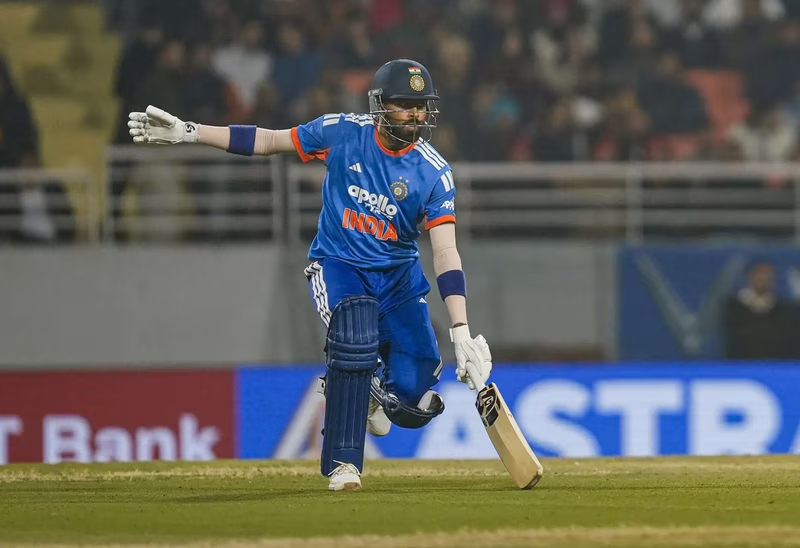
Hardik Pandya’s ‘Stand-and-Deliver’ Fails Again: Irfan Pathan Reveals the Real Reason His Spark Vanished
It was a jarring sight for Indian fans. Hardik Pandya, the explosive all-rounder who lit up the first T20I, returned to his frustratingly cautious self in the second match against South Africa. But this time, the critique came not just from fans, but from a respected former teammate. Legendary all-rounder Irfan Pathan has issued a blunt verdict: the problem isn’t just a lack of runs—it’s a flawed batting philosophy.
Table of Contents
- The ‘Stand-and-Deliver’ Critique
- Mullanpur Pitch: A Key Factor
- Broader Team Concerns: Gill and Bowling
- Is Pandya’s Slow Style Here to Stay?
- Conclusion: The Technique Trap
- Sources
The ‘Stand-and-Deliver’ Critique
Pathan didn’t mince words in his post-match analysis. He zeroed in on what he called Pandya’s “stand-and-deliver” style of batting. This, Pathan argues, is a fatal flaw on pitches that offer even the slightest bit of slowness or low bounce. “You’ve got to move your feet,” Pathan emphasized, suggesting that Pandya’s rooted stance prevents him from generating the necessary power and timing when the ball isn’t coming onto the bat at pace .
This critique is particularly damning because it questions the very foundation of Pandya’s recent T20I approach. Gone are the days of free-flowing boundaries; in their place is a method that prioritizes survival over spark. While this might seem like a prudent strategy for a captain, Pathan believes it’s fundamentally at odds with what makes Hardik Pandya a dangerous T20 player in the first place.
Mullanpur Pitch: A Key Factor
The venue for the 2nd T20I, the Maharaja Yadavindra Singh Cricket Stadium in Mullanpur, played a pivotal role. Contrary to the high-scoring expectations, the pitch offered a more balanced contest. Reports suggested it was a surface that provided “something for both batters and bowlers,” but crucially, it was not the lightning-fast track that rewards static, flat-bat shots .
On such a surface, a batsman’s ability to get to the pitch of the ball or work it off his pads becomes paramount. Pandya’s reluctance to commit to footwork left him vulnerable, especially against the slower balls and cutters that are a staple of modern T20 bowling. His struggles weren’t just a bad day at the office; they were a direct consequence of a technique mismatched to the conditions .
Broader Team Concerns: Gill and Bowling
Pathan’s analysis didn’t stop with the captain. He also raised a red flag over vice-captain Shubman Gill’s ongoing T20I struggles. Since his return to the format in 2025, Gill’s numbers have been underwhelming, with an average hovering around the low 20s . This lack of form at the top of the order puts immense pressure on the middle, forcing players like Pandya into a defensive mindset from the outset.
Furthermore, Pathan hinted at deeper bowling concerns for the Indian side. While the first T20I saw a dominant bowling performance , consistency remains an issue. The need for a flexible attack that can adapt to varied conditions—from the pace of some venues to the slowness of others—is a challenge India must solve .
Is Pandya’s Slow Style Here to Stay?
The central question now is whether Pandya can, or even wants to, recapture his old explosiveness. His role as captain seems to have instilled a sense of caution that may be at odds with his natural game. The data shows a clear trend: his strike rate in recent T20Is has dipped significantly from his peak years.
For India’s success in the high-stakes T20 World Cup on the horizon, the team needs the all-round Hardik Pandya—the one who can not only lead but also take the game away from the opposition in a matter of overs. A captain who is merely competent with the bat is not enough. As Pathan’s critique suggests, Pandya must find a way to balance his leadership responsibilities with the aggressive instinct that made him a star.
For more on India’s captaincy dynamics, see our deep dive on [INTERNAL_LINK:india-t20-captaincy-challenges].
Conclusion: The Technique Trap
Irfan Pathan’s sharp analysis has exposed a critical vulnerability in Hardik Pandya‘s game. The “stand-and-deliver” method is not a sustainable strategy in the unpredictable world of T20 cricket, especially on pitches that demand adaptability. While his leadership is invaluable, his batting technique must evolve to meet the demands of the format. The onus is now on Pandya to rediscover his footwork and, with it, his spark. The future of India’s T20I campaign may well depend on it.
To understand the technical nuances of modern batting, the International Cricket Council’s official resources offer a great starting point for aspiring players and analysts alike.
Sources
CricTracker analysis by Irfan Pathan on Hardik Pandya’s batting style.
Irfan Pathan Criticises Hardik Pandya After India Lose 2nd T20I.
Maharaja Yadavindra Singh Cricket Stadium, Mullanpur pitch report.
Shubman Gill’s T20I Form: A Comprehensive Analysis.
India Vs South Africa T20Is: Irfan Pathan Warns Bowling.
India blow away South Africa: Should the rest of the T20.