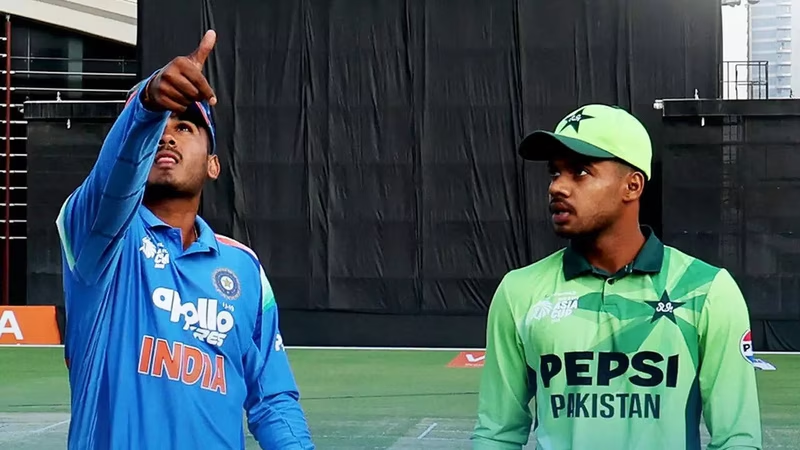
The coin hadn’t even hit the ground yet, but the message was already loud and clear. In the high-stakes arena of the U19 Asia Cup, the much-anticipated India vs Pakistan encounter began not with cheers, but with silence—an almost theatrical absence of the customary sportsmanship we’ve come to expect at the toss. Indian captain Ayush Mhatre and his Pakistani counterpart Farhan Yousaf stood side by side, yet worlds apart. No handshake. No nod. Not even fleeting eye contact. As Pakistan won the toss and opted to bowl, the two young leaders gave their interviews to separate broadcasters and walked off in opposite directions. This wasn’t just a cricket match—it was a microcosm of a decades-old rivalry, played out in chilling real-time.
Table of Contents
- The Icy Toss That Broke Tradition
- India vs Pakistan: A Rivalry Beyond the Boundary
- Why the Silence? Politics, Protocol, or Pressure?
- When Youth Cricket Loses Its Diplomatic Shield
- How the World Reacted to the Snub
- What Comes Next for These Young Stars?
- Conclusion: Cricket’s Unspoken Language
- Sources
The Icy Toss That Broke Tradition
For years, the pre-match handshake between captains has been a quiet but powerful symbol of mutual respect in international cricket—even in the fiercest of rivalries. But in this U19 Asia Cup clash, that tradition was conspicuously absent. Footage from the ground showed Mhatre and Yousaf standing just feet apart, both staring straight ahead as if the other didn’t exist. The awkwardness was palpable. Broadcasters noted the lack of verbal exchange, and media outlets instantly flagged it as a significant departure from norms. While neither team has officially commented, the visuals spoke louder than any press release could.
India vs Pakistan: A Rivalry Beyond the Boundary
To understand this moment, you have to look beyond the pitch. The India vs Pakistan cricketing rivalry is arguably the most politically charged in all of sport. Matches between the two nations are rarely just about runs and wickets—they’re cultural events, emotional battlegrounds, and sometimes, unofficial extensions of geopolitical tension. Historically, even in ICC tournaments, handshakes have been maintained as a nod to the spirit of the game. From the 2007 T20 World Cup final to the 2011 ODI World Cup semi, captains have exchanged pleasantries, however brief. The break from this norm in a youth tournament is particularly jarring.
Why the Silence? Politics, Protocol, or Pressure?
Was this a personal choice by the captains? Unlikely. At the U19 level, players operate under strict team protocols. It’s widely believed that such decisions are guided by team management, possibly even higher sporting bodies. With bilateral relations between the two countries at a historic low, national boards may have issued unofficial directives to minimize interaction. The BCCI, for instance, has long maintained a policy of no bilateral series with Pakistan outside ICC events. This cultural backdrop likely trickles down—even to teenagers wielding willow and leather. The silence wasn’t rudeness; it was compliance.
When Youth Cricket Loses Its Diplomatic Shield
One of the great hopes of U19 cricket has always been its role as a bridge—a space where future stars can compete fiercely but respectfully, free from the baggage of adulthood. Tournaments like the U19 World Cup have often been celebrated for moments of camaraderie: shared selfies, jersey exchanges, joint press conferences. But this toss in the U19 Asia Cup suggests that even this protective bubble is no longer immune. When young athletes are denied the chance to humanize their rivals, it risks hardening attitudes for a generation. As noted by the International Cricket Council (ICC), promoting fair play and mutual respect is a core pillar of youth development.
How the World Reacted to the Snub
Social media exploded within minutes of the toss. Fans on both sides hailed it as “standing firm,” while others lamented the “death of sportsmanship.” Former players weighed in too. Some defended the captains, saying “they’re just following instructions,” while others called it “a sad day for cricket.” Notably, neutral observers from Australia, England, and South Africa expressed concern that the game’s spirit was being eroded by forces beyond the players’ control. The incident has reignited global debate about whether politics should ever dictate on-field conduct—even at the junior level.
What Comes Next for These Young Stars?
Ayush Mhatre and Farhan Yousaf are among the most promising talents in their respective systems. Mhatre, a left-handed batter with elegant timing, is already on the radar of IPL scouts. Yousaf, a gritty all-rounder, has drawn comparisons to Pakistan’s golden-era utility players. Their careers may one day intersect again on the senior stage—perhaps in an ICC final. Will they remember this silent toss? Will it shape how they interact in the future? Or will they, in time, choose to defy the script and extend a hand when it matters most? That’s the hope many cricket purists are holding onto.
Conclusion: Cricket’s Unspoken Language
In the end, the most powerful moments in sport are often the quietest. The India vs Pakistan toss may have lacked words, but it communicated volumes. It reminded us that cricket, especially between these two nations, is never just a game. Yet, it also underscores why the sport needs its rituals—like the handshake—not as empty formalities, but as acts of courage and grace in a divided world. For now, the silence stands. But perhaps, in a future match, a simple gesture can begin to rebuild what politics has strained. For deeper insight into the psychology of high-pressure rivalries, see our feature on the mental toll of India-Pakistan cricket.
Sources
- Times of India: High tension! India maintain ‘no handshake’, avoid eye contact vs Pakistan
- International Cricket Council (ICC): Official Code of Conduct and Spirit of Cricket Guidelines
- PTI & ESPNcricinfo match reports from U19 Asia Cup 2025