Table of Contents
- Rajeev Shukla’s Stark Warning: ‘Winter Cricket Is an Emergency Risk’
- The Lucknow T20I That Never Was: AQI 411 and Zero Balls Bowled
- Why North India’s Winter Air Is a No-Go for Cricket
- The Real Danger: How Smog Threatens Player Health
- BCCI’s Winter Scheduling: A Pattern of Avoidable Disasters
- Winter cricket North India: Is a BCCI Ban on the Horizon?
- Series Decider Shifts to Ahmedabad—A Safer Alternative?
- Beyond Players: The Emotional and Financial Toll on Fans
- How Other Nations Handle Climate-Based Scheduling
- In Conclusion: Time to Prioritize Health Over Broadcast Slots
- Sources
The abandoned India vs South Africa T20I in Lucknow wasn’t just a logistical hiccup—it was a public health wake-up call. And now, one of Indian cricket’s most influential voices is demanding action. Rajeev Shukla, vice-president of the Board of Control for Cricket in India (BCCI), has issued a stark directive: “Stop winter cricket in North India.”
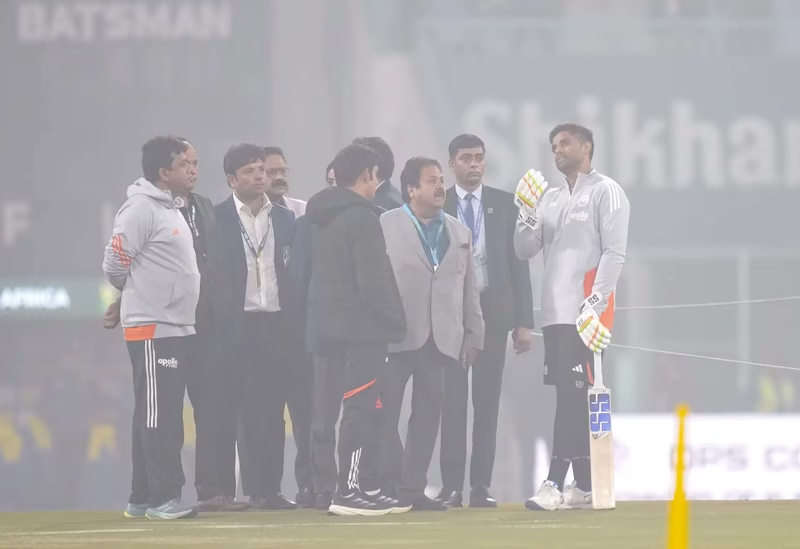
Calling the air pollution levels an “emergency,” Shukla’s comments—made in the wake of the December 17 match cancellation—signal a potential seismic shift in how the BCCI approaches its home international calendar. With AQI levels hitting a hazardous 411 and players like Hardik Pandya seen wearing masks during warm-ups, the debate is no longer about convenience. It’s about safety. And at the heart of it lies the controversial practice of scheduling high-stakes cricket in North India during peak smog season—a practice that may finally be coming to an end.
Rajeev Shukla’s Stark Warning: ‘Winter Cricket Is an Emergency Risk’
In a candid statement to reporters, Shukla didn’t mince words: “We cannot ignore the health of our players and fans. The situation in North India during December is not just poor—it’s an emergency.”
His remarks go beyond mere regret. As a senior BCCI official with direct influence on fixture planning, Shukla’s words carry significant weight. This isn’t just commentary—it’s a preliminary signal of an impending policy review.
The Lucknow T20I That Never Was: AQI 411 and Zero Balls Bowled
The now-infamous match at Ekana Stadium was abandoned without a single delivery due to dense fog and dangerous air quality. The AQI of 411 falls into the “severe” category, where even healthy adults are advised to avoid all outdoor exertion.
Compounding the issue, fans had traveled from across Uttar Pradesh—some selling harvests to afford tickets—only to be turned away. The emotional backlash, amplified by social media, added moral pressure to the technical failure.
Why North India’s Winter Air Is a No-Go for Cricket
From late November to mid-January, North India faces a perfect storm of pollution:
- Stubble burning: Massive crop residue fires in Punjab and Haryana.
- Temperature inversion: Cold air traps pollutants close to the ground.
- Industrial & vehicular emissions: Concentrated in the Indo-Gangetic plain.
- Low wind speed: Prevents dispersion of smog.
Cities like Delhi, Lucknow, Kanpur, and Patna regularly top global pollution rankings during this period—making them entirely unsuitable for elite athletic performance.
The Real Danger: How Smog Threatens Player Health
According to the World Health Organization (WHO), prolonged exposure to PM2.5 particles—abundant in winter smog—can lead to:
- Reduced lung function
- Increased risk of asthma and bronchitis
- Long-term cardiovascular damage
- Impaired cognitive performance
For cricketers engaging in high-intensity sprints and deep breathing, the risk is magnified. As one sports pulmonologist noted, “Playing a T20I in AQI 400+ is physiologically comparable to training at high altitude—without the acclimatization.”
BCCI’s Winter Scheduling: A Pattern of Avoidable Disasters
This isn’t the first time winter cricket in the north has backfired:
- 2017 Delhi ODI: Players wore masks; match delayed 90 minutes.
- 2022 Kanpur T20I: Abandoned after 3 overs due to fog.
- 2023 Women’s ODI in Lucknow: Postponed last minute.
Yet the BCCI has persisted, often citing “stadium availability” and “broadcast time zones” as justification—despite safer alternatives in the south and west.
Winter cricket North India: Is a BCCI Ban on the Horizon?
Shukla’s statement suggests a major policy shift is under consideration. Potential reforms could include:
- A formal ban on international fixtures in North India from November 15–January 15.
- Mandatory AQI thresholds (e.g., max 150) for match approval.
- Priority allocation of winter matches to low-pollution venues like Bengaluru, Thiruvananthapuram, Ahmedabad, and Guwahati.
Such a move would align India with global best practices—prioritizing athlete welfare over commercial convenience.
Series Decider Shifts to Ahmedabad—A Safer Alternative?
Following the Lucknow cancellation, the series decider has been confirmed for the Narendra Modi Stadium in Ahmedabad on December 20. With an average December AQI of 80–120, Ahmedabad offers significantly cleaner air and reliable visibility. [INTERNAL_LINK:india-vs-sa-t20i-schedule-2025]
Ironically, this shift may prove beneficial for both teams—allowing them to compete in conditions that reflect their true skill, not environmental chaos.
Beyond Players: The Emotional and Financial Toll on Fans
While player safety is paramount, fans bear the hidden cost. Refunds don’t restore lost travel, time, or emotional investment. As one fan poignantly said, “I sold three sacks of wheat to see my team. No refund gives that back.”
A smarter scheduling policy would protect not just athletes, but the millions who support them.
How Other Nations Handle Climate-Based Scheduling
Cricket boards worldwide adapt to local conditions:
- Cricket Australia: Avoids northern venues during monsoon.
- ECB (England): Uses weather-indexed contracts for summer fixtures.
- Cricket South Africa: Reschedules matches during extreme heat waves.
India’s reluctance to act has been an outlier—until now.
In Conclusion: Time to Prioritize Health Over Broadcast Slots
Rajeev Shukla’s call to end winter cricket North India isn’t just prudent—it’s long overdue. With air quality at life-threatening levels and public trust eroding, the BCCI has a moral and professional obligation to act. The Lucknow fiasco may finally be the catalyst for change. Because in modern cricket, the scoreboard shouldn’t come at the cost of someone’s health.
Sources
- Times of India: “’Stop winter cricket in North India’: Shukla sounds alarm after Lucknow T20I”
- Central Pollution Control Board (CPCB): “AQI Categories and Health Implications”
- World Health Organization (WHO): “Ambient Air Pollution Guidelines 2024”
- NDTV: “Hardik Pandya Wears Mask Amid Lucknow Smog”
- ESPNCricinfo: “History of Weather-Affected Matches in India”
- The Hindu: “Why Southern Venues Are Ideal for Winter Cricket”
- ICC Environmental Policy Framework: “Player Welfare in Extreme Conditions”
[INTERNAL_LINK:bcci-scheduling-policy-reform] [INTERNAL_LINK:air-quality-and-cricket-safety]