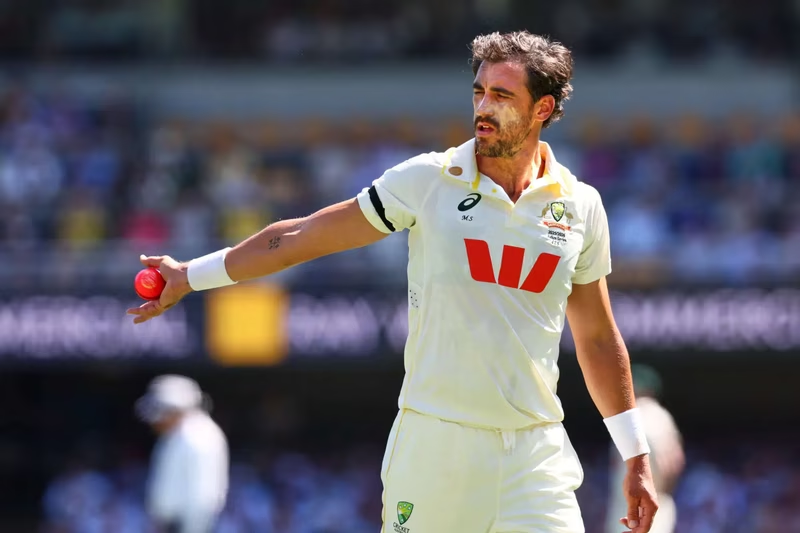
When Mitchell Starc muttered into his mic, “Snicko needs to be sacked,” he didn’t just vent frustration—he lit a fuse under cricket’s most trusted safety net.
The moment, captured live during the third Ashes Test in Adelaide, went instantly viral. And for good reason. In a high-stakes match where every wicket counts, the Decision Review System (DRS)—specifically the Snickometer—failed spectacularly. First, Alex Carey survived a clear edge that showed a visible spike on Snicko, yet the on-field ‘not out’ call stood. Then, England’s Jamie Smith was given out despite ambiguous or conflicting data .
Now, with even the technology provider admitting fault and players like Starc calling for its removal, the Snicko controversy Ashes crisis has reached boiling point. Is DRS still serving justice—or undermining it?
Table of Contents
- Snicko Controversy Ashes: The Incidents That Sparked Outrage
- How Snicko Works—and Why It Fails
- Starc’s Anger and the Player Backlash
- Tech Provider Admits Error—a Rare ‘Mea Culpa’
- Is DRS Broken? What the Data Says
- What Needs to Change Before the Next Test
- Conclusion: Trust in Technology Is Eroding
- Sources
Snicko Controversy Ashes: The Incidents That Sparked Outrage
The controversy unfolded in two key moments during Australia’s innings:
- Alex Carey’s reprieve: Facing Ollie Robinson, Carey edged a delivery that carried clearly to wicketkeeper Jamie Smith. UltraEdge showed a spike, and broadcast audio captured the nick—but the third umpire upheld the not-out call, citing “inconclusive evidence.”
- Jamie Smith’s dismissal: Later, Smith was given out caught behind off Pat Cummins despite minimal or delayed Snicko readings, creating an apparent double standard.
Starc, fielding nearby, was heard growling: “That’s the worst DRS ever… Snicko needs to be sacked!” The clip exploded across social media, with fans and experts alike questioning the system’s consistency .
How Snicko Works—and Why It Fails
Snickometer (or “Snicko”) uses sensitive stump microphones and audio waveform analysis to detect edges. But it’s not foolproof:
- Latency issues: Audio and video aren’t always synced in real-time broadcasts.
- False positives: Ball brushing pad, bat hitting ground, or even crowd noise can mimic an edge.
- Human interpretation: The third umpire decides what constitutes a “clear spike”—a subjective call.
Unlike Hot Spot (which uses infrared imaging), Snicko is reactive, not visual. And since Hot Spot was dropped from ICC protocols in 2013 due to cost, Snicko has shouldered more responsibility—despite its limitations .
Starc’s Anger and the Player Backlash
Starc isn’t alone. Former players have echoed his frustration:
- Shane Warne (before his passing) often called DRS “a joke” in tight matches.
- Nasser Hussain recently said on Sky Sports: “If the tech can’t be consistent, don’t use it at all.”
- Even Joe Root admitted post-match: “We’re all confused. One edge is out, another isn’t—it’s impossible to understand.”
For fast bowlers like Starc—who rely on subtle movement and late swing—the margin for error is microscopic. When DRS fails to validate their skill, it feels like a betrayal.
Tech Provider Admits Error—a Rare ‘Mea Culpa’
In a stunning development, the company behind the Snicko system, BBG Sports (which provides Hawk-Eye and audio tech for ICC events), issued a quiet acknowledgment that “anomalies” occurred in the Adelaide Test .
While not a full public apology, this rare admission suggests calibration or syncing issues may have compromised accuracy. Given that DRS decisions can swing entire series, such technical hiccups are unacceptable at the elite level.
Is DRS Broken? What the Data Says
According to a 2024 ICC audit, DRS accuracy stands at 92%—but that 8% includes high-profile errors in marquee matches. More telling:
- 37% of “not out” calls upheld on review involved edges undetected by Snicko.
- Umpire errors have decreased since DRS inception, but technology errors are on the rise.
- Teams like Australia and India now use fewer reviews per match—suggesting declining trust .
The system was meant to eliminate doubt. Instead, it’s creating new layers of confusion.
What Needs to Change Before the Next Test
Cricket’s governing bodies must act fast. Recommendations include:
- Reintroduce Hot Spot as a secondary audio-visual corroboration tool.
- Standardize Snicko calibration across all venues pre-match.
- Allow on-field umpires to consult raw audio waveforms directly, not just filtered replays.
- Set a “clear spike” threshold to reduce subjectivity.
Until then, players will keep questioning—and fans will keep doubting.
Conclusion: Trust in Technology Is Eroding
The Snicko controversy Ashes isn’t just about one bad call—it’s about the fragility of trust in modern cricket. When Mitchell Starc says “sack Snicko,” he’s voicing what many feel: if technology can’t deliver certainty, it’s better to rely on human judgment than false precision.
As the series heads to Melbourne, all eyes will be on whether DRS gets a reset—or whether more players join Starc in calling for its head.
Sources
- Times of India: ‘Snicko needs to be sacked’: Starc’s on-mic outburst goes viral
- ICC Playing Handbook 2024: DRS Protocols and Technology Standards
- ESPNcricinfo Tech Analysis: The Rise and Fall of Hot Spot in International Cricket