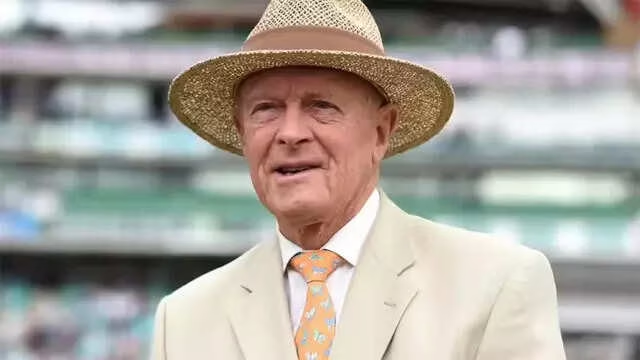
It’s a crisp winter morning in Delhi. The Feroz Shah Kotla ground is quiet—no roaring crowds, no flashing cameras, just the soft thud of leather on willow. At the crease stands a man known for his grit, not glamour: Geoffrey Boycott.
He needs 82 runs to overtake the legendary Garry Sobers as Test cricket’s all-time leading run-scorer—a record Sobers had held for nearly a decade. It’s December 23, 1981. And what unfolds next isn’t just a personal milestone. It’s a pivotal chapter in cricket history.
With a cover drive off Kapil Dev, Boycott reaches his 22nd Test century and, more importantly, his 8,037th Test run—surpassing Sobers’ mark of 8,032. The achievement caps a career built on discipline, patience, and an almost obsessive focus on occupation of the crease. Yet, astonishingly, Boycott would retire from international cricket just six weeks later, leaving fans stunned.
Table of Contents
- Boycott Surpasses Sobers Test Runs: The Delhi Innings
- The Sobers Era and Why the Record Mattered
- Boycott’s Methodical Path to Greatness
- The Abrupt Retirement: Why He Quit at His Peak
- Legacy: How the Record Stacks Up Today
- Eyewitness Accounts and Media Reaction
- Conclusion: A Quiet Revolution in Delhi
Boycott Surpasses Sobers Test Runs: The Delhi Innings
The stage was set during the fourth Test of England’s 1981–82 tour of India. Boycott walked in at No. 3 on Day 1, facing a potent Indian attack featuring Kapil Dev, Balwinder Sandhu, and Dilip Doshi.
His innings was classic Boycott: unhurried, technically pristine, and utterly defiant. He scored his runs at a glacial pace—just 46 off the first 200 balls—but every run was deliberate. When he finally edged past Sobers’ total, there was no grand celebration. Just a raised bat, a nod to the dressing room, and a return to his guard.
He finished the day on 104*, having batted 7 hours and 19 minutes. The century wasn’t just about the record—it was a statement of endurance in subcontinental conditions where English batsmen often floundered.
The Sobers Era and Why the Record Mattered
Before Boycott, Garry Sobers wasn’t just a run-scorer—he was the embodiment of cricketing genius. A left-handed all-rounder who could bat, bowl pace or spin, and field like a panther, Sobers amassed 8,032 runs in 93 Tests between 1954 and 1974 .
For 7 years, his run tally stood unchallenged. In an era before Tendulkar, Kallis, or Cook, Sobers’ record was the pinnacle of batting longevity and consistency. To overtake him wasn’t just a statistical feat—it was symbolic: the triumph of method over flair, of discipline over exuberance.
Boycott’s Methodical Path to Greatness
Boycott’s philosophy was simple: “Get in, stay in, and the runs will come.” Critics called him selfish; fans called him reliable. His career average of 47.72—built over 108 Tests—reflected his resilience.
Key milestones on his path to 8,037 runs:
- 1964: Debut vs Australia—scored 107.
- 1970: Returned from self-imposed exile, rebuilt his technique.
- 1977: Scored his 100th first-class century—only the third Englishman to do so.
- 1981: Reached 8,000 Test runs during the Ashes, setting up the Delhi showdown.
Unlike Sobers, who played with joyful abandon, Boycott approached cricket like a chess match—every ball calculated, every risk minimized.
The Abrupt Retirement: Why He Quit at His Peak
Just six weeks after his Delhi century, Boycott announced his retirement from international cricket—at age 41, as the world’s leading run-scorer.
Why? Several factors converged:
- Team politics: He’d clashed repeatedly with England captain Ian Botham over tactics and attitude.
- Media scrutiny: His slow scoring drew constant criticism, especially in the post-Botham “Entertainment Era.”
- Personal choice: He later admitted he “wanted to leave while still on top”—and with the record in hand, he felt he had nothing left to prove .
His exit shocked the cricketing world. But in hindsight, it was quintessentially Boycott: controlled, decisive, and on his own terms.
Legacy: How the Record Stacks Up Today
Boycott held the record for only 4 years before Sunil Gavaskar surpassed him in 1985. Today, the list is dominated by modern giants:
- Sachin Tendulkar: 15,921 runs (all-time leader)
- Ricky Ponting: 13,378 runs
- Steve Smith: Still climbing
Yet Boycott’s feat remains significant. He was the first to break the 8,000-run barrier—a threshold once thought unreachable. His Delhi century symbolized the professionalization of batting: no longer just art, but science.
For context on how records have evolved, the ESPNCricinfo archives provide a compelling timeline of Test run-scoring milestones .
Eyewitness Accounts and Media Reaction
Contemporary reports from The Times of India described the Kotla crowd as “sparse but respectful.” Indian players, including Kapil Dev, later praised Boycott’s concentration.
Back in England, the BBC called it “a triumph of will over pace.” Yet, even celebratory headlines were tinged with melancholy—many sensed this was Boycott’s swansong.
Conclusion: A Quiet Revolution in Delhi
Geoffrey Boycott’s record-breaking innings in Delhi wasn’t flashy. There were no sixes, no dance down the pitch, no emotional outbursts. Just 297 balls, 12 boundaries, and a legacy secured.
In an age of instant highlights and viral moments, Boycott’s achievement reminds us that cricket’s greatest triumphs are sometimes quiet—forged in patience, discipline, and an unshakable belief in one’s method. On this day in 1981, Test cricket didn’t just get a new run-scorer. It got a new definition of greatness.