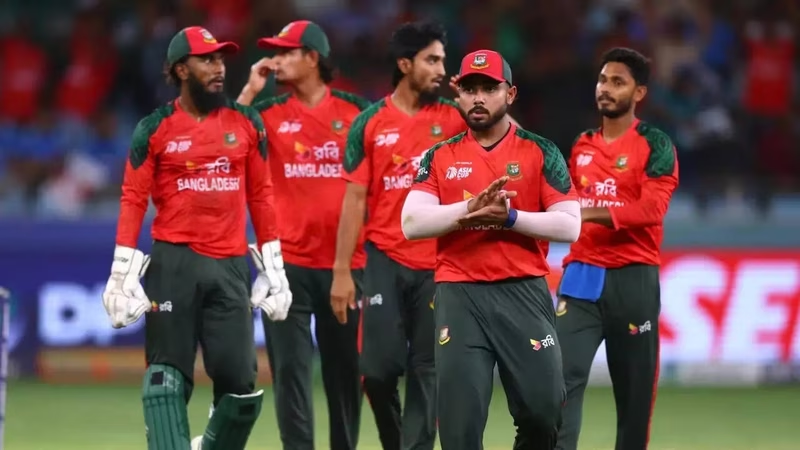
Cricket fans were bracing for high-octane India-Bangladesh clashes in the upcoming T20 World Cup 2026. But those plans may now go up in smoke. In a dramatic turn of events, the Bangladesh Cricket Board (BCB) has formally declined to tour India for the tournament, explicitly citing “safety and security concerns” as its primary reason.
This bombshell—confirmed after an emergency online meeting of BCB directors on Saturday night—comes on the heels of star fast bowler Mustafizur Rahman’s sudden exit from the Indian Premier League (IPL). While the BCCI has remained largely silent, sources confirm its advisory role in Rahman’s release, which has now escalated into a full-blown international sporting crisis.
The fallout? Bangladesh refuses T20 World Cup India tour—a decision that could reshape the tournament’s structure, strain bilateral ties, and force the ICC into damage-control mode.
Table of Contents
- The Trigger: Mustafizur Rahman’s IPL Exit
- Bangladesh Refuses T20 World Cup India Tour: Official Statement
- What Happened in the BCB Emergency Meeting?
- Indian Reactions and Political Fallout
- Impact on the T20 World Cup 2026
- What the ICC Can Do Next
- Conclusion: When Safety Concerns Overrule Sport
- Sources
The Trigger: Mustafizur Rahman’s IPL Exit
On the surface, Mustafizur Rahman’s departure from the Kolkata Knight Riders (KKR) looked like a routine roster adjustment. But behind the scenes, it was anything but.
According to multiple reports, the Board of Control for Cricket in India (BCCI) advised KKR to release the Bangladeshi pacer due to what it described as “prevailing security conditions.” While no official threat was cited, the context points to recent communal tensions in Bangladesh and India’s resulting diplomatic caution.
For the BCB, however, this wasn’t just a precaution—it was a red flag. If one of their star players wasn’t welcome in the IPL, how could the entire squad be safe during a multi-week international tournament?
Bangladesh Refuses T20 World Cup India Tour: Official Statement
In a rare public clarification, the BCB issued a statement saying:
“After thorough deliberation and in light of current circumstances, the Board has serious concerns regarding the safety and security of our players and support staff. In the absence of credible assurances, we cannot send our team to India for the T20 World Cup.”
Notably, the BCB stopped short of calling it a “boycott,” instead framing the decision as a precautionary, player-first move. Still, the message is clear: without guarantees, Bangladesh won’t participate in matches scheduled for Kolkata, Mumbai, or Bengaluru.
What Happened in the BCB Emergency Meeting?
The BCB directors convened late Saturday night in a virtual session that lasted over two hours. Key points discussed included:
- Review of intelligence inputs and media reports regarding Mustafizur’s IPL release
- Consultation with Bangladesh’s Ministry of Foreign Affairs
- Assessment of past security arrangements during India tours
- Legal implications under ICC tournament regulations
According to a senior BCB official (who requested anonymity), the consensus was “overwhelmingly in favor of postponing or relocating” the team’s participation. “Player welfare is non-negotiable,” the source said.
Indian Reactions and Political Fallout
The news sparked immediate reactions in India. Congress leader and cricket aficionado Shashi Tharoor called the episode a “self-inflicted embarrassment,” blaming the BCCI for “mixing sport with statecraft.”
Meanwhile, the BCCI has maintained a low profile, with a spokesperson only stating that “all decisions were made in consultation with relevant authorities.” Critics argue this ambiguity is worsening the crisis.
For context on how past India-Bangladesh cricket ties have navigated politics, see [INTERNAL_LINK:india-bangladesh-cricket-diplomacy-history].
Impact on the T20 World Cup 2026
If Bangladesh sticks to its stance, the ICC faces a logistical nightmare:
- Venue reshuffling: All of Bangladesh’s group games (likely vs India, Pakistan, and a qualifier) must be moved.
- Revenue loss: The BCCI could lose an estimated ₹300–500 crore in match-day income from high-demand fixtures.
- Fan backlash: Millions of spectators who bought tickets may face cancellations or relocations.
Worse, other nations might question the stability of hosting mega-events in India—a serious blow to its global sporting reputation.
What the ICC Can Do Next
The International Cricket Council now has three paths:
- Relocate Bangladesh’s matches to a neutral venue like Sri Lanka or UAE—already used in past emergencies.
- Facilitate direct talks between BCCI and BCB to restore trust, possibly with third-party security guarantees.
- Invoke tournament rules and declare forfeits if Bangladesh withdraws entirely—though this is seen as a last resort.
The ICC’s official stance so far: “We are in active dialogue with all member boards and will ensure the tournament proceeds with integrity.” (Source: ICC Official Website)
Conclusion: When Safety Concerns Overrule Sport
The phrase “Bangladesh refuses T20 World Cup India tour” is more than a headline—it’s a symptom of deeper fractures between sport and state. While the BCB’s decision is framed around player safety, its roots lie in diplomatic mistrust and opaque decision-making by the BCCI.
Cricket has long been India and Bangladesh’s shared passion. But if institutions prioritize politics over the pitch, even the world’s second-most popular sport may not be enough to keep the peace.
Sources
Times of India. (2026, January 4). ‘Safety and security concerns’: What Bangladesh said on not touring India for T20 WC. https://timesofindia.indiatimes.com/…
ESPNcricinfo. (2026). BCB cites security concerns over India T20 WC tour. https://www.espncricinfo.com
The Hindu. (2026). Mustafizur’s IPL exit triggers Bangladesh’s World Cup dilemma. https://www.thehindu.com/…
ICC Governance and Tournament Regulations