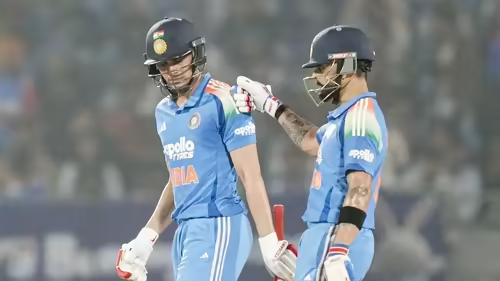
Cricket has a cruel way of balancing brilliance with heartbreak. On January 18, 2026, at Eden Park in Auckland, Virat Kohli delivered yet another masterclass—his 54th ODI century—a knock full of grit, timing, and vintage cover drives that reminded the world why he remains the benchmark for modern batting . Yet, as the final wicket fell, India stood defeated by 41 runs, their series-deciding match slipping away despite their superstar’s heroics.
In the aftermath, newly appointed captain Shubman Gill faced the press with a mix of pride and pragmatism. “Virat bhai is always a plus,” he said, “but…” That pause spoke volumes. It wasn’t just about one loss—it was about a team in transition, searching for identity beyond individual brilliance.
Table of Contents
- Kohli’s Century in a Lost Cause
- Gill’s Leadership and the ‘But…’
- Bright Spots: Harshit Rana and Nitish Reddy
- What Went Wrong for India?
- Looking Ahead to World Cup 2027
- Conclusion: Brilliance Isn’t Enough
- Sources
Kohli’s Century in a Lost Cause
Chasing 293 against a disciplined New Zealand attack, India’s top order crumbled early. At 48/3, the game seemed lost. Enter Virat Kohli. What followed was a 112-ball 107—laced with 10 boundaries and two sixes—that anchored India’s fightback. He stitched crucial partnerships, rotated strike intelligently, and even accelerated in the death overs .
But cricket is a team sport. Once Kohli was dismissed in the 44th over, the innings collapsed like a house of cards. The next highest score? Just 28. His century, while magnificent, became a solitary island in a sea of underperformance—a painful reminder that even greatness can’t win alone.
Virat Kohli 54th ODI century: Gill’s Leadership and the ‘But…’
Speaking post-match, Gill didn’t shy away from hard truths. “Having Virat bhai in the side is always a plus,” he began, “but we need more players to step up. One good performance isn’t enough to win games at this level.”
His words reflect a mature captaincy philosophy—one focused on collective responsibility rather than relying on legends. As India builds toward the 2027 ODI World Cup, Gill knows that sustainable success requires depth, not just star power.
He also emphasized the importance of learning from failure: “We’re experimenting with combinations. Some things worked, some didn’t. That’s part of the process.”
Bright Spots: Harshit Rana and Nitish Reddy
Amid the disappointment, Gill highlighted two emerging talents who gave him hope:
- Harshit Rana: The young pacer impressed with his pace and control, finishing with figures of 2/48 in his first high-pressure ODI. His yorkers in the death overs showed promise beyond his years.
- Nitish Kumar Reddy: The all-rounder contributed a quickfire 22 and bowled a tidy spell of medium pace, showcasing the kind of versatility India needs in middle-order roles.
“These are the guys we’re investing in,” Gill noted. “They’re fearless, and they’re learning fast.”
What Went Wrong for India?
Beyond the lack of support for Kohli, several issues plagued India’s performance:
- Top-order fragility: Openers failed again, putting undue pressure on the middle order.
- Death bowling: Conceding 65 runs in the last 10 overs allowed New Zealand to post a competitive total.
- Fielding lapses: Two dropped catches proved costly, including one off Kohli’s bat that could’ve changed the game’s momentum.
As analyzed by experts at [INTERNAL_LINK:india-odi-fielding-analysis], consistent fielding standards remain a work in progress for the current squad.
Looking Ahead to World Cup 2027
With the 2027 ODI World Cup in South Africa still over a year away, this series serves as a vital stress test. The BCCI’s long-term vision is clear: transition from a Kohli-Dhoni-Rohit core to a new generation led by Gill, Suryakumar Yadav, and Rishabh Pant.
According to the ICC’s official roadmap for the 2027 cycle, teams are using bilateral series like this one to finalize core squads and playing styles. India’s management appears committed to this process—even if it means short-term losses.
Conclusion: Brilliance Isn’t Enough
Virat Kohli’s 54th ODI century was a gift to fans—a final flourish of genius in a fading era. But as Shubman Gill so wisely implied, the future of Indian cricket can’t be built on nostalgia. It must be forged through collective growth, tactical discipline, and the courage to let new stars rise. Kohli will always be a “plus.” But for India to win when it matters most, they need eleven pluses—not just one.
Sources
- Times of India: ‘Virat bhai always a plus, but …’: Gill reflects after Kohli’s ton fails to save India
- ICC Official Website: 2027 ODI World Cup Preparation Guidelines
- Match Scorecard: India vs New Zealand, 3rd ODI, Auckland, Jan 18, 2026