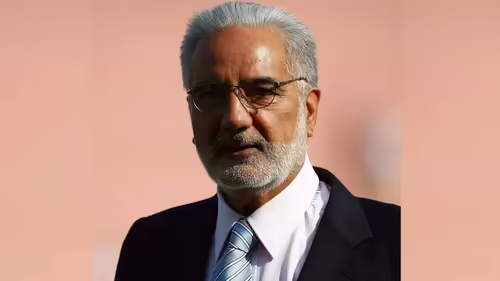
When you think of modern Indian cricket, names like Tendulkar, Kohli, or even Ambani might come to mind. But behind the glitz of billion-dollar TV rights and packed stadiums stood a man few outside the corridors of power truly knew—IS Bindra.
His recent passing has sent ripples through the cricketing world, not with the fanfare of a superstar’s farewell, but with the deep, respectful silence reserved for those who built the stage others perform on. Veteran administrator Prof. Ratnakar Shetty put it best: “BCCI was lucky to have a top administrator like IS Bindra.”
But who was he, really? And why do insiders consider him the unseen architect of India’s cricketing empire?
Table of Contents
- Who Was IS Bindra? The Man Behind the Miracle
- IS Bindra and the BCCI’s Financial Revolution
- The World Cup Host and Asian Cricket Diplomat
- His Secret Hand in the IPL’s Birth
- Tributes Pour In From Across the Cricketing World
- Conclusion: Why IS Bindra’s Legacy Matters Today
- Sources
Who Was IS Bindra? The Man Behind the Miracle
Indrapal Singh Bindra wasn’t a cricketer. He never hit a six or took a wicket. Yet, his impact on the game arguably rivals any on-field legend. A former chairman of the Punjab Cricket Association and a long-serving BCCI official, Bindra rose through the ranks during an era when Indian cricket was still finding its voice on the global stage.
Known for his sharp intellect, strategic foresight, and unwavering integrity, he became one of the most trusted figures in international cricket administration. His tenure coincided with India’s transition from a passionate cricketing nation to the sport’s undisputed financial and political center.
IS Bindra and the BCCI’s Financial Revolution
One of IS Bindra’s most pivotal contributions was leading the BCCI’s historic fight for broadcasting rights. In the late 1990s and early 2000s, cricket boards worldwide were at the mercy of state broadcasters or foreign networks. Bindra, alongside other key administrators, championed the idea that the BCCI—not external entities—should own and monetize its content.
This shift was revolutionary. It laid the foundation for the massive media deals that now fund Indian cricket, grassroots development, and infrastructure. Without this financial autonomy, the IPL as we know it would never have existed. As Ratnakar Shetty noted, Bindra’s vision ensured that “Indian cricket earned what it deserved.”
The World Cup Host and Asian Cricket Diplomat
Beyond finances, IS Bindra was instrumental in strengthening India’s ties within Asian cricket. He played a key role in forging alliances with boards in Pakistan, Sri Lanka, Bangladesh, and the UAE—relationships that proved crucial when India co-hosted major tournaments.
He was deeply involved in the successful hosting of the 1987 and 1996 Cricket World Cups in the subcontinent. These weren’t just sporting events; they were logistical and diplomatic triumphs that showcased Asia’s ability to organize global spectacles. Bindra’s behind-the-scenes coordination helped turn these tournaments into benchmarks for future hosts.
His Secret Hand in the IPL’s Birth
While Lalit Modi is often credited as the “father of the IPL,” insiders like Shetty reveal that IS Bindra was a critical guiding force in its formative years. As a senior BCCI advisor during the league’s inception in 2007–08, Bindra provided institutional wisdom, navigated political minefields, and helped establish governance frameworks that gave the IPL initial credibility.
He understood that for the IPL to succeed, it needed more than glamour—it needed structure, transparency, and alignment with the BCCI’s long-term vision. His influence helped temper the league’s commercial frenzy with administrative discipline, ensuring it didn’t collapse under its own ambition.
Tributes Pour In From Across the Cricketing World
Following his passing, tributes have flooded in from across the cricket ecosystem:
- Ratnakar Shetty: “He was a top administrator whose contributions are immeasurable.”
- Former BCCI officials: Called him “the conscience of Indian cricket administration.”
- ICC representatives: Remembered his role in promoting unity among Asian nations during tense geopolitical periods.
What’s striking is the consistency of the praise—not for charisma, but for competence, integrity, and quiet leadership. In an age of noise, Bindra was the steady hand on the tiller.
Conclusion: Why IS Bindra’s Legacy Matters Today
In today’s era of franchise leagues, digital streaming wars, and global cricket politics, the foundations laid by IS Bindra are more relevant than ever. He proved that strong, principled administration is just as vital as star players.
As the BCCI navigates new challenges—from revenue sharing to global expansion—Bindra’s legacy serves as a blueprint: prioritize long-term vision over short-term gains, build alliances, and never lose sight of the game’s spirit. For anyone interested in how cricket became a business powerhouse, understanding his role is essential. Dive deeper into the evolution of Indian cricket with our feature on [INTERNAL_LINK:bcci-governance-through-the-decades].