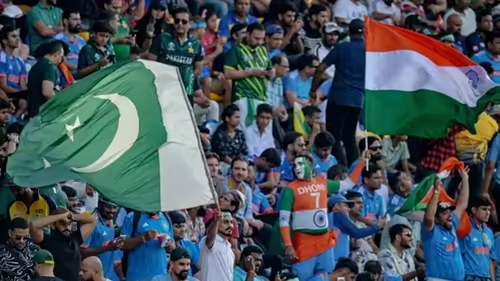
In a move that has sent shockwaves through the cricketing world, the Pakistani government has instructed its national team to boycott its scheduled T20 World Cup 2026 match against arch-rival India on February 15th in Colombo [[1]]. The International Cricket Council (ICC), the sport’s global governing body, has responded with unprecedented force, labeling the decision as “selective participation” and a direct assault on the foundational principles of international competition.
Table of Contents
- ICC’s Official Statement and Core Concerns
- What Does Pakistan’s Boycott of the T20 World Cup Mean?
- Potential Consequences for the PCB and Pakistani Cricket
- Historical Context: India-Pakistan in ICC Events
- The Road Ahead for the T20 World Cup 2026
- Conclusion
- Sources
ICC’s Official Statement and Core Concerns
The ICC has made its position crystal clear. In its official response, the council stated it is “awaiting formal communication from the Pakistan Cricket Board (PCB)” but has already expressed its deep reservations [[3]]. The core of the ICC’s argument rests on three non-negotiable pillars: fairness, integrity, and equal competition.
By refusing to play a single opponent while still participating in the rest of the tournament, Pakistan is engaging in what the ICC calls “selective participation.” This practice, the council argues, fundamentally undermines the spirit of a global event where every team is expected to compete against all others on a level playing field. The ICC has warned that this precedent, if left unchallenged, could have severe and far-reaching implications for the future of international cricket [[5]].
What Does Pakistan’s Boycott of the T20 World Cup Mean?
The decision, which appears to be a political one made by the government rather than the PCB or the players themselves, puts the entire tournament in jeopardy [[14]]. The Pakistani captain, Salman Ali Agha, has publicly stated that the boycott was “not our decision,” highlighting the uncomfortable position the athletes have been placed in [[14]].
This isn’t just about one match; it’s about the sanctity of the competition. If teams can opt out of fixtures based on political tensions, the credibility of every future ICC event—from the World Test Championship to the Women’s ODI World Cup—would be called into question. The ICC has emphasized that such actions not only harm the global game but also deeply disappoint millions of fans, including those within Pakistan who were eagerly anticipating the high-stakes encounter [[3]].
Potential Consequences for the PCB and Pakistani Cricket
The ICC’s warning is not an empty threat. The council has explicitly asked the PCB to consider the “long-term implications for cricket in its own country” [[5]]. These implications could be devastating:
- Heavy Fines: The PCB could face significant financial penalties for breaching its participation agreement with the ICC.
- Points Deduction or Forfeit: The match against India could be awarded to India by forfeit, severely damaging Pakistan’s chances of progressing in the tournament.
- Suspension from Future Events: In the most extreme scenario, the ICC is reportedly contemplating the suspension of Pakistan from future ICC events, a move that would isolate the nation from the international cricketing community [[6]].
- Loss of Hosting Rights: Any future bids by Pakistan to host major ICC tournaments would likely be rejected.
These sanctions would not only punish the board but would also deprive a generation of talented Pakistani cricketers of the opportunity to compete on the world stage.
Historical Context: India-Pakistan in ICC Events
The rivalry between India and Pakistan is arguably the most intense in all of sports. While their bilateral series have been sporadic due to political tensions, ICC tournaments have remained the primary battleground for this epic contest. Historically, India has dominated these high-pressure encounters, winning 14 of the 17 completed matches across World Cups and T20 World Cups [[20]].
From the inaugural T20 World Cup final in 2007 to the nerve-wracking group stage clashes in recent years, these matches have consistently delivered unforgettable drama. The prospect of this fixture being absent from the 2026 tournament is a massive blow to fans and a significant loss of prestige for the event itself. You can learn more about this storied rivalry in our deep dive on [INTERNAL_LINK:india-pakistan-cricket-history].
The Road Ahead for the T20 World Cup 2026
As of now, the situation remains fluid. While the government has issued its directive, there are reports of high-level talks that could potentially lead to a softening of Pakistan’s stance [[11]]. The ICC has urged all parties to find a resolution that upholds the integrity of the game.
The next few days will be critical. The ICC must receive official communication from the PCB and will then have to make a decisive ruling on how to proceed. The entire cricketing world is watching, hoping that sport can triumph over politics and that fans will not be denied what is always one of the tournament’s marquee fixtures.
Conclusion
The ICC’s strong reaction to Pakistan’s decision to boycott its T20 World Cup match against India is a necessary defense of the sport’s core values. Allowing “selective participation” would set a dangerous precedent that could fracture the global cricketing ecosystem. The onus is now on the PCB and the Pakistani government to reconsider their position, not just for the sake of the 2026 tournament, but for the long-term health and unity of international cricket. The consequences of inaction could be catastrophic for the game in Pakistan and beyond.
Sources
- Al Jazeera. “Pakistan to boycott T20 World Cup match against India on February 15.” https://www.aljazeera.com/sports/2026/2/1/pakistan-to-boycott-t20-world-cup-match-against-india-on-february-15
- Times of India. “Pakistan to play T20 World Cup but boycott India match, ICC warns of consequences.” https://timesofindia.indiatimes.com/sports/cricket/icc-mens-t20-world-cup/pakistan-to-play-t20-world-cup-but-boycott-india-match-icc-warns-of-consequences/articleshow/127851705.cms
- ESPNcricinfo. “ICC warns PCB of consequences of boycotting India match at T20 World Cup.” https://www.espncricinfo.com/story/icc-warns-pcb-of-consequences-of-boycotting-india-match-at-t20-world-cup-1521957
- NDTV Sports. “ICC Contemplates ‘Suspending’ Pakistan As T20 World Cup Sanction Over India Boycott.” https://sports.ndtv.com/t20-world-cup-2026/icc-contemplates-sanctions-on-pakistan-over-india-boycott-in-t20-world-cup-10929259
- NDTV Sports. “Pakistan Skipper’s Honest Reply To T20 World Cup 2026 ‘Boycott’: ‘Not Our Decision’.” https://sports.ndtv.com/t20-world-cup-2026/pakistan-skipper-salman-ali-agha-breaks-silence-on-t20-world-cup-2026-boycott-not-our-decision-10928141
- News18. “A Look Back at India-Pakistan Encounters in ICC Events.” https://www.news18.com/cricketnext/news/a-look-back-at-india-pakistan-encounters-in-icc-events-india-lead-arch-rivals-14-3-4094858.html