Table of Contents
- Australia’s Bold Move: Prioritizing the Long Game
- The Josh Hazlewood T20 World Cup 2026 Situation
- Who Steps Up? The New-Look Pace Attack
- Australia’s T20 WC 2026 Path and the Sri Lankan Challenge
- What This Means for Australia’s Title Defense
- Conclusion: A Calculated Risk
- Sources
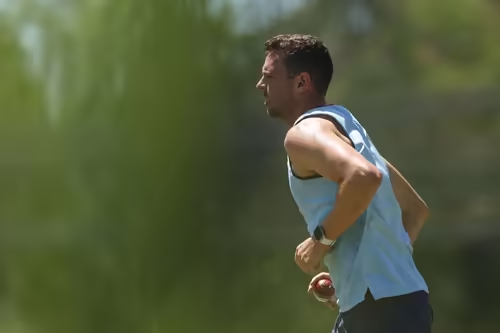
The defending champions just threw a massive curveball into the T20 World Cup 2026 mix. In a move that’s equal parts cautious and controversial, Cricket Australia has confirmed that their premier fast bowler, Josh Hazlewood, will sit out the tournament’s opening fixtures. This isn’t just a minor setback; it’s a strategic gamble that could define Australia’s entire campaign. So, what’s really going on, and can the Aussies survive without their pace spearhead?
Australia’s Bold Move: Prioritizing the Long Game
Forget the short-term pain; Australia is playing a marathon, not a sprint. The decision to keep Hazlewood back in Sydney for targeted rehabilitation isn’t about giving up on the early games—it’s about winning the ones that matter most. With a history of managing workloads for their key quicks, the selectors are betting that a fully fit Hazlewood in the Super Eight stage and beyond is worth more than a compromised version in the group stage.
This strategy, while frustrating for fans eager to see their full-strength team, speaks volumes about the depth of respect for Hazlewood’s role in the side. He’s not just another bowler; he’s the architect of pressure, the master of the death overs, and a leader on the field. Rushing him back from an Achilles issue could risk a far more serious, long-term problem—a scenario Cricket Australia is desperate to avoid [[1]].
The Josh Hazlewood T20 World Cup 2026 Situation
The official word is clear: Hazlewood is staying home to continue his rehab from an Achilles injury in a familiar environment [[5]]. This follows a series of setbacks, including a hamstring strain that ruled him out of the latter part of the Ashes series, before the Achilles soreness flared up [[2]]. The goal is to have him join the squad in Colombo later in the group stage, ideally before the crucial knockout rounds.
This news comes as a significant blow, especially following the earlier confirmation that Pat Cummins is also being managed through injury, leaving a gaping hole in Australia’s pace department [[6]]. The Josh Hazlewood T20 World Cup 2026 absence is a stark reminder of the physical toll of modern cricket and the fine line between availability and peak performance.
Who Steps Up? The New-Look Pace Attack
With Hazlewood on the sidelines, the spotlight shifts dramatically to the rest of the squad. The good news for Australia is that they’ve already bolstered their ranks. Glenn Maxwell, Tim David, and Nathan Ellis have all joined the main squad in Colombo, ready to go [[13]].
However, the most critical addition is Sean Abbott, who has been named as a travelling reserve specifically for bowling cover [[15]]. Abbott, a seasoned domestic performer with a knack for yorkers, is now on high alert. His experience could be vital in the subcontinental conditions of Sri Lanka, where Australia will play all their group stage matches [[23]].
Here’s a quick look at the potential pace options for Australia’s early games:
- Nathan Ellis: Returning from his own hamstring issues, Ellis will be expected to lead the line. His slingy action can be tricky, but his fitness is a question mark [[17]].
- Sean Abbott: The primary backup, known for his death-bowling skills in the BBL. He’s the most likely to get the first call if needed [[11]].
- Cameron Green: The all-rounder will be asked to shoulder a heavier bowling load, which could impact his batting.
- Xavier Bartlett: A young quick with promise, but limited international experience in high-pressure tournaments.
Australia’s T20 WC 2026 Path and the Sri Lankan Challenge
Australia’s group stage journey begins on February 11th against Ireland in Colombo, followed by a match against Zimbabwe on February 13th [[22]]. While these are theoretically winnable games even without Hazlewood, the real test will be how the makeshift attack handles the slow, turning pitches of Sri Lanka. These conditions naturally favour spinners, but a reliable, accurate seamer is still crucial to contain the power hitters in the middle overs.
Losing Hazlewood’s metronomic line and length in these conditions is a significant tactical disadvantage. His ability to bowl tight spells and build pressure is something that’s hard to replicate, especially with a less experienced group of pacers. For fans looking to track every ball, our [INTERNAL_LINK:live-scores] page will be your best friend.
What This Means for Australia’s Title Defense
Let’s be honest: Australia’s path to a second consecutive T20 World Cup title just got a lot rockier. Their strategy is a high-risk, high-reward play. If Hazlewood returns in top form for the business end of the tournament, they might just have the firepower to go all the way. But if the early losses pile up or the backup bowlers struggle to contain opposition batting line-ups, their campaign could fizzle out before the main man even arrives.
This situation also puts immense pressure on their batting unit, led by Mitchell Marsh and Travis Head, to post big totals and take the burden off the inexperienced bowlers. It’s a fascinating subplot to watch in the coming weeks. For a deeper dive into their chances, check out our [INTERNAL_LINK:analysis] section.
Conclusion: A Calculated Risk
Cricket Australia’s decision to manage Josh Hazlewood’s return from injury is a masterclass in long-term planning, but it’s fraught with immediate peril. By sacrificing their early group stage strength, they’re betting everything on having their full-strength leader for the final showdown. It’s a bold statement of intent, but one that leaves their title defense hanging in the balance. All eyes will be on Colombo to see if this gamble pays off or if it becomes their biggest regret of the tournament.
Sources
- Yahoo News Australia. “Injury-prone paceman to miss early T20 World Cup games”. https://au.news.yahoo.com/…/ [[1]]
- Nine.com.au. “Cricket T20 World Cup 2026: Josh Hazlewood injury”. https://www.nine.com.au/…/ [[2]]
- Times Now News. “After Pat Cummins, Australia Suffer Another Blow…”. https://www.timesnownews.com/…/ [[6]]
- Rediff.com. “Hazlewood to miss Australia’s early T20 World Cup games”. https://www.rediff.com/…/ [[5]]
- Cricbuzz. “Hazlewood to link up late with Australia’s T20 World Cup squad…”. https://www.cricbuzz.com/…/ [[13]]
- ESPN. “Hazlewood could miss the early phase of the World Cup…”. https://www.espn.com/…/ [[15]]
- Cricket Australia. “Hazlewood’s late arrival comes amid Aussie Cup concerns”. https://www.cricket.com.au/…/ [[17]]
- Cricket Australia. “All the squads for Men’s T20 World Cup 2026”. https://www.cricket.com.au/…/ [[22]]
- Facebook – Cricket N More. “Australia will play all their T20 World Cup 2026 group-stage matches in Sri Lanka…”. https://www.facebook.com/…/ [[23]]