The cricketing world is reeling from a seismic political decision that threatens to undermine the very foundation of international sport. In an unprecedented move, the Pakistan government has instructed its national team to boycott its scheduled T20 World Cup 2026 match against India, citing unrelated geopolitical grievances [[7]]. This act of selective participation has been met with swift and firm condemnation from the sport’s global governing body, the ICC, and now, a powerful ally has emerged in its defense: the Board of Control for Cricket in India (BCCI).
Table of Contents
- BCCI Stands Firm with ICC
- The ICC’s Unwavering Position
- Why Pakistan Boycotts India Match: A Deeper Look
- A Rivalry for the Ages: India vs. Pakistan in ICC Tournaments
- What Happens Next? Potential Consequences
- Conclusion: The Future of Cricket at a Crossroads
- Sources
BCCI Stands Firm with ICC
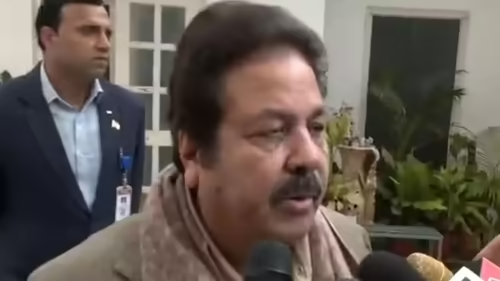
In a clear and decisive statement, BCCI Vice-President Rajeev Shukla has thrown his board’s full weight behind the International Cricket Council. “We completely agree with the ICC,” Shukla stated, signaling a united front against the politicization of the sport [[3]]. The BCCI, while historically protective of its own interests, has recognized the dangerous precedent set by Pakistan’s actions. Their stance is not just about one match; it’s about defending the integrity of the entire global cricketing ecosystem.
Shukla also indicated that the BCCI would await formal discussions with the ICC before making any further public comments, demonstrating a strategic and collaborative approach to resolving the crisis [[5]]. This measured response contrasts sharply with the abrupt and politically motivated decision from across the border.
The ICC’s Unwavering Position
The ICC has left no room for ambiguity in its official response. The world body has emphasized that “selective participation undermines the integrity of global sporting events” [[13]]. This is a core principle of international sport: all teams that enter a tournament must be willing to play every opponent on the schedule, regardless of political tensions off the field.
The ICC’s rules are clear, and the consequences for non-compliance are severe. The most likely outcome is that India will be awarded a walkover victory, receiving the full two points for the abandoned match [[9]]. However, the long-term implications for Pakistan’s standing within the ICC and its future participation in global events could be far more damaging.
Why Pakistan Boycotts India Match: A Deeper Look
While the immediate trigger for the boycott appears to be linked to the exclusion of Bangladesh from the tournament—a decision made by the ICC for reasons unrelated to India—the underlying cause is the decades-long political friction between the two nuclear-armed neighbors. Cricket has often been a proxy for this complex relationship, with matches between the two nations carrying immense emotional and nationalistic weight.
However, using a sporting event as a political bargaining chip is a dangerous game. It not only punishes the fans who have waited years for another chapter in this legendary rivalry but also isolates the Pakistani team from the global cricketing community. This decision is widely seen as a move by the government, not necessarily the cricket board or the players themselves, who would likely relish the challenge of facing their biggest rivals on the world stage.
A Rivalry for the Ages: India vs. Pakistan in ICC Tournaments
The potential absence of an India-Pakistan clash in the T20 World Cup is a massive loss for the sport. Their encounters in ICC tournaments are the stuff of legend, consistently drawing the highest global viewership and creating unforgettable moments of high drama.
Historically, India has dominated this fixture in World Cups, having won all 12 of their previous meetings in ODI and T20 World Cups combined [[14]]. The inaugural T20 World Cup final in 2007, where India triumphed over Pakistan, remains one of the most iconic matches in the format’s history [[17]]. This streak of Indian victories in neutral venues has only added to the intense pressure and anticipation surrounding every new encounter. Fans around the world were eagerly awaiting the next installment in Colombo, which now looks set to be a non-event.
What Happens Next? Potential Consequences
The fallout from this situation is likely to be multi-layered:
- For the Tournament: India will almost certainly be granted a walkover, securing a crucial two points in the group stage without having to bat or bowl [[9]].
- For Pakistan: Beyond the lost points, the ICC may impose fines or other sanctions on the Pakistan Cricket Board (PCB) for failing to fulfill its fixture. Their reputation as a reliable partner in the global game will suffer a significant blow.
- For the Future of Bilateral Cricket: This incident will make the already remote possibility of a bilateral series between the two nations even more unlikely in the near future. [INTERNAL_LINK:india-pakistan-bilateral-series-history]
- For the Fans: Millions of passionate fans on both sides of the border, and across the globe, are left deeply disappointed. The commercial and emotional heart of the tournament has been ripped out.
Conclusion: The Future of Cricket at a Crossroads
The decision by Pakistan to boycott its India match is a stark reminder of how fragile the apolitical nature of sport can be. While the BCCI’s strong backing of the ICC is a welcome affirmation of the sport’s core values, the damage to the game’s spirit is already done. The ICC now faces its biggest test in recent years: enforcing its rules without escalating a political conflict, while upholding the principle that a global tournament is meaningless if participants can pick and choose their opponents. The world will be watching to see how this delicate situation is resolved.
Sources
- Deccan Chronicle. “BCCI Backs ICC on Pakistan Boycotting T20 WC Match Against India.” https://www.deccanchronicle.com/bcci-backs-iccs-stance-on-pakistan-boycotting-t20-wc-match-rajeev-shukla-1934389
- Al Jazeera. “Pakistan to boycott T20 World Cup match against India on February 15.” https://www.aljazeera.com/sports/2026/2/1/pakistan-to-boycott-t20-world-cup-match-against-india-on-february-15
- The Times of India. “Pakistan to play T20 World Cup but boycott India match, ICC warns of consequences.” https://timesofindia.indiatimes.com/sports/cricket/icc-mens-t20-world-cup/pakistan-to-play-t20-world-cup-but-boycott-india-match-icc-warns-of-consequences/articleshow/127851705.cms
- T20WorldCup2026.com. “ICC Responds to Pakistan Boycott of India Match at T20 WC.” https://t20worldcup2026.com/icc-statement-pakistan-boycott-india/
- Vedantu. “List of World Cup Matches Between India and Pakistan.” https://www.vedantu.com/general-knowledge/list-of-world-cup-matches-between-india-and-pakistan
- Wikipedia. “History of the Men’s T20 World Cup.” https://en.wikipedia.org/wiki/History_of_the_Men%27s_T20_World_Cup