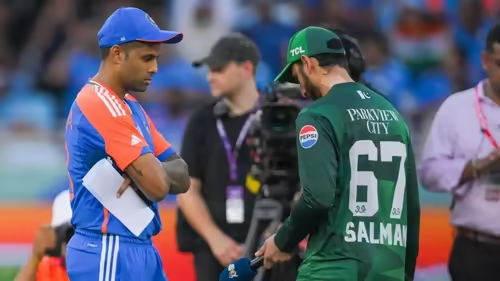
The cricketing world is reeling from a seismic announcement that transcends sport. On Sunday, the Pakistan Cricket Board (PCB), acting on government directives, declared it will not play its scheduled T20 World Cup 2026 group-stage match against India on February 15th [[1]]. This isn’t just a missed game; it’s a formal boycott with significant sporting and political ramifications. But what does this mean for Team India? The answer lies in the clear, albeit rarely used, ICC walkover rules.
Table of Contents
- The Official Announcement
- What Is a Walkover Under ICC Rules?
- Impact on India’s Campaign
- Consequences for Pakistan
- Historical Context and Fan Reaction
- Summary
- Sources
The Official Announcement
The statement from Pakistan was unequivocal: “The Pakistan cricket team shall not take the field in the match scheduled on 15th February 2026 against India,” [[2]]. This decision, reportedly stemming from a directive by the Government of Pakistan, confirms long-standing speculation about the fixture’s fate [[4]]. While Pakistan has stated its intention to continue participating in the rest of the tournament, their refusal to face India creates a unique and complex scenario for the International Cricket Council (ICC) to manage.
What Is a Walkover Under ICC Rules?
A walkover is a procedural outcome when one team fails to appear for a scheduled match without a valid reason accepted by the ICC. In the context of the Pakistan boycotts India T20 World Cup situation, the protocol is straightforward:
- India’s Obligation: Team India must still be present at the venue at the scheduled time and be ready to play. They must also be present for the toss.
- Pakistan’s Absence: If the Pakistani team fails to appear on the field or refuses to take the field after the toss, they are deemed to have forfeited the match.
- ICC’s Ruling: The match referee will officially award a walkover to India. This is not a victory by runs or wickets, but a formal administrative win.
According to the ICC’s playing conditions for its events, a team awarded a walkover is credited with a full win, which translates to two crucial points in the group stage standings [[3]]. This is the same number of points India would have received for a conventional victory.
Impact on India’s Campaign
For India, the immediate sporting impact is positive. Securing two points without having to bat or bowl is a significant boost to their position in the group. This virtually guarantees them a strong chance of progressing to the Super 8s or knockout stages, depending on the tournament format. However, this comes with a bittersweet taste.
From a competitive standpoint, the team loses a high-stakes, high-pressure match that serves as a vital benchmark against their biggest rival. These matches are often the ultimate test of a team’s mettle in a World Cup. Furthermore, fans are deprived of what is arguably the most anticipated fixture in the entire tournament—a clash that generates unparalleled global viewership and passion. For many, a walkover feels like an empty victory, lacking the drama and satisfaction of a hard-fought contest on the field.
Consequences for Pakistan
While Pakistan secures its participation in the rest of the tournament, the cost of this boycott is steep. Beyond the immediate loss of two points in the standings, the PCB is likely to face severe repercussions from the ICC. These could include:
- Financial Penalties: The ICC has the authority to impose hefty fines on the PCB for failing to fulfill a fixture [[9]].
- Reputational Damage: Such a politically motivated withdrawal severely damages Pakistan’s standing in the international cricketing community, painting them as unreliable partners in a global event.
- Future Sanctions: There is speculation that the ICC could consider more stringent measures, such as a ban from future tournaments, though this remains a complex legal and political issue [[7]].
This decision isolates Pakistan and puts its players in an awkward position, forced to compete in a World Cup while carrying the weight of a forfeited match against their arch-rival.
Historical Context and Fan Reaction
The India-Pakistan cricket rivalry is one of the most intense in all of sports, often serving as a proxy for the complex political relationship between the two nations. While bilateral series have been scarce in recent years, their meetings in ICC tournaments have remained a sacred, if tense, tradition. This boycott breaks that tradition in the most definitive way possible.
Fan reaction has been predictably polarized. Indian fans are frustrated at being denied the spectacle but relieved to secure the points. Many see it as a sign of weakness from Pakistan. Pakistani fans, on the other hand, are caught between national pride and the disappointment of missing out on a World Cup contest. The global cricketing community largely views this as a sad day for the sport, where politics has once again overshadowed competition. You can read more about the history of this rivalry in our deep dive on [INTERNAL_LINK:india-pakistan-cricket-rivalry-history].
Summary
In conclusion, the Pakistan boycotts India T20 World Cup decision has triggered a clear ICC protocol. India will be awarded a walkover for the February 15th match, securing two vital points for their campaign. While this is a strategic win for India, it comes at the cost of a legendary sporting contest. For Pakistan, the short-term political gain is likely to be outweighed by long-term financial penalties, reputational harm, and the disappointment of their own fans. The ICC now faces the challenge of upholding its regulations while navigating a deeply political minefield.
Sources
- [[1]] Sportstar: “Pakistan boycotts India T20 World Cup 2026 match”
- [[2]] Al Jazeera: “Pakistan to boycott T20 World Cup match against India on February 15”
- [[3]] The Hindu: “T20 World Cup | Pakistan to boycott game against India”
- [[4]] OpIndia: “Pakistan will participate in T20 World Cup but won’t play against India”
- [[9]] NDTV Sports: “Pakistan To Face Financial Penalties For Boycotting T20 World Cup Game vs India”