Pakistan’s T20 World Cup Boycott: A Crisis for Global Cricket
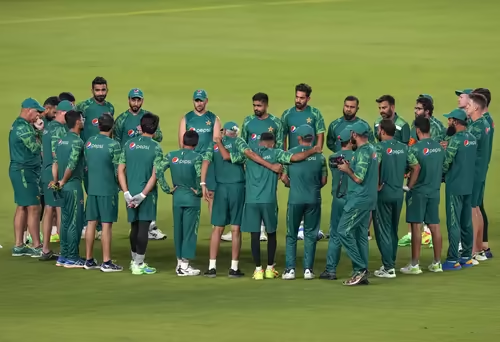
The most anticipated fixture of the T20 World Cup 2026 has been thrown into chaos. In a decision that has sent shockwaves through the cricketing world, Pakistan has confirmed it will boycott its league match against India scheduled for February 15 in Colombo. This isn’t just a missed game; it’s a direct challenge to the authority of the International Cricket Council (ICC) and the very fabric of the sport’s global ecosystem.
The ICC has responded with an unprecedented level of urgency and severity, warning the Pakistan Cricket Board (PCB) of dire consequences that could cripple the nation’s cricket for years to come [[1]].
Table of Contents
- The ICC’s Stark Warning
- What Happens on February 15?
- The Broader Fallout for Pakistani Cricket
- Historical Context: The India-Pakistan Rivalry
- Conclusion: A Defining Moment for Cricket
- Sources
The ICC’s Stark Warning
The ICC’s message to the PCB is clear and uncompromising. In official communications, the governing body has urged Pakistan to consider the “long-term implications for cricket in its own country” should they proceed with the boycott [[1]]. This is not a mere slap on the wrist. The ICC is signaling that this action could be seen as a breach of the fundamental participation agreement that all member nations sign.
The potential sanctions are severe and multi-faceted:
- Expulsion from the tournament: While Pakistan intends to play its other matches, the ICC could still decide to remove them entirely from the T20 World Cup 2026 as a punitive measure for refusing to fulfill a core fixture [[2]].
- Massive financial penalties: The ICC could impose crippling fines on the PCB, which would directly impact their ability to fund domestic cricket, player development, and future tours [[3]].
- Loss of future hosting rights: Pakistan could be barred from hosting any future ICC events, a significant blow to their efforts to bring top-level cricket back home.
- Diplomatic isolation: Perhaps the most damaging consequence is the potential for other major cricketing nations to refuse to engage in bilateral series with Pakistan, effectively isolating them from the international circuit [[3]].
What Happens on February 15?
On the day of the scheduled match, if the Pakistani team does not appear for the toss, the match referee will have no choice but to award India a walkover [[8]]. This means India will be granted two crucial points in the group standings without having to bat or bowl a single ball [[5]]. For Pakistan, it’s an automatic loss that severely damages their own chances of progressing to the next stage of the tournament.
This scenario is not just a sporting forfeit; it’s a political statement played out on a global cricketing stage, and the ICC is determined to ensure such actions do not become a precedent.
The Broader Fallout for Pakistani Cricket
The consequences of this boycott extend far beyond the points table. The ICC’s entire revenue model and the health of the global game depend on the cooperation of its Full Member nations. By refusing to play a scheduled match, Pakistan is undermining the integrity of the tournament and the trust between members.
For the players, this is a devastating personal blow. Stars like Babar Azam and Mohammad Rizwan are being denied the chance to compete in one of cricket’s biggest spectacles, not due to their performance, but due to forces outside their control [[4]]. The fans, who live for the intensity of an India-Pakistan clash, are left disappointed and disillusioned.
Furthermore, this incident casts a long shadow over Pakistan’s reputation as a reliable partner in international cricket. Rebuilding that trust, should the boycott go ahead, will be a monumental task for the PCB.
Historical Context: The India-Pakistan Rivalry
The India-Pakistan cricket rivalry is arguably the most intense in the sport. However, in the high-pressure environment of ICC tournaments, India has historically held a dominant edge. Out of 17 previous encounters in ICC events, India has won a staggering 14 matches [[21]]. This lopsided record, which includes the famous 2007 T20 World Cup final victory for India [[23]], adds another layer of complexity to Pakistan’s current predicament.
While political tensions have often threatened these fixtures, both teams have always found a way to compete on the field under the ICC banner. The 2026 boycott, if it happens, would mark a dangerous new precedent, moving the conflict from the diplomatic arena onto the playing field itself—a line the ICC is fiercely determined not to let be crossed.
Conclusion: A Defining Moment for Cricket
The Pakistan boycott India T20 World Cup saga is more than just a news story; it’s a critical juncture for the sport. The ICC now faces its biggest test of authority in recent years. Its response will set a precedent for how it handles political interference in its flagship events. For Pakistan, the short-term political gain of a boycott could lead to a long-term exile from the heart of the international cricketing community. The eyes of the world are on Colombo on February 15, waiting to see if cricket can rise above politics, or if the game will suffer a self-inflicted wound from which it may take years to recover.
Sources
- [[1]] ESPNcricinfo: “ICC warns PCB of consequences of boycotting India match”
- [[2]] Cricket News: “ICC warns Pakistan of consequences: Exploring the sanctions”
- [[3]] Rediff: “T20 World Cup: India match no-show could cost Pakistan millions”
- [[4]] NDTV Sports: “Pakistan’s India Boycott In T20 World Cup Live Updates”
- [[5]] Al Jazeera: “Pakistan to boycott T20 World Cup match against India on February 15”
- [[8]] Times of India: “T20 World Cup: How India will get a walkover after Pak’s February 15 match boycott”
- [[21]] News18: “A Look Back at India-Pakistan Encounters in ICC Events”
- [[23]] Wikipedia: “History of the Men’s T20 World Cup”