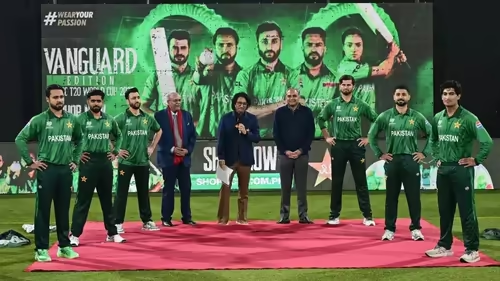
The cricketing world is abuzz with a high-stakes political drama that threatens to overshadow the upcoming T20 World Cup 2026. At the heart of it is a simple yet explosive question: Can the ICC sanction Pakistan for its reported decision to boycott its marquee match against India? Former PCB chairman and ex-ICC president Ehsan Mani has delivered a resounding ‘no,’ and his reasoning is as complex as the decades-long rivalry between the two nations.
Mani’s stance isn’t just a defense of his home country; it’s a direct challenge to the ICC’s authority and a stark reminder of how geopolitics can hijack the gentleman’s game. In this deep dive, we’ll unpack Mani’s argument, examine the ICC’s own rulebook, and explore the historical precedent that makes this situation so uniquely contentious.
Table of Contents
- Mani’s Core Argument: Following Orders, Not Breaking Rules
- The ICC Rulebook on Government Interference
- Historical Precedent: India’s Own Refusals to Tour Pakistan
- Potential Consequences for Pakistan (Beyond Sanctions)
- Conclusion: A Geopolitical Quagmire the ICC Can’t Escape
- Sources
Mani’s Core Argument: Following Orders, Not Breaking Rules
Ehsan Mani’s central thesis is straightforward: the Pakistan Cricket Board (PCB) is not acting of its own volition but is instead complying with a direct order from the Pakistani government [[1]]. He argues that this crucial distinction shields the PCB from punitive action by the International Cricket Council.
“Can’t be any sanctions,” Mani stated bluntly, emphasizing that the PCB is merely an instrument of state policy in this instance [[3]]. His point is that the ICC’s jurisdiction lies with its member boards, not with sovereign governments. Punishing the PCB for obeying its government, he contends, would be both unfair and legally murky.
Furthermore, Mani points to what he sees as the ICC’s own hypocrisy and inaction. He argues that the council has failed to establish a consistent policy on politically motivated boycotts, which weakens its position to act decisively now [[3]].
The ICC Rulebook on Government Interference
Mani’s argument, however, runs headlong into a core tenet of the ICC’s constitution. Article 2.4(D) of the ICC’s governing document is explicit: its members must “manage their affairs autonomously and ensure that there is no government (or other public or quasi-public body) interference in the governance, regulation, and administration of their affairs” [[11], [16]].
This rule exists for a good reason. The ICC has previously taken strong action against members who allow their governments to dictate cricketing matters. The most recent and stark example is the suspension of Sri Lanka Cricket in 2023 after the country’s sports ministry dissolved its board [[13]]. This move effectively banned Sri Lanka from international cricket until the autonomous board was reinstated.
So, while Mani frames the PCB’s actions as a simple case of following orders, the ICC could very well view it as a textbook case of government interference, a serious breach of its fundamental principles. The council’s official statement on the matter already hints at this, noting that the move “undermines the integrity of global cricket” and urging the PCB to consider the “significant and long-term consequences” [[8]].
Historical Precedent: India’s Own Refusals to Tour Pakistan
Mani’s most potent weapon in this debate is historical precedent, specifically India’s own track record. For years, India has refused to send its national team to Pakistan for bilateral series or even multi-nation tournaments hosted there, citing security concerns.
Key examples include:
- 2009: India cancelled a full tour of Pakistan (three Tests and five ODIs) following the 26/11 Mumbai terror attacks [[17]].
- 2023 Asia Cup: India refused to travel to Pakistan, forcing the hosts to play their matches at a neutral venue [[22]].
- 2025 Champions Trophy: India again declined to tour Pakistan, with all its matches scheduled for a neutral location [[18], [19]].
Critically, in none of these instances did the ICC impose any formal sanctions on the BCCI. The matches were simply moved to neutral venues, a solution that preserved the tournament but sidestepped the underlying political issue. Mani leverages this history to accuse the ICC of a double standard: if India can refuse to play in Pakistan without penalty, why should Pakistan face sanctions for refusing to play India on a global stage? [[3]]
Potential Consequences for Pakistan (Beyond Sanctions)
While Mani is confident that formal ICC sanction Pakistan action is off the table, he is under no illusion that there will be no fallout. He has publicly warned of severe non-regulatory consequences that could be just as damaging:
- Revenue Losses: The India-Pakistan match is the biggest money-spinner in cricket. Boycotting it would mean forfeiting massive broadcast rights fees, sponsorship deals, and ticket sales that are vital for the PCB’s financial health.
- Sporting Isolation: Such a move could lead to future bilateral series being cancelled and make other nations wary of engaging with Pakistan, fearing similar political disruptions.
- Reputational Damage: Pakistan’s image as a reliable and committed member of the international cricketing community would suffer a significant blow.
In essence, Mani is arguing that the punishment will come not from the ICC’s rulebook, but from the harsh realities of the sport’s economic and diplomatic ecosystem.
Conclusion: A Geopolitical Quagmire the ICC Can’t Escape
Ehsan Mani’s argument presents the ICC with an impossible dilemma. On one hand, its own constitution demands autonomy from government interference. On the other, a direct sanction against Pakistan would ignite a massive political firestorm and expose the council’s past inaction regarding India’s similar refusals.
The most likely outcome is a messy compromise. The ICC may stop short of a formal ban or suspension—a move that would be unprecedented for a Full Member—but will almost certainly impose heavy fines and other penalties. The bigger battle, however, is about the soul of the sport. Until the ICC can develop a clear, consistent, and enforceable policy on politically motivated boycotts, it will remain a pawn in a geopolitical game it cannot win. For fans of the game, the real tragedy is that the world’s most passionate cricket rivalry continues to be held hostage by forces far beyond the boundary ropes.
For more on the intricate politics of the subcontinent, check out our analysis on [INTERNAL_LINK:india-pakistan-cricket-history].
Sources
- [[1]] India Today: “ICC can’t punish Pakistan for boycotting India at T20 World Cup”
- [[3]] Times of India: “‘Can’t be any sanctions’: Former PCB chief on why ICC can’t punish Pakistan”
- [[8]] NDTV Sports: “ICC Breaks Silence On Pakistan Boycotting T20 World Cup 2026 Game Against India”
- [[11], [16]] Gulf News & Church Court Chambers: Reporting on ICC Constitution Article 2.4(D)
- [[13]] BBC Sport: “Sri Lanka Cricket suspended by International Cricket Council”
- [[17], [18], [19], [22]] Various sources on India’s refusal to tour Pakistan