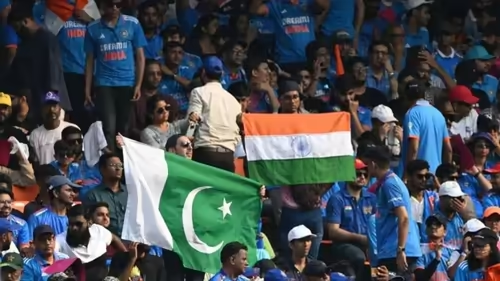
The cricketing world is once again at a crossroads. In a highly anticipated but now deeply controversial announcement, Pakistan has declared it will boycott its T20 World Cup 2026 clash against India, scheduled for February 15th in Colombo [[1]]. This isn’t just another missed rivalry; it’s a seismic event that challenges the very foundation of international sport and echoes a troubled past.
Table of Contents
- The Official Announcement and Immediate Fallout
- What Does “Pakistan Boycotts India” Mean for the Tournament?
- The ICC’s Iron-Fisted Stance on Selective Participation
- A Troubled Past: History of ICC Match Forfeits
- Conclusion: The Future of Cricket and Diplomacy
- Sources
The Official Announcement and Immediate Fallout
The news broke on February 1st, 2026, via an official statement from the Government of Pakistan, leaving fans and officials stunned. The message was clear and unambiguous: “The Pakistan cricket team shall not take the field in the match scheduled on 15th February 2026 against India” [[2]]. This decision, driven by complex geopolitical tensions rather than sporting ones, has thrown the tournament into disarray. India is now set to receive a walkover, a hollow victory that offers no real satisfaction to players or fans alike [[4]].
What Does “Pakistan Boycotts India” Mean for the Tournament?
The phrase “Pakistan boycotts India” in this context signifies a deliberate refusal to compete in a single, specific fixture within a larger, multi-team tournament. It’s a form of selective participation that creates a massive logistical and ethical headache. While Pakistan has confirmed it will play its other group matches, singling out the India game undermines the tournament’s integrity. It transforms a global sporting event into a stage for political posturing, leaving players like captain Salman Agha in an impossible position, forced to execute a government directive they likely had no part in making [[8]].
The ICC’s Iron-Fisted Stance on Selective Participation
The International Cricket Council (ICC) wasted no time in issuing a stern warning. Their position is unequivocal: selective participation is completely unacceptable. In their official response, the ICC stated, “ICC tournaments are built on sporting integrity, competitiveness, consistency and fairness, and selective participation undermines the spirit and sanctity of the competitions” [[19]]. This isn’t just a slap on the wrist; it’s a clear signal that such actions could lead to severe consequences, including potential fines, points deductions, or even future bans. The ICC’s primary concern is protecting the credibility of its flagship events, which are meticulously planned years in advance [[26]].
A Troubled Past: History of ICC Match Forfeits
While shocking, Pakistan’s decision is not without precedent in the annals of ICC history. Teams have forfeited matches before, usually citing security concerns:
- 1996 ODI World Cup: Both Australia and the West Indies refused to travel to Sri Lanka for their group stage matches due to security fears following a bombing in Colombo. Sri Lanka was awarded both matches by forfeit and went on to win the entire tournament [[14]].
- 2003 ODI World Cup: England forfeited their match against Zimbabwe in Harare due to political unrest and security concerns. Around the same time, New Zealand also decided not to travel to Kenya for their fixture, resulting in another forfeit [[18]].
These historical instances, while also controversial, were generally based on broad security assessments for an entire country. The current situation is unique because it targets a specific opponent, making it a politically motivated sporting sanction rather than a general safety precaution. This distinction is crucial and is what makes the ICC’s response so forceful [[10]].
Conclusion: The Future of Cricket and Diplomacy
The decision for Pakistan to boycott its India match in the T20 World Cup 2026 is a stark reminder that cricket, especially on the subcontinent, exists in a space where sport and politics are often inseparable. While past forfeits were rooted in genuine, if debatable, security fears, this latest move appears to be a direct political act. The ICC now faces its biggest test in upholding its own rules and protecting the spirit of the game. The long-term impact could be a chilling effect on future bilateral series and a further erosion of trust between the two cricketing giants. For fans, it’s a bitter pill to swallow—a marquee fixture sacrificed not on the field, but in the corridors of power. You can learn more about the ICC’s official regulations on such matters on their website.
Sources
- Al Jazeera. “Pakistan to boycott T20 World Cup match against India on February 15.” https://www.aljazeera.com/sports/2026/2/1/pakistan-to-boycott-t20-world-cup-match-against-india-on-february-15
- ESPNCricinfo. “Pakistan to boycott T20 World Cup match against India.” https://www.espncricinfo.com/story/pakistan-to-boycott-t20-world-cup-match-against-india-1521915?platform=amp
- Times of India. “Pakistan boycotts India T20 World Cup clash: Why teams skipped selective ICC matches before.” https://timesofindia.indiatimes.com/sports/cricket/icc-mens-t20-world-cup/pakistan-boycotts-india-t20-world-cup-clash-why-teams-skipped-selective-icc-matches-before/articleshow/127858665.cms
- Telecom Asia. “ICC Warns Pakistan on Selective Participation Undermines Integrity of T20 World Cup.” https://www.telecomasia.net/za/blog/icc-warns-pakistan-on-selective-participation-undermines-integrity-of-t20-world-cup/
- Wisden. “Nine Instances Of Teams Refusing To Travel For ICC Tournaments.” https://www.wisden.com/series/icc-mens-t20-world-cup-2026/cricket-news/forfeitures-withdrawals-and-venue-changes-nine-instances-of-teams-refusing-to-travel-for-icc-tournaments