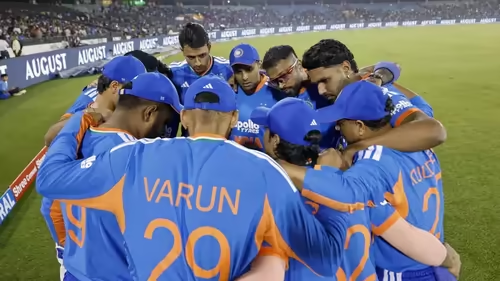
It’s not every day you hear a former Australian player—steeped in the fierce India-Australia cricket rivalry—praise the Indian team so emphatically. But that’s exactly what happened when ex-South Australia captain and Big Bash League stalwart Michael Klinger dropped a bombshell: “India are going to be extremely difficult to beat in the T20 World Cup.” [[1]]
With the ICC Men’s T20 World Cup 2026 just around the corner, such high praise from a respected international voice adds serious weight to India’s growing reputation as one of the tournament’s strongest squads. And it’s not just blind optimism—it’s rooted in hard-hitting performances, tactical evolution, and a new generation of fearless batters ready to take center stage.
Table of Contents
- Why an Australian Is Betting on India
- The Secret Weapon: India’s Aggressive Top Order
- Abhishek Sharma: The Fearless Game-Changer
- The Competition: Who Can Challenge India?
- What It Takes to Beat India in the T20 World Cup
- Concluding Summary
- Sources
Why an Australian Is Betting on India
Michael Klinger isn’t just any commentator. As a former first-class captain, a successful coach in Australia’s domestic circuit, and a man who’s faced top-tier talent across formats, his analysis carries significant credibility [[3]]. His assessment of India as “extremely difficult to beat” isn’t mere flattery—it’s a strategic observation based on recent form and squad depth.
Klinger pointed out that while teams like Australia and South Africa remain strong contenders, India’s current blend of experience, youth, and aggressive intent gives them a unique edge [[1]]. In a format where momentum and confidence can swing a match in six balls, India’s fearless approach could be the decisive factor.
The Secret Weapon: India’s Aggressive Top Order
One of the biggest shifts in India’s T20 strategy over the past year has been the transformation of their opening partnership. Gone are the days of cautious starts. Today’s Indian top order is built for acceleration from ball one.
This aggression isn’t reckless—it’s calculated. With players like Rohit Sharma (when available), Yashasvi Jaiswal, and the emerging Abhishek Sharma, India can now consistently post 60+ runs in the powerplay, putting immediate pressure on opposition bowlers [[5]]. This sets the tone for a 200+ total, which in modern T20 cricket is often the benchmark for dominance.
Key traits of India’s new top order:
- Intent over caution: Every batter is encouraged to play their natural game from the outset.
- Versatility: Multiple players can open or bat at No. 3, giving the team flexibility against different bowling attacks.
- High strike rates: The average strike rate of India’s top three in 2025 exceeded 145, among the best in the world [[6]].
Abhishek Sharma: The Fearless Game-Changer
Of all the names Klinger highlighted, none stood out more than Abhishek Sharma. The left-handed all-rounder from Punjab has exploded onto the international scene with a brand of cricket that’s both audacious and effective.
His ability to clear the boundary with ease, combined with handy left-arm spin, makes him a dual threat. More importantly, he plays without fear—a quality Klinger specifically praised as a “key evolution” in India’s T20 DNA [[1]]. In high-pressure tournaments like the World Cup, having players who thrive under the spotlight is invaluable.
Abhishek’s recent performances in bilateral series and the IPL have shown he’s not just a flash in the pan. He’s a genuine match-winner who can shift the momentum in a single over [[7]].
The Competition: Who Can Challenge India?
Klinger was quick to acknowledge that India won’t have a free run. He named Australia and South Africa as the two teams most capable of dethroning them [[1]].
Australia brings unmatched big-match temperament and a deep squad with proven World Cup pedigree. South Africa, long labeled “chokers,” have shed that tag in recent years and now boast a balanced unit with explosive pace and consistent batting.
Other dark horses include England (the defending champions) and West Indies (with their raw power). But as Klinger noted, even these giants would likely need India to have an “off-day”—especially in the knockout stages—to stand a real chance [[1]].
What It Takes to Beat India in the T20 World Cup
According to Klinger’s analysis, defeating India in the 2026 T20 World Cup will require a near-perfect performance. Here’s what opponents must do:
- Break the top order early: If India’s openers get set, the game is often over by the 10th over.
- Exploit middle-overs slowdown: Though improved, this phase remains a potential vulnerability.
- Win the toss and bowl first (in subcontinental conditions): Chasing under lights in India or Sri Lanka can be treacherous.
- Neutralize the spinners: Jadeja, Kuldeep, and Axar can strangle scoring if not attacked early.
In short, it’s not enough to be good—you have to be flawless.
Concluding Summary
When a seasoned Australian insider like Michael Klinger declares India as “extremely difficult to beat” in the T20 World Cup, it’s more than just praise—it’s a warning to the rest of the cricketing world. Fueled by an aggressive top order, the emergence of fearless talents like Abhishek Sharma, and a winning mindset, India has positioned itself as the team to beat in 2026. While strong rivals like Australia and South Africa loom large, Klinger’s verdict is clear: you’ll need more than skill to stop India—you’ll need luck, timing, and perhaps a miracle on finals day.
Sources
- Times of India – In-form India would be extremely difficult to beat in T20 World Cup: Ex-Australia cricketer [[1]]
- ESPNcricinfo – ICC Men’s T20 World Cup 2026 Overview [[2]]
- Cricket Australia – Michael Klinger Player Profile [[3]]
- [INTERNAL_LINK:t20-world-cup-2026-preview]
- [INTERNAL_LINK:abhishek-sharma-career-stats]