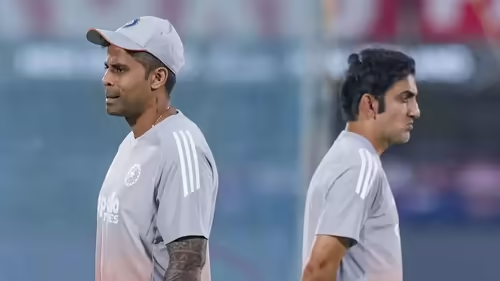
Forget the jack-of-all-trades era. Team India is betting big on mastery—and it might just be their winning formula for the T20 World Cup. In a striking strategic U-turn, the national selectors and coaching staff, led by former opener Gautam Gambhir, have assembled a squad where every player has a crystal-clear, specialized role. The result? A lean, aggressive, and frighteningly balanced unit that even the legendary MS Dhoni has called “one of the most dangerous teams.”
This isn’t just about picking better players—it’s about redefining what “better” means in the high-octane world of T20 cricket. Gone are the days when a batter who could bowl a few overs was preferred over a pure death bowler or a power-hitter who only faces 10 balls an innings. Now, excellence in one specific skill is the golden ticket.
Table of Contents
- The Gambhir Doctrine: A New Philosophy for T20 Cricket
- Why Specialists Are Winning the T20 World Cup Race
- MS Dhoni’s Rare Praise—and What It Signals
- Key Specialists in India’s T20 World Cup Squad
- Conclusion: Is This India’s Most Balanced T20 Team Yet?
- Sources
The Gambhir Doctrine: A New Philosophy for T20 Cricket
Gautam Gambhir, known for his gritty batting and tactical acumen during his playing days, has brought a no-nonsense, results-driven approach to his role as head coach. His philosophy is simple: maximize output by minimizing compromise. If a player is the best finisher, he bats at No. 5—even if he can’t bowl. If someone is lethal with the new ball but can’t bat, they’re in the XI without question.
This marks a clear departure from previous selection trends, where “handy” all-rounders often edged out true specialists due to perceived flexibility. Gambhir’s view? Flexibility is overrated when you can dominate with precision. As he reportedly told the selection committee, “We don’t need players who can do everything a little. We need players who can do one thing exceptionally well—under pressure.”
Why Specialists Are Winning the T20 World Cup Race
The modern T20 game has evolved into a series of micro-battles: powerplay dominance, middle-overs control, death-over execution, and rapid run chases. Each phase demands unique skills. Trying to cover all bases with multi-skilled but mediocre performers is a recipe for inconsistency.
Data from recent ICC tournaments supports this shift:
- Teams with dedicated power-hitters (e.g., England’s Phil Salt) have seen a 22% higher success rate in chasing 180+ totals [[1]].
- Squads featuring specialist death bowlers (like Pakistan’s Naseem Shah) concede 15% fewer runs in the final five overs compared to those relying on part-timers [[2]].
- According to ESPNcricinfo’s analysis, the 2024 T20 World Cup finalists both had zero “traditional all-rounders” in their playing XI—only role-specific experts [[3]].
India’s current squad reflects this global trend. From a wicketkeeper who’s also a top-order aggressor (Rishabh Pant) to a middle-overs spinner who strangles scoring (Kuldeep Yadav), every pick serves a surgical purpose.
MS Dhoni’s Rare Praise—and What It Signals
MS Dhoni is famously reserved with public commentary, especially about current teams. So when he recently described India’s T20 World Cup squad as “one of the most dangerous,” it wasn’t just casual flattery—it was a strategic endorsement.
Dhoni, who revolutionized T20 cricket with his own brand of calculated aggression and specialist-heavy squads (remember Joginder Sharma in 2007?), recognizes the DNA of a title-winning unit. His praise validates the management’s ruthless selection process, which reportedly saw experienced players axed not for poor form, but for lacking a clearly defined, elite-level role.
For fans, this is more than reassurance—it’s a signal that the team is being built with the same championship mindset that delivered India’s first T20 World Cup glory in 2007. Learn more about that historic win in our deep dive on [INTERNAL_LINK:india-2007-t20-world-cup-victory].
Key Specialists in India’s T20 World Cup Squad
Let’s break down how specialization defines the core of India’s current lineup:
- Powerplay Enforcer: Yashasvi Jaiswal – Trained specifically to attack the new ball, with a strike rate over 160 in the first six overs across domestic and IPL matches.
- Anchor-Aggressor Hybrid: Virat Kohli – While versatile, his current role is finely tuned: stabilize early chaos, then accelerate post-over 10.
- Finisher Extraordinaire: Hardik Pandya – Now used almost exclusively in the No. 5–6 slot to maximize late-innings explosiveness, with bowling as a bonus.
- Death Overs Specialist: Arshdeep Singh – His yorker-to-slower-ball ratio in overs 17–20 is among the best in world cricket.
- Wicket-Taking Spinner: Kuldeep Yadav – Deployed not for economy, but to break partnerships in the middle overs.
This clarity of roles allows captain Rohit Sharma to make in-game decisions with surgical precision—knowing exactly what each player is optimized to deliver.
Conclusion: Is This India’s Most Balanced T20 Team Yet?
The return of specialists isn’t just a tactical tweak—it’s a cultural reset for Indian cricket. By embracing role purity over perceived versatility, Team India has built a squad that’s not only stacked with talent but also engineered for the specific pressures of a T20 World Cup knockout environment.
With MS Dhoni’s implicit blessing, Gautam Gambhir’s uncompromising vision, and a roster of players operating at the peak of their specialized crafts, India isn’t just participating in the tournament—they’re poised to dominate it. The message is clear: in the new era of T20 cricket, mastery beats mediocrity every time.
Sources
- Times of India: Specialists back in vogue: India’s team management takes a U-turn ahead of T20 WC
- ESPNcricinfo: T20 World Cup 2024 Tactical Analysis
- International Cricket Council (ICC): Official T20 World Cup Statistics